Over £1,000 was raised for World Disability Billiards and Snooker (WDBS) last Friday an exhibition event held in Lincoln by Snooker Legends.
Featuring five-time world champion Ronnie O’Sullivan and BBC commentator John Virgo, the event was organised by former WDBS event winner Nigel Coton and saw the Rocket in top form as he made seven century breaks from nine frames, including a maximum 147 during the evening.
As had been agreed prior to the event, surplus funds raised will be donated to the WDBS. The money, totalling £1,147 will be incorporated into the overall prize fund for the inaugural WDBS Welsh Open, to be held at Redz Snooker Club on 30 June – 2 July 2017.
On hand to receive the donation on behalf of the WDBS were regular players Daniel Blunn and Joe Hardstaff, both of whom had the opportunity to meet and have photographs with O’Sullivan.
Ronnie was in Gosport yesterday night for a third exhibition in three days and it was again a great night. He won all his matches, had a 116 and two attempts at a maximum, ending on 96.
You can watch the last balls of the first one here:
He also got to play against Suzie Opacic, one of the leading Ladies players. Apparently It came as a surprise to Suzie that she was playing Ronnie as she didn’t even have her cue with her! But she totally enjoyed the occasion: read her account on her facebook page, it comes with some photos too!
Chuffed to bits to have had a frame against Ronnie O’Sullivan tonight with John Virgo as MC. I enjoyed every second of the 2 shots I had! 😂 Glued Ronnie to baulk cushion on first safety shot, he missed reds completely so I stuck him back in, I then missed a long red off his safety and he had 116 break. To have shared the baize with a pure genius of the game is a memory I’ll never forget!
And a few more pictures, posted by Jason Francis and fans
Jason also shared this video on youtube, it’s the 147 Ronnie made on Friday night in Lincoln. Enjoy!
The 2017/18 season is about to kick-off with the Q-School starting tomorrow. For the first time since the nineties we have a player truly dominating the game in Mark Selby. Mark has just won his third World title, as a defending Champion, and is a runaway n°1, a spot he occupies since six years, no less. Of course, fans, pundits and “anoraks” alike wonder how many more he could win and for how long he could stay the n°1 player, if/when he will challenge his predecessors records and … become the GOAT, greatest of all times?
In this post I will try to explain why I believe that the “Greatest Of All Times” tag doesn’t make actual sense, what, in my eyes, makes a player a “Great Of The Game”, who I see in this bracket and why.
In fact, I should have written “Great Of the Modern Era” because I don’t know enough about the pre-Crucible era, pre-1980 to be precise, to have an opinion on players prior that year and as footages are rare, so it’s difficult to really know how well those guys played. 1980 is also when the World Championship more or less adopted the format we know today. There were a few changes since, but no essential ones.
As a premise, I want to state that every player who has won the World Championship more than once, as well as the UK Championship and the Masters during the modern era is, in my eyes, a “Great of the Game”.
That leaves us with this list: Alex Higgins, Steve Davis, Stephen Hendry, John Higgins, Mark Williams, Ronnie O’ Sullivan and Mark Selby. Those are our “Greats”.
So, why am I reluctant to try and name a ” Greatest” among them? Well … because I’m a mathematician. No kidding.
Let me explain: to determine “the best” in about everything, people rely on statistics, but statistics are only meaningful if the “conditions of the experience” are the same for all objects / people subjected to the comparison. When we try to compare snooker players records through history we should be aware that the “conditions” have changed significantly over time and therefore the comparison may not be a valid one.
To be more specific, here are a few examples of those “changing conditions”
Who is competing on the tour, and how players can qualify: you can read about how it evolved in this Wikipedia article. For instance in 1990, just before the game was opened, people like Ken Doherty or Peter Ebdon were still amateurs but were in fact far better than most professionals as they swiftly proved once they were able to turn pro. Clearly how much anyone wins depends on how well they play but also on the quality of the opposition they face.
The number of events available to the players and which ones are ranking. This is something you want to look into when comparing players tallies of titles and has also varied a lot over time: there were a lot of events but very few ranking ones in the 80th, less events but more ranking ones in the 90th, a serious dip in the number of events in the 2000th and now we have an almost full calendar as illustrated by the table below :
1986 / 1987
1996 / 1997
2006 / 2007
2016 / 2017
# tournaments / # ranking tournaments
(*)
28 / 6
19 / 10
11 / 7
24 / 18
(*) source Cuetracker – excluding qualifying events, team events and events played under variant rules.
Obviously, players’ records depend on how much events are available to them during their career, and, in particular during their prime time.
The ranking system. This has changed considerably over time as well, and you need to take that into account when comparing how long a player has been n°1 or in the top 16 bracket. It evolved from a system based solely on the World Championship results, to a system based on points collected by competing in “ranking tournaments” with players ranking staying unchanged through the whole season, to a rolling system based on prize money. Therefore when we look at how long a player has been n°1, we look at different things depending if they played under the yearly ranking system, the rolling one or both during their career. You can find a bit more about it in this Wikipedia article. The point based system very much favoured consistency, whilst the current money based system favours the winners.
The structure and format of the events. In the past the standard format was best of 9, with MSI after 4 frames, now, since Barry Hearn took over, it’s best of 7 without interval. The shorter format is a leveler. The interval quite often changed the psychology of the match, each player having had time to reflect on the state of the game “mid-match”. This aspect has now largely disappeared. Also most events had qualifying rounds played separately with a tiered structure, whilst now most events are played under a flat draw, random or not. The current system is more brutal, both for the low ranked players and the top players. It has removed a certain level of protection for top players. For the lowest ranked players though it means that they have to play less matches to reach the television stages but are due to face a top player in their opening match more often than not.
The playing conditions. These have changed a lot over time. The material used to make the balls has evolved, and the balls are lighter now. The cloth as well is now thinner and faster than it used to be. This has an influence on the way the game is played. The current conditions favour an attacking game, and prolific break building, with balls splitting easier and traveling further, but cue ball control has become harder. Some types of shots are easier to play, other are harder, like, for instance, the ones involving a lot of side as the “grip” on a thinner cloth is lighter and the balls are more prone to slide. And kicks have become much more of an issue than they were in the past. Because of the changing conditions, comparing players tallies of centuries over eras may not make sense.
Considering all this, I don’t think that statistics are an accurate and meaningful measure of those players greatness, especially as Ronnie, John Higgins, Mark Williams and Mark Selby are still playing, whilst the others are retired. Mark Selby in particular is only in his prime. The only ones you can actually compare fairly are Ronnie, John Higgins and Mark Williams as they all turned pro in 1992, are all still playing, and are all still in the top 16 as they enter their 26th season as pros. Here is a table that summarises the main stats about their career (sources: Cuetracker, @prosnookerblog, Wikipedia)
Career statistics at the end of the 2016/17 season
Ronnie O’Sullivan
John Higgins
Mark J. Williams
Pro tournaments played / won / %
293 / 59 / 20.13%
363 / 44 / 12.12%
373 / 26 / 6.97%
Full ranking events won / Majors won
28 / 17
28 / 9
18 /6
World Championships
5
4
2
Masters
7
3
2
UK Championships
5
2
2
Matches played / won / %
1156 / 858 / 74.22%
1339 / 920 / 68.71%
1324 / 841 / 63.52%
Deciding frames played / won / %
204 / 127 / 62.25%
236 / 133 / 56.36%
283 / 154 / 54.42%
# Centuries / # 147
874 / 13
672 / 8
383 / 2
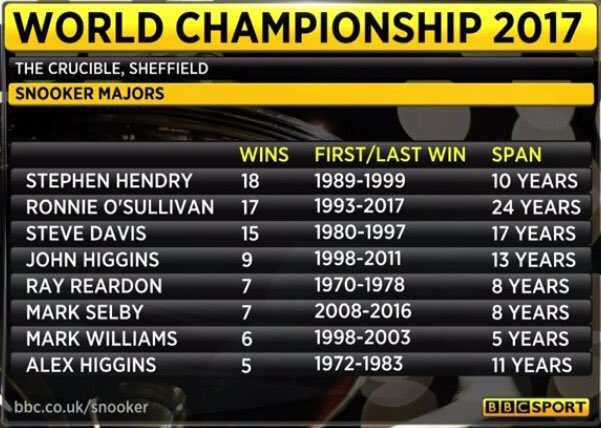
As an additional info, there is also this, shown by BBC during the World Championship, telling about the longevity of these players as it stands today. I would be very surprised if Mark Selby didn’t improve on that.
What I’m certain about though is that all those “Greats” would have been “Greats” in any era because to win multiple World titles and all the majors, under any system, you need to possess loads of talent, an excellent temperament, a competitive spirit, grit, dedication and put in a lot of hard work. That’s the recipe for “Greatness” and that doesn’t change ever.
Another point of interest is that all of those greats have transformed the game and influenced the next generation.
Alex Higgins was a maverick and, in my opinion, not a very nice person at all, but there is no doubt that he very much brought snooker to the media attention and played a very attacking and entertaining brand of snooker. He also was a very imaginative shot-maker and a better safety player than people give him credit for. He got people hooked and talking. And precisely because he was far from perfect as a person, many were able to relate to him. He changed the image of snooker.
Steve Davis was a student of the game. If you read his bio “Interesting” you will see how he approached his snooker in an almost scientific way. He was constantly assessing his technique, as well as experimenting with new things. He also was the first player who, through his association with Barry Hearn, treated his sport with the kind of professionalism that is now expected from top performers in any mainstream sport. Steve was also able to reinvent himself after his prime years were gone. He managed to work on his approach as well as on his technique in such a way that he was still in the top 16 at 50, and famously reached the QF at the 2010 World Championship, aged 52, knocking out the defending champion in the process.
Stephen Hendry introduced a radical, all out attack approach that profoundly changed the way the game is played. When he came on the scene, he was very young, fearless and devoid of battling scars. If he could see a ball, he would go for it, and more often than not get it. Gone were the days when putting a ball on the baulk cushion was “safe”. He also used to keep his opponent in their seat, setting a new, very high standard for breakbuilding. And of course for about 7 years he was winning everything that mattered. He was the ultimate ruthless predator. He never compromised on this approach and, maybe, this is why, after losing to Ken Doherty in 1997, aged only 28, he only won one major, the World Championship in 1999.
The “Class of 92”, Ronnie, John Higgins and Mark Williams – England, Scotland and Wales. Three very different men and players who incredibly have won 129 titles, including 74 majors between them, being in their prime at a time when the number of tournaments was at its lowest, and, in their 26th year as pros are still all three in the top 16. What they did is learn from their predecessors, integrate all the lessons from the past and build their own style, each playing to their considerable skills: Ronnie is flair, attack and breakbuilding, Higgins all-round super solid in every aspect, Williams the lethal potter, cunning and patient when it gets scrappy. They also had a true rivalry, being all in their prime at the same time, and elevating the standard of snooker to a level that had never been seen before and was higher, in my opinion, than the standard we have today. And they lasted … they still last, which means they found the right balance between their sport and their life.
Mark Selby, still only 33, is dominating the sport in a way that has not been seen since the Hendry days. In the studio during the world Championship, Ronnie tweeted ” If you want to win events you need to play like selby. It’s the new modern way of playing..#lethalsnooker“. Mark is capable of playing like Ronnie, like John Higgins or like Mark Williams, depending on the situation he faces and mentally he’s absolutely granite. Could he win another 4 of 5 World titles? Possibly, especially as I can’t see anyone, except Ding Junhui maybe, who could stand up to him currently. Think about this: he won 5 ranking titles this season and made another final. Lets forget the Paul Hunter Classic that is no more than a glorified PTC , early in the season and with a very short format. Who did Mark Selby beat? In the UK Championship, it was Ronnie, in the International Championship, Ding, in the China Open, Mark Williams, and in the World Championship, John Higgins. So, the 40+ “Class of 92” are the ones who are still challenging him in majors. Only Ding, who beat him in Shanghai, seems able to live with Mark. And that’s worrying for the future of the game. Where are you Neil Robertson, Shaun Murphy, Mark Allen, Judd Trump?
So here is my stance: instead of bikering, and at times being rude to fellow fans, over who is the greatest, we should watch, admire and cherish them all. We are being spoilt, and have been for about 3 decades. Lets enjoy it and be grateful for what they gave us, still give us.
May is exhibitions time in snooker, the main tour taking a break after the World Championship and Ronnie started with a bang!
Yesterday evening he played in Lincoln, and made 7 centuries in 9 frames! Needless to say, the crowd and organisers were delighted!
You can watch the last balls of the maxi here (video shared on facebook by Snooker Legends):
The event was played in support of World Disability Billiard and Snooker and I’m particularly happy for the club owner, Nigel Cotton who is a disabled snooker player himself and a very good one!
Here are a few more pictures shared on social media by Jason Francis and fans:
Mark Selby was named snooker’s Player of the Year at the sport’s annual awards ceremony in London tonight.
Leicester’s Selby enjoyed a historic 2016/17 season, winning a record equalling five ranking events: the Paul Hunter Classic, International Championship, UK Championship, China Open and World Championship. The 33-year-old, who won his third world title earlier this week, smashed the record for the most prize money earned in one season, banking £932,000, and extended his vast lead at the top of the world rankings.
Selby also took the Snooker Journalists Player of the Year and Kunlunshan Fans Player of the Year award, which included votes from fans on social media.
Yan Bingtao from China won the Rookie of the Year award after a tremendous debut season which saw him reach the last 16 of seven ranking events, climb to 56th in the world and earn a first appearance at the Crucible.
The Magic Moment of the Year category was won by Mark King for the emotional speech which followed his maiden ranking tournament victory at the Northern Ireland Open.
Performance of the Year went to Anthony Hamilton as he scored his first ranking event triumph at the German Masters at the age of 45.
Ten-time ranking event winner Jimmy White was inducted into snooker’s Hall of Fame, alongside broadcaster and journalist Clive Everton.
The awards ceremony at the Dorchester Hotel also helped raised money for Jessie May Children’s Hospice at Home, which is World Snooker’s official charity – for more details see www.jessiemay.org.uk
Full list of awards: World Snooker Player of the Year: Mark Selby Snooker Journalists Player of the Year: Mark Selby Fans Player of the Year: Mark Selby Rookie of the Year: Yan Bingtao Performance of the Year: Anthony Hamilton Magic Moment of the Year: Mark King Hall of Fame inductees: Jimmy White and Clive Everton
Today is the day of the annual World Snooker award ceremony … so I though I could as well hold my own, here, and see how close I come from the “official” honours list. Only that I will distribute a Golden Turkey as well.
Awards
Player of the season: Mark Selby
No contest here, five ranking titles, including the UK Championship and the World Championship. Joining the very short list of players who have defended the World title (Steve Davis, Hendry, Ronnie and now Mark). Finishing World n°1 for the sixth season in a row. What can you say?
Rookie of the season: Yan Bingtao
This boy, who only turned 17 a few weeks ago, managed to climb into the last 64 in his very first season. Reaching a QF in Germany, and taking some scalps during his first pro season: Shaun Murphy, Michael Holt, Liang Wenbo and Mark Selby to name only the most illustrious of his victims.
Achievements of the season: Mark King, Anthony Hamilton, and Ronnie
I couldn’t choose between those three: Mark King, 43, a pro since 1991 won his first ranking title, the Irish Open 2016; Anthony Hamilton, 45, a pro since 1991 won his first ranking title, the German Masters 2017; Ronnie O’Sullivan, 41, a pro since 1992 won a record-breaking 7th Masters in January 2017. For Mark and Anthony it was the very emotional crowning of a long career spent mainly in the shadow, the reward of 26 years of blood, sweat, and tears and they both celebrated with their family, the people who had supported them through thick and thin. For Ronnie, it was stamping his authority on what is very much his “home” tournament, the second more prestigious event on the calendar, setting a new record, and doing it without playing at his best but overcoming his own doubts as well as tip issues.
Media work of the season: the Eurosport UK studio team
Neal Foulds, Ronnie, Jimmy White and Colin Murray … this team has a dynamic and a “chemistry” that makes it both extremely interesting and genuinely entertaining. Neal is the wise man with all the experience and knowledge of the game history, Ronnie is the geek, analysing the action with acute knowledge, without compromise and saying as it is, Jimmy is oozing his love for the sport and Colin is the ringmaster, radiant with enthusiasm and providing the “glue”. And, boy, does it work a treat!
A great, great insight on some of the greatest, most iconic matches at the Crucible through the eyes and memories of those involved: the players and their entourage. Just read it!
Announcement of the season: Barry Hearn: no more entry fees for the pros
Announced by Barry Hearn during the World championship, this is definitely something that will genuinely help the lower-ranked players and the beginners on the tour. It might also lift a blocking hurdle for many amateurs who didn’t even consider a pro career because they knew that they didn’t have the means to support the cost of it.
New event of the season: the World Seniors Snooker Championship
You will tell me it’s nothing new, but it is in this form and format. Jason Francis did a sterling job in a short time span to revive and refresh the event and plant the seeds of a true Seniors tour. By opening it to amateurs only, he got some of the legends of the past, including Stephen Hendry, as well as some of the best club players, to play in it (again) as they felt they had a genuine chance. And so it proved. By adding some glamour to it, it felt both festive and serious. He even managed to get sponsors that were not all betting related! And although there were a few issues with the streaming early on, the response from the fans was extremely positive.
Invisible heroes of the season: Nigel Mawler, his team and all the WDBS players
The World Disability Snooker family is something else. I can only advise everyone who has the opportunity to go, watch and support their events and players. Their love for the game, the mutual respect, and support, the creativity in overcoming their disabilities … words are poor to describe how much in awe I am of these men and women.
Craziest celebration of the season: Liang Wenbo after winning the English Open
Nuffing said.
2016 English Open: Liang Wenbo’s celebration – Judd Trump
Golden Turkey
Most controversial decision of the season: Barry Hearn: making the Shootout a ranking event
Totally wrong in my eyes. This is an event that isn’t played under the rules of snooker, with matches reduced to just one frame, under a shot-clock that is so ridiculously short that using any implement is almost impossible and in an atmosphere that proved unsuitable for conducting proper refereeing. David Gilbert was badly robbed. Mark Williams missed out an automatic spot at the Crucible because the winner of this farce got almost as many ranking points as the World quarter-finalists (and the said winner himself admitted that it shouldn’t be ranking). And that’s not all … to quell the criticisms Barry Hearn offered the players the opportunity to vote: either keep it ranking or ditch it. That was always a non-choice. Why would players, many of them struggling financially, ditch an income opportunity? What they wanted was clear for all reading social media: keep it but invitational, as it was before, but that choice wasn’t offered. Allegedly this is not commercially viable. Hum … even ranking it didn’t attract many of the very top players. So?






 Ronnie O'Sullivan