UK Championship 2017 – Ronnie beats Stephen Maguire in the SF

UKChamps2017SFRonSFWin

Ronnie beat Stephen Maguire by 6-4, fending off a spirited comeback from the Scot who was 4-0 down at the MSI.

Tomorrow he will play either Ryan Day or Shaun Murphy in the Final, his seventh UK Championship Final, and his fifth final this season already.

A win tomorrow would see Ronnie equal Steve Davis’ record of six UK Championship and Stephen Hendry’s record of 18 “majors”. But hopefully, Ronnie won’t think about that … he doesn’t need additional pressure, no player does.

Here is the report on the BBC  website

UK Championship 2017: Ronnie O’Sullivan beats Stephen Maguire 6-4 in first semi-final

Five-time winner Ronnie O’Sullivan held off Stephen Maguire’s spirited fightback to reach his seventh UK Championship final with a 6-4 victory.

O’Sullivan, beaten in last year’s final by Mark Selby, looked in ominous form early on, opening up a 4-0 lead with breaks of 61, 54 and 64.

Maguire made 91 and 129 as he cut the deficit to 5-4, but O’Sullivan – who had a 111 clearance – edged through.

He faces 2008 winner Shaun Murphy or Ryan Day in Sunday’s best-of-19 final.

He came back at me but I was lucky to be 4-0 ahead,” O’Sullivan told BBC Sport.

He didn’t capitalise on the first few frames and I did well to stay in and am pleased to reach another UK final.

“I knew he was playing well because I saw his results and he looked to be cueing well. I knew I had to play decent to get through.

Maguire added: “It would have been nice to get to 5-5 and see what happens. He was starting to rock a little bit because nobody likes it when you come back on them. I just did not get a chance.

O’Sullivan improving with age

O’Sullivan is aiming to equal Steve Davis’ haul of six UK titles and victory would also draw him level with Stephen Hendry’s 18 ‘Triple Crown’ triumphs in the BBC’s World, UK and Masters events.

At 42 years old, it will also be his third ranking final of an outstanding season, having already claimed the English Open and Shanghai Masters, as well as finishing runner-up in two invitational events.

The second frame was crucial as Maguire could have levelled at 1-1 but missed a simple final black off the spot, allowing O’Sullivan to take it.

The mid-session interval seemed to help Maguire, who hit back by winning four of the next five frames, but O’Sullivan progressed with a 63 break after his opponent’s poor safety.

O’Sullivan said he has had to “battle and battle” for form this year, and feels he has yet to hit the heights of 12 months ago despite that final loss to Selby.

You have to tough it out sometimes,” added O’Sullivan.

There is no player in the game who can play badly and win apart from Mark Selby, he is the only guy. This week I have not been at my best but I have dug in and it is all down to positive mental attitude.

“For me, Selby is in his prime. He has not done well in this tournament but he has won a title this season. He is definitely the best player in the world and I am able to give him a game on my day.

“It is about consistency and he has had that over the last few years.”

And the report on Worldsnooker

UKChamps2017SFRon-2Ronnie O’Sullivan remained on course to win a sixth Betway UK Championship – and an 18th Triple Crown title – as he beat Stephen Maguire 6-4 in the semi-finals.

O’Sullivan saw a 4-0 lead over Maguire reduced to just one frame at 5-4, but he secured victory in the tenth frame to reach his seventh UK final. He has won five of his previous six; his only defeat coming last year in York against Mark Selby.

The Rocket will meet Shaun Murphy or Ryan Day over 19 frames on Sunday with the winner to bank £170,000. Victory would see O’Sullivan match two significant records: Steve Davis’s six UK titles and Stephen Hendry’s 18 Triple Crown wins.

World number four O’Sullivan is also aiming to win his 31st career ranking title and third within seven weeks having captured the English Open trophy in October and the Shanghai Masters in November. He is into his fifth final of the season having finished runner-up at the Hong Kong Masters and Champion of Champions. At the age of 42, O’Sullivan is playing arguably the most consistently impressive snooker of his career.

Maguire misses out the chance to double his tally of UK titles, having lifted the trophy in 2004. Defeat today also means he is out of the running in the race to the Masters, with Liang Wenbo hanging on to the 16th and final spot.*

UKChamps2017SFRon-3O’Sullivan made a 61 clearance to win the opening frame. The second came down to the colours and Maguire thumped in a long pink but then missed a relatively simple black to a top corner. After a safety exchange the Scot went for an other long pot but left the black in the jaws, and his opponent converted for 2-0. Runs of 54 and 64 helped O’Sullivan lead 4-0 at the interval.

Maguire took the next two, including a break of 91 in frame six, and he had first chance in frame seven but missed the yellow to a baulk corner on 22. O’Sullivan’s 111 put him 5-2 ahead.

World number 20 Maguire continued to battle and compiled runs of 51 and 129 to close to 5-4. But a loose safety when he trailed 21-6 in frame ten allowed O’Sullivan to pot a red to a centre pocket which set up a match-winning break of 63.

“Stephen is a quality player and I expected some kind of resistance,” said O’Sullivan, who has not faced a top 16-ranked player so far in this event. “I just tried to keep my patience and wait for the chance to pounce. I’ve got lucky that other players have struggled against me this week. I suppose to get to the final having not played my best is not a bad thing.

“I was listening to an interview with Mark Selby and he said he’d much rather play well and lose than play badly and win. I thought ‘yeah, that’s how I feel.’ Me and Mark played last year in the final and even though I lost I still came off thinking ‘I enjoyed that, it was a good workout.’ This week I’ve really had to battle and I’ve just scrambled through.”

Maguire said: “I just didn’t settle until 4-0 down. I put up a bit of a fight but I’d lost it in the first four frames. I was always positive because I felt as if I was cueing okay and potting the balls.

“It would have been nice to get to 5-5 and see what happened because he was obviously starting to rock a little bit. I just didn’t get a chance in that 10th frame and that’s disappointing.

“I hate losing and I lost that before the interval which I’m gutted about. At the end there I fancied the job. I wasn’t even looking at the scoreboard, I just fancied it if I got in the balls. It was just a pity that it came too late.”

*The line up for the Masters is now confirmed, below are the 16 players. These are not necessarily in seeding order as the seeding will be confirmed at the end of the Betway UK Championship. The draw for the Masters will be done on Sunday. Tickets for the event at Alexandra Palace (January 14-21) are available now, for details click here 

Ronnie O’Sullivan
Mark Selby
Judd Trump
Ding Junhui
John Higgins
Shaun Murphy
Barry Hawkins
Mark Allen
Marco Fu
Mark Williams
Luca Brecel
Ali Carter
Kyren Wilson
Anthony McGill
Ryan Day
Liang Wenbo

Videos of interest:

The BBC intro and players walk-on:

The match preview (ES)

The match midsession (ES)

The match:

The match review with Ronnie’s interview with ES


Strange article in the Weekly Standard

It’s long and strange and whilst there is truth in it, I’m not sure I agree … to me, it’s the expectations put on Ronnie by people who forget he’s only human, and by himself as well in the past, that are crazy, not his career that is a “failure” by any means.

This is it

The God of the Snooker Table

The game’s greatest player and the anguished dream of perfection.
 A beautiful simplicity seems to unfold when Ronnie O’Sullivan constructs a century break, potting 100 points’ worth of balls on a single visit to a snooker table. No one ever described snooker as an easy game, but when O’Sullivan begins to flow, he makes each moment look natural. Obvious, almost. Self-evident. To watch him line up a shot is often to think that you—or I, any of us—could pot that particular ball. And while we’re watching the struck ball settle in the pocket, the cue ball has magically drifted to a spot where the next shot possesses the same easy clarity. The same self-evidence. And so with the next, and the next, and the next, until he’s finished putting away the 36 balls that make up a completed frame of snooker.

“The Rocket,” they call him for the speed with which he plays, and he is, more than anything else, an artist at the game. Michelangelo once said that sculptors should discern the shape that wants to be freed from a block of marble, and Ronnie O’Sullivan practices a kindred art, perceiving in some not fully conscious way the simplicity that wants to be revealed on a snooker table.

That artistry may be what keeps O’Sullivan the crowd favorite everywhere he plays. At age 42—getting on in years for a successful professional snooker player—he is still by a huge margin the most popular figure in the sport from London to Shanghai. He’s lost nine tournaments for every tournament he’s won, but bookies nonetheless make him the favorite in nearly every match, if only to lay off the sentimental bets that invariably follow him.

His artistry may also be the problem with Ronnie O’Sullivan’s game. By almost any measure, the Rocket has had a successful career. His 30 career tournament victories over his 26 years of professional play tie him for second-most since the modern recordkeeping system was established in the 1970s. He stands as the all-time leader in prize money, having won in competition some £9 million (plus many millions more from exhibition matches, endorsements, and celebrity appearance fees).

And yet, to watch him play—to watch, for example, his seven-match trek to the English Open championship this October—is to wonder why he hasn’t been even more successful. For anyone else, his snooker career would seem a triumph, making him one of the all-time greats. But the Rocket wasn’t supposed to be one of the greats. Since his debut as a professional at age 16 in 1992—for that matter, since he first started appearing on the covers of snooker magazines as the game’s child prodigy at 10 or 12—O’Sullivan has demonstrated his transcendental ability, the best snooker has ever known. He’s also demonstrated his petulance, his quirky charm, his oddball humor, and his deep unhappiness: a morbid depression at each failure to play consistently at the impossible level of perfect snooker. It’s one of the many peculiarities of Ronnie O’Sullivan that he could have found all this success and still seem something of an underachiever. Something of a disappointment. Something of a failure.

Added to his play is the drama of his public presence, ginned up in equal measure by O’Sullivan himself and a British press that grasps at any storyline about the only snooker player whose name the entire nation knows. He sprained his ankle on a long-distance run just before the English Open, and he spent his first match limping around the table while wearing comfortable blue sneakers with the black vest and bow tie that snooker tradition demands. He easily won the best-of-seven match 4-1, but the British reporting was all about his rule-breaking shoes.

In the end, the shoe controversy was settled sensibly enough, with the tournament authorities giving O’Sullivan medical leave to wear soft shoes in his remaining matches, as long as they were black. But soap opera refuses to travel far from the Rocket. At the end of his third match, a middle-aged woman came down from the stands and began trotting around the table, telling O’Sullivan that she was “just going for a jog.” Snooker referees enforce silence during shots, decorum during matches, with a ferocity that golf officials, tennis umpires, and Amtrak conductors on the quiet car can only envy. But the invasion of the players’ area seemed to have them at a loss. So O’Sullivan calmly stepped up, potted the pink ball that assured him the match. And then—worried, he said, that the officials “were going to rugby-tackle her”—he handed the jogging spectator his cue so she could take on the final ball remaining. (She missed. Twice.)

In the following days, he struggled to set aside his most successful contemporary, John Higgins, then romped through the remaining rounds, defeating Kyren Wilson 9-2 in the best-of-17 final, with 4 century breaks along the way. But every O’Sullivan match has to have a little melodrama for the tabloids to report. He showed up for the final at Barnsley Metrodome arena on October 22 without his cue. Only a friend’s 40-minute dash back to the hotel saved O’Sullivan from having to forfeit the opening frames.

What championship tennis players arrive at a tournament final without their rackets? Golfers without their clubs? Boxers without gloves? O’Sullivan’s career is littered with dozens of strange episodes—some small, like the forgotten cue, and some large, like his storming out of the arena after his (victorious) first round of the 2016 world championship. Enraged that he hadn’t played as well as he wanted, he skipped the mandatory media interview, let his close friend, the artist Damien Hirst, watch him smash up his dressing room, and then fled to London to spend five days in the hospital getting treatment for depression and exhaustion. (He returned in time for the tournament’s second round the next week, which he lost, marking one of his earliest exits in years.)

Ronnie O’Sullivan would probably have been a happier man—and have won at rates that better reflect his talent—if only he could have brought himself to play the game as others do. With 13 perfect frames in his career (scoring all 147 possible points) and over 900 century breaks (the most 100-point turns anyone has achieved) he has considerable great play to be satisfied about.

But snooker was not designed for much precision. Small flaws and minute miscuings add up across the expanses of green baize, and the Rocket cannot stand it. In truth, Ronnie O’Sullivan has never played much snooker. What he plays is some mad game against the imperfection of the world and his own demons. The battle only happens to take place on a snooker table. Having won 74 percent of his matches over his career, O’Sullivan has the highest winning percentage of any longtime tournament player, but it feels to him mostly a record of frustration: How could he lose more than a quarter of his matches? The greatest snooker talent who ever lived, snooker’s sole genius, plays to create the perfect simplicity of a work of art.

It’s a mug’s game.

* *

Tabletop cue-and-ball games originated in the 15th century among French and English aristocrats, essentially as lawn games moved indoors for the winter (hence the traditional green color of the cloth). At the beginning, the thick end of the stick was used to whack the balls, like a miniature version of croquet. Pockets, once they started to appear, were akin to ponds or bunkers in golf: things to be avoided while the balls smashed around the table.

By the 18th century, the pockets had become goals rather than hazards, with the narrow end of the cue used to poke the cue ball. A range of new games developed, culminating in the modern forms of billiards and pool. Snooker, too, although it was a deliberately invented variety, created in the 1870s by British Army officers stationed in India. Snooker was army slang for a new and useless cadet, and in the officers’ mess the term came to be applied to the game: first as a position with the target ball blocked from a direct shot (leaving a player snookered) and then as a name for the game itself.

The officers brought snooker back to Great Britain, and the game had a brief vogue among the upper middle classes and the posh gentlemen’s clubs. But soon enough it drifted down to working-class pubs and what became snooker halls, where it picked up the vague aura of seediness and criminality it kept for decades. (No one was surprised, for instance, to learn that the Kray brothers, England’s most infamous 1950s gangsters, had started out managing snooker clubs.)

Still, in the late 1920s, the game found its chance. Billiards, snooker’s main rival in Britain, was falling in popularity, mostly because of the tedious stalemates at the highest level of play, while American pool had never caught on. Perceiving the opening, some skillful players (notably Joe Davis, who won every “world championship” from 1927 to 1946) tried to bring respectability to a professional version of the sport. They mandated vests and bowties for snooker players and dressed the referees in dinner jackets, giving the game the working-class formality of emcees in 1920s music halls—an aesthetic to which snooker still adheres.

As far as the rules go, snooker thrives on the kind of British complexity that makes cricket so indecipherable. (Hard to play, hard to watch, and hard to explain to Americans, as the old line runs.) A frame of snooker starts with 21 balls on the table, plus a cue ball. Fifteen red balls, worth one point each, are arranged in a triangle. Six different balls are then set in marked positions around the table. Called “the colors”—yellow, green, brown, blue, pink, and black—these balls rise in value from two to seven points. The game requires using the white cue ball to knock any red ball into one of the table’s six pockets, followed by knocking in any colored ball. Each time one of the colored balls is potted, the referee returns it to its place on the table. After all the red balls are gone, the colors must then be potted in order from yellow to black.

At most, then, a frame of snooker requires knocking in 36 balls: 15 reds, alternating with 15 colors, followed by the 6 colors. Players continue a turn, called a break, until they miss, at which point their opponents get a chance. And all of this takes place on a table almost double the area of even the largest tournament-sized pool table, with pockets an inch tighter. Just to make things more difficult, the green baize covering a snooker table has a definite nap running in one direction, distinguishing the warp from the woof of the cloth. Many of the combinations allowed in pool are banned by the rules of snooker, which require the object ball, whether a red or the designated color, be the first ball struck by the cue ball. A foul results from accidentally potting a color other than the one the player named while lining up for the shot, which eliminates most bash-and-pray techniques.

All these rules are designed to lend snooker a superficial precision—and to casual spectators, cue-and-ball sports do look like wonderfully clean games: Euclidean in their angles and Newtonian in their motions. In the 17th century, deistic philosophers commonly used billiards as a metaphor for God’s mechanistic management of the physical universe.

Unfortunately, snooker at the highest level becomes something non-Euclidean and even anti-Newtonian. Snooker tables are so big that a pot down the diagonal runs over 13 feet—an enormous distance to roll a five-and-a-half-ounce ball across napped cloth and expect it to hold its line. On those expanses, infinitesimal imperfections in the cloth and resin-cast balls, even dustings of chalk, have an influence. Balls wobble, failing to keep an even motion. Unpredictability adds up from tiny slippages of the chalked cue tip, angular momentum as the balls spin, and small compressions as they strike one another.

Players sometimes seek non-Euclidean lines with tricks of friction to swerve and reverse direction (putting “English” on the ball, in the old American expression). But always they play with a probabilistic physics. Professional snooker is more like Niels Bohr’s vision of the atom than Newton’s picture of the solar system. The key to snooker is only partly—almost incidentally—the potting of reds and colors. The real game concerns where the cue ball goes after it has struck the target balls. Using top spin, side spin, or back spin to control the bounce of the cue ball off the target ball, calculating the reversal off the side cushions and the cannon (a billiards corruption of the French word carom) off other balls, the players aim for a probabilistic field, seeking to settle the cue ball somewhere within the area offering the greatest chance to line up the next shot.

And how do you play the game if you’re someone who despises chaos theory and unpredictable cascade effects—someone congenitally incapable of a let’s-just-see-what-happens attitude? How do you play the game if you’re Ronnie O’Sullivan?

* *

O’Sullivan owns a painting Damien Hirst made for him, an enormous tableau (12 feet by 6 feet, the size of a tournament snooker table) that shows the position of the balls as O’Sullivan began his first maximum break of 147 points, with ghostly gray images of the frame’s later positions.

Snooker has had some famous moments in the years since the BBC began televising it, giving the game a national prominence—originally in 1969 with a program called Pot Black, designed to show off the BBC’s new color broadcasting, and then in 1978 with the first coverage of the World Snooker Championship tournament. Cigarette companies became the broadcasts’ enthusiastic supporters (followed by gambling companies, once the BBC banned tobacco advertisements, and snooker has had a problem with players’ gambling in recent years). As the television and promotional money increased, so did the number of players converting from amateur to professional, and the level of prizes rose from a few hundred pounds to tens of thousands.

Television showed a classic frame in 1982, for example, when Alex Higgins—the Hurricane, he was nicknamed: a slight and wildly self-destructive Irish player, the most popular figure of the time—snatched an improbable victory from another crowd favorite, Jimmy White, in the semifinals of the world championship. A second came in the 1985 championship final, when the largest British audience for a sporting event tuned in to watch Dennis Taylor in his oversized glasses defeat the most successful player of the 1980s, Steve Davis. After grueling through to a 17-17 tie, Taylor and Davis played a 35th and final frame that lasted 68 minutes, ending well after midnight with over 18 million viewers watching Taylor pot the final black ball to win the title.

And then there was the break Hirst memorialized for O’Sullivan—a first-round match at the 1997 championship in which the Rocket, 21 years old, scored a perfect 147 in a break that took him only 5 minutes and 20 seconds. A typical frame for professionals lasts around 20 minutes, with matches varying from as few as best-of-7 frames to as many as best-of-35—and tournaments requiring as many as 7 matches to get through to the final round. Like the walking in professional golf, the grinding through frames, day after day, makes endurance one of the abilities needed to win a snooker tournament.

That grinding seemed to irritate O’Sullivan even while he was young, and the speed of his 1997 perfect break remains unrivaled. A 147 score requires that the 7-point black ball be the only color potted after each red: no reaching for a nearby pink or blue to ease the tactical situation, no running up the table for a yellow, green, or brown. O’Sullivan’s 5:20 time, averaging 8.8 seconds per shot, stands as one of those sports records never seriously challenged, akin to Wilt Chamberlain’s 100-point basketball game and Joe DiMaggio’s 56-game hitting streak in baseball.

And perhaps the most interesting element, as one watches video of the break, is that the young O’Sullivan never appears hurried. A handful of professional snooker players (notably Tony Drago, Hurricane Higgins, and the Whirlwind, Jimmy White) played the game fast, rapidly lining up the best available shots. But they always seemed to be rushing, pressing for speed, while O’Sullivan simply flows around the table, gliding to the next spot and even appearing to take his time. Each of his career’s 13 perfect games is a master-class in break building, but that first 147 had a joyousness in its perfection—a happy promise of all the young genius would do. And then he lost the next round and failed to reach even the quarterfinals, growing frustrated and surrendering a 12-13 match to a journeyman named Darren Morgan.

The highs and lows of that 1997 tournament are a perfect microcosm, a lasting figure, for much of O’Sullivan’s odd career. Every sport has seen players of undoubted ability (think of, say, football’s Ryan Leaf) who failed to click at the professional game. Every sport, for that matter, has seen any number of players who had runs of brilliance (think baseball’s Denny McLain) but never quite put together an extended career. What’s rarer are the athletes who have shown what, for any others, would have been greatness at a high level for a considerable period but nonetheless appear to leave their talent unfulfilled. Mike Tyson, certainly. Mickey Mantle, perhaps. Jim Brown. The wildly emotional early years of John McEnroe. Tiger Woods, maybe. Often enough, father-figure demons haunted them. Many of them drank, drugged themselves, and misbehaved, rebelling against the activity that had made them famous. All of them found less joy in the sport than we believe we would have, when we imagine ourselves with their stratospheric levels of talent.

* *

This is the class of which Ronnie O’Sullivan is the archetype. Born in 1975, he was both cosseted and abandoned as a child. His parents were working class with millionaire money, running a string of sex shops in London. It kept them too busy to care much for Ronnie and rich enough to hire constant help. The father, Ron Sr., cut a large figure, paying all his son’s club fees as he developed into a young snooker phenomenon. Whenever Ron came into the club to watch his son, one friend recounted, he paid for all: “No one put their hand in their pocket.”

By the time he was 12, the ambidextrous boy was reportedly making several thousand pounds a year from exhibitions and junior tournaments, and he was already developing the charm and persona of working-class shyness that would endear him to fans. Asked how big he wanted to be in the sport, he told a television interviewer he wanted to be 5-foot-10—the perfect height, he thought, for a snooker player. The interviewer laughed and the audience fell in love with the wide-eyed little boy in a satin waistcoat and bowtie.

By the time he was ready to turn professional at 16, he seemed primed to explode on the snooker scene. Forced to play qualifying matches as a first-year player, he set the sport’s record by winning 38 matches in a row and 74 of his 76 qualifiers. But then in 1992 his father was sent to jail for knifing to death in a pub brawl a driver for the gangster Charlie Kray. Emotionally, the world collapsed for the young player.

Ronnie won the U.K. championship the next year at age 17, the youngest champion of one of the Triple Crown tournaments, the three most prestigious events on the tour. Dozens of reporters lined up to film him and shout questions as he brought the trophy to prison to show his father. Two years later, his mother, Maria, was sent to prison for tax evasion.

Through the first decade and a half of his career, he won enough tournaments to keep himself among the game’s premier players, including the Masters in 1995 at age 19 and the world championship in 2001, completing his trio of Triple Crown victories. But his wins were rarer than they should have been as he wandered through the snooker scene lost in drink and fatherlessness. In 1996 he was suspended after he head-butted an official. He quarreled with the snooker association, gave shyly charming interviews that kept him in the public eye, and lost matches he should have won. In 2000, O’Sullivan checked himself into rehab after being stripped of a title for failing a drug test. In 2001, while winning the world championship, he called a suicide hotline and began dosing himself with antidepressants.

Snooker players usually start to lose their edge in their 30s. Stephen Hendry, for example, was the greatest player of the 1990s, the man whose 36 career victories in ranking tournaments place him ahead of O’Sullivan. He no longer had his old invincibility by the time he was in his mid-30s, and had essentially retired by 40. What weaken, most obviously, are the eyes: Snooker lives in the middle range between nearsightedness and farsightedness as the players lean over to bring the cue ball, an arm’s-length from their faces, in focus with a target ball sometimes 10 feet away.

Throughout his late 20s and early 30s, O’Sullivan seemed a wild man. He grew his hair out. He shaved his head. He sat through another player’s break with a towel over his face. He sired three children out of wedlock with two different women, neither of whom is his current companion, and he reportedly has rarely seen his eldest daughter.

In 2004, the six-time world champion Ray Reardon coached him on improving the weakest part of his game, setting up safety shots and snookers that leave opponents no good replies, and O’Sullivan won the 2004 world championship. It didn’t settle him. He repeatedly threatened to retire, and he walked out of a match with Stephen Hendry down only 4-1, reportedly saying, “I’ve had enough of it, mate.” It was always as though he wanted to play by himself, hating the presence of his opponents and being out of sync with the referees. In 2008, he threw away a match against Marco Fu by playing too fast and too sloppily—and then, obviously stoned, he made an obscene suggestion to a female reporter at the after-match press conference. And just because he was the unpredictable Ronnie O’Sullivan, he went on to win the world championship, his third, only a few weeks later.

A dry spell would soon follow, as age apparently caught up with O’Sullivan, who failed to win a tournament from late 2009 to early 2012. His top spin disappeared, his long pots went astray, and his safety shots rolled short. He found himself concentrating even more on his obsessive running, seeking in the loneliness of roadwork some escape from his anxieties. (His 2003 autobiography, Ronnie, tells of his parents’ troubles, while his 2013 book, Running, speaks of his own demons.) Over his career, he’s flirted with multiple religions and even left the game for a while to try farming.

What eventually did seem to help were sessions with the sports psychiatrist Steve Peters, and suddenly, at age 36, he started claiming tournaments again. In 2012 and 2013 he won his fourth and fifth world championships. In 2014 he took his fifth Masters and his fifth U.K. championship. In 2016 and 2017 he added his sixth and seventh Masters titles—despite such well-reported adventures as deliberately refusing a perfect game, scoring 146 in protest over the low bonus offered for a 147.

Mark Selby has been the top-ranked player for the past few years, but Ronnie O’Sullivan, entering relatively few events, remains a serious threat at 42 years old—reviving his career yet again this season as he followed his English Open victory by reaching the finals of the Champion of Champions on November 12, winning the Shanghai Masters on November 18, and playing well in the U.K. championship through the first week of December.

* *

The late surge of good play hasn’t made him entirely happy or content. He claims to be much calmer these days, much more accepting of small failures. But after winning the English Open, he immediately began to squabble with tournament officials and refused to accept the trophy that went along with his victory. He publicly complained about “numpties” in subsequent matches, his word for minor players who, he thought, enter tournaments just so they can get their pictures taken with famous champions. He caused a scene by insisting on photographers being thrown out of a match in Shanghai, and he told an interviewer that he would happily skip the next Triple Crown tournament for the chance to appear on a British reality-television show.

What remains for him? Still able to win matches in his 40s, embarked on yet another successful run this season, O’Sullivan should reach in the next few years the mark of 1,000 century breaks he has said he wants. Six more ranking tournament victories would match Hendry’s 36 wins (albeit over a much longer period than Hendry’s 17 years). O’Sullivan’s last 147 was in 2014, and he may add a few more perfect breaks before he stops playing. His career will go down in snooker history as ranking alongside the careers of Joe Davis, Ray Reardon, Steve Davis, Stephen Hendry, and perhaps Mark Selby.

It doesn’t seem quite enough. The greatest sheer talent snooker has ever seen, the one true genius of the sport, he should have no one rank alongside him. To watch Ronnie O’Sullivan play snooker, in those moments when the Rocket flows and his break-building reveals the simple beauty in the game, is to wonder how he ever lost a match.

The answer is inextricable from the style with which he plays. The imperfections of the snooker table, like the imperfections of the world, will not be overcome forever. The demons of the human condition will not be held at bay for long. Ronnie O’Sullivan wanted to make a perfect art of snooker, and the problem isn’t his choosing snooker. The problem is his sad need for perfection. His mad need for art.

UK Championship 2017 – Day 10

It was Quarter Finals day in York and it yielded this line-up for the Semi Finals today:

in the afternoon: Ronnie O’Sullivan v Stephen Maguire

in the evening: Shaun Murphy vs Ryan Day

And we are down to one table!

This was the preview by Hector Nunns and Rob Walker:

Here are the QF reports on Worldsnooker:

Afternoon:

Ronnie O’Sullivan is just two wins away from capturing a record-equalling sixth Betway UK Championship title as he beat Martin Gould 6-3 to reach the semi-finals.

The Rocket lifted the trophy in 1993, 1997,  2001, 2007 and 2014 and victory on Sunday night would see him match Steve Davis’s record of six crowns. O’Sullivan is chasing the 31st ranking title of his career and third within two months having won the English Open and Shanghai Masters. First, he will have to win a semi-final clash on Saturday afternoon (1pm start) against Stephen Maguire, who beat Joe Perry 6-3.

World number four O’Sullivan was off to a tremendous start today as breaks of 107 and 106 put him 2-0 up. He got the better of a fragmented third frame then took the fourth by clearing from the last red. And a 55 clearance in the next put him on the brink of victory at 5-0.

Londoner Gould made a spirited fight back by taking the next three frames with runs of 101, 61 and 70. But O’Sullivan’s 94 in frame nine put him into the last four. The result ends Gould’s hopes of a place in the Masters as he remains 18th in the race to Alexandra Palace.

O’Sullivan said: “I just battled and tried to be professional and leave every ounce I’ve got in me on the table. I’ve given up analysing it any more, I just go out there and just try to do my best. Today was probably a bit better than yesterday. I’m kind of detached and I won’t allow myself to get sucked in, I’m here on a bit of a vacation and I’ve picked up a bit of Christmas shopping money and had a bit of fun.

“Stephen Maguire is a great player, he’s been around for a long time and he’s hitting the ball well so hopefully it’ll be a good match for everyone. I really like him as a person, he’s a top guy – if he battered me I’d still be his mate.

Maguire’s match followed an identical pattern as he raced into a 5-0 lead before fending off a late fight back. Glasgow’s 36-year-old Maguire is through to his first ranking semi-final since he lost to Ryan Day in the final of the Riga Masters in June.

World number 20 Maguire won this title in 2004 and also reached the final in 2007 and the semis in 2008, 2009 and 2014.

Perry had chances in each of the first three frames but couldn’t take them and Maguire won all three on the colours. The Scot then made a 76 to go 4-0 up and added the fifth with a superb 61 clearance. Perry took the next three with top runs of 57 and 61 before Maguire completed the scoreline with a break of 75.

I’ve never lost a match from 5-0 up so when it came back up to 5-3 I thought that was a frame that I seriously wanted to win, because if it goes to 5-4 then anything can happen,” said five-time ranking event winner Maguire. “So I was willing to play a bit more safety in the last frame and wait for my chance.

In 2004 at this event, O’Sullivan said that Maguire could “rule the game for the next ten years.” Recalling that tournament today, Maguire said: “That was a great win, I was up and coming then and I was fearless and everything went in. I’ve got battle scars now but I don’t think I’ve gone any more defensive, I still go for more or less everything I see.

“I hope it’s a great match tomorrow, I’m there to try my hardest and if I lose I’ll be devastated. Ronnie brings the crowd, he’s an entertainer and he’s one of the players that I’d pay money to watch. I actually think he’s playing better now than he’s ever done.

Perry said: “It was a match of missed opportunities for me and a few early Christmas presents for Mr Maguire. I just keep plugging on, my game is definitely coming back but I missed too many easy balls today.

Evening:

Shaun Murphy scored his second consecutive 6-1 win at the Betway UK Championship, beating Mark King to reach the semi-finals.

King knocked out Luca Brecel and John Higgins in the previous two rounds but he was no match for world number six Murphy. Breaks of 71, 56, 78, 75 and 60 helped Murphy wrap up the result in just 102 minutes and set up a meeting with Ryan Day on Saturday evening.

Murphy is through to the last four of this event for the sixth time and is hoping to double his tally of UK titles having lifted the trophy in 2008. Victory tomorrow would see the 35-year-old through to his fourth final of the season having won the Champion of Champions and finished runner-up at the China Championship and Paul Hunter Classic.

I knew I was up against one of the men to beat tonight because Mark knocked out John Higgins,” said Murphy, who beat Ricky Walden 6-1 in the previous round. “I had some luck tonight and on another day it could have been a lot closer. When my long potting is good I can be dangerous, and my safety game has been working for the last few weeks. It’s nice for everything to come together in a big week.

Welshman Day reached the semi-finals of a Triple Crown event for the first time with a tense 6-5 win over Mark Joyce, which finished at midnight.

Victory for Day also secured his place at next month’s Masters at Alexandra Palace. Liang Wenbo can still be knocked out of the top 16 seeds if Stephen Maguire beats Ronnie O’Sullivan in the other semi-final tomorrow.

Joyce came from 2-0 down to lead 3-2 with breaks of 54, 106 and 71. The next two frames were shared then Day made 55 and 111 to lead 5-4. Walsall’s Joyce got the better of frame ten to set up the decider.

Day had first chance and made 32 before missing a tricky red with the spider, then Joyce replied with 34 only to miss a red along the top cushion. Pontycymmer’s Day added 25 points which proved enough to cross the winning line.

I am very relieved,” said world number 19 Day, who won his first ranking title at the Riga Masters in June. “It wasn’t a fantastic match. I won my previous two matches 6-5 so once I got to five frames tonight I was very confident I would win, even if it went to a decider. I fancied winning it in one visit but I got a kick on the red with the spider.

“One of my goals this week was to secure my Masters place as it’s a massive event and it’s been a while since I have played in it. Now I’m in the semis here and there are two more matches I’ve got to win.

“Shaun Murphy is a great player, we grew up together as juniors and played each other countless times so we both know what to expect. I’m really looking forward to it.

Stephen Maguire is a very genuine lad and, speaking about Ronnie’s predictions that he would one day dominate the game, he expressed himself in a slightly more colourful way than reported above … Reading the press titles this morning some might be under the impression that we are in for a needle match. There is none of that, those titles are misleading. The two are good mates and in many ways very similar persons.

You can read the true story, both sides, here in the Express:

What Maguire said

What Ronnie said

It’s all good-natured banter.

Regarding today’s matches:

I’d have Maguire slightly favourite over Ronnie, mainly because he is probably a lot fresher. Ronnie has won two tournaments and has been in another long final in the last 7-8 weeks, and has traveled between China and UK without much time to recover. But both will want to win and Ronnie nowadays is probably the more patient of the two if it becomes scrappy.

In the other match, I really don’t know. Day tends to be a bit shaky under huge pressure (although he’s improved on that recently) whilst Shaun Murphy always looks confident. On the other hand Day is playing the better snooker of the two for what I have seen. Shaun’s opponents got a lot of occasions, didn’t take them. I’d dare to say that Shaun has had the easiest route to the semi finals of all four still involved and hasn’t been really tested. yet.

More on Ronnie’s QF win here


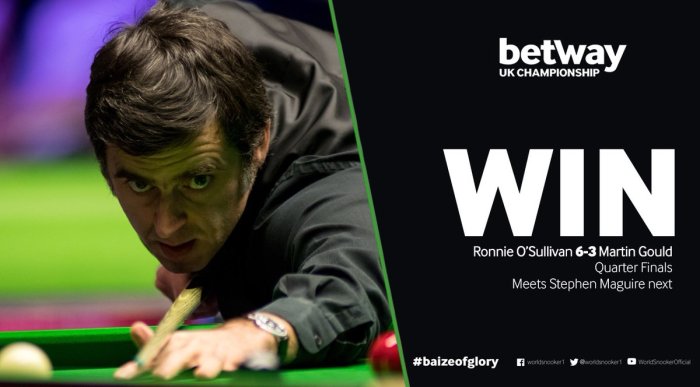
UK Championship 2017 – Ronnie beats Martin Gould in the QF

UKChamps2017QFWin

Ronnie surged to a 5-0 lead, playing better than yesterday, but Martin Gould fought back, taking 3 frames on the trot before Ronnie finished the match with a 6-3 score.

Here are a few images taken during the match by Tai Chegzhe. Thank you Tai!

Tomorrow Ronnie will face Stephen Maguire, who beat Joe Perry by 6-3 as well, having lead 5-0.

UKChamps2017QFPresser

Here is the report on the BBC website:

UK Snooker Championship 2017: Ronnie O’Sullivan beats Martin Gould

and the report on Worldsnooker

Ronnie O’Sullivan is just two wins away from capturing a record-equalling sixth Betway UK Championship title as he beat Martin Gould 6-3 to reach the semi-finals.

The Rocket lifted the trophy in 1993, 1997,  2001, 2007 and 2014 and victory on Sunday night would see him match Steve Davis’s record of six crowns. O’Sullivan is chasing the 31st ranking title of his career and third within two months having won the English Open and Shanghai Masters. First, he will have to win a semi-final clash on Saturday afternoon (1pm start) against Stephen Maguire, who beat Joe Perry 6-3.

World number four O’Sullivan was off to a tremendous start today as breaks of 107 and 106 put him 2-0 up. He got the better of a fragmented third frame then took the fourth by clearing from the last red. And a 55 clearance in the next put him on the brink of victory at 5-0.

Londoner Gould made a spirited fight back by taking the next three frames with runs of 101, 61 and 70. But O’Sullivan’s 94 in frame nine put him into the last four. The result ends Gould’s hopes of a place in the Masters as he remains 18th in the race to Alexandra Palace.

O’Sullivan said: “I just battled and tried to be professional and leave every ounce I’ve got in me on the table. I’ve given up analysing it any more, I just go out there and just try to do my best. Today was probably a bit better than yesterday. I’m kind of detached and I won’t allow myself to get sucked in, I’m here on a bit of a vacation and I’ve picked up a bit of Christmas shopping money and had a bit of fun.

“Stephen Maguire is a great player, he’s been around for a long time and he’s hitting the ball well so hopefully it’ll be a good match for everyone. I really like him as a person, he’s a top guy – if he battered me I’d still be his mate.”

Videos of interest:

The match preview on ES

The match:

The post-match BBC interview:

The match midsession with the pundits

The match review


UK Championship 2017 – Day 9

It was another memorable day at the Barbican, especially the evening session where Sunny Akani and Ronnie played a very close match, intense, full of twists and turns. It went to a decider and Ronnie won it, but Sunny Akani made himself proud and surely gained a lot of fans. Right after the match, the reactions on social media were overwhelmingly positive. This was snooker at its best, not because both players played faultless snooker – Ronnie certainly did not – but it was dramatic, hard-fought, and yet played in excellent spirit.

Pictures courtesy of Thai Chengzhe, thanks Tai!

Both players had positives to take in their press conference after the match

There were three other matches played yesterday of course, but none reached such dramatic intensity. Shaun Murphy easily beat an out-of-sorts Ricky Walden. I watched this match too and, honestly, Shaun made a lot of mistakes in that match too but they were easily forgotten because Ricky was unable to punish them. I didn’t see the other two matches, but Martin Gould admitted that he struggled out there and had to win “ugly”.

Here are the reports on Worldsnooker:

Afternoon session

Shaun Murphy eased to a 6-1 win over Ricky Walden to set up a quarter-final with Mark King at the Betway UK Championship.

Murphy has had an excellent first half to the season, winning the Champion of Champions as well as reaching two other finals. And the world number six will be determined to go all the way to the £170,000 this week in York and add to the UK title he won in 2008.

Capitalising on mistakes from his opponent, Murphy needed just two hours to end the challenge of Walden, making breaks of 51, 55 and 114. He will now meet King on Friday evening.

I’m delighted to get through but on another day that match could have been a lot closer,” said 35-year-old Murphy. “Ricky missed a couple that he wouldn’t have in matches earlier on in the week. It’s just up to me to try and take my chances.

“It was a good match although I lost control of that little white ball every now and then. We all want to play one visit snooker knocking lots of centuries in but sometimes the game just doesn’t go that way.

“It doesn’t get any easier. Mark King is a completely different animal now since winning in Northern Ireland last year. He knows how to win. I know he’s been working a lot with my coach Chris Henry on the mental side of the game and you can see the effect it’s hard on him. He doesn’t always get the plaudits he deserves.

“I would dearly love to win this title again but having already won it I suppose the pressure is not as strong as it could be.

Asked why he thought so many of the top seeds have been knocked out of the tournament, Murphy replied: “Everyone’s so bloody good! The flat 128 draws aren’t new any more. The lower ranked players are all great snooker players. There are seven billion people in the world and we’ve got the best 128 snooker players here. These results may shock you but they don’t shock me.

Martin Gould reached the quarter-finals in York for the second time in three years by beating China’s Xiao Guodong 6-4. Londoner Gould has been on an impressive run of form having reached the semi-finals of the International Championship and the quarter-finals of the Shanghai Masters.

Today’s win also gives Gould a boost in the race to the Masters though he must still win his next match against Ronnie O’Sullivan or Sunny Akani on Friday afternoon to have a chance of a spot at Alexandra Palace.

In a tight match today the first eight frames were shared, Gould making the highest break with an 82. The Englishman took the ninth with a run of 69 then made a calm 66 clearance in the tenth to secure victory.

“It was a weird game. Apart from the first frame where I made an 80 break and I had to draw on my battling qualities to get myself through,” said world number 18 Gould. “We both struggled a little bit. Sometimes you’ve got win ugly. It’s nice to be here in the quarters and hopefully I’ll still be here at the weekend.

“Apart from the Crucible, this is one of the best venues we’ve got and we’ve had good crowds here all week. If I do play Ronnie tomorrow the crowd will be 99% on his side. I’m going to try and enjoy myself because that’s when I play my best. You can’t discount Sunny though, it’ll be interesting to see how he handles the crowd tonight.

Evening session:

Ronnie O’Sullivan narrowly avoided one of the biggest shocks in Betway UK Championship history, winning an epic tussle with Sunny Akani 6-5 to reach the quarter-finals.

World number 84 Akani, playing a televised match in a Triple Crown event for the first time, came within four balls of beating his illustrious opponent in the tenth frame when he led 5-4, but was unlucky to knock the blue in when he potted the green. Victory for 22-year-old Akani would have been arguably the most surprising result in this tournament since Marcus Campbell beat Stephen Hendry 9-0 in 1998.

Instead, O’Sullivan took the last two frames and he will continue his quest for a sixth UK title when he faces Martin Gould on Friday at 1pm. World number four O’Sullivan is also aiming for his third ranking title within two months having won the English Open in October and Shanghai Masters in November.

Thailand’s Akani dominated the opening frame then made a break of 74 in the second to lead 2-0. O’Sullivan hit back with 121 and 98 for 2-2 but his opponent was clearly enjoying the occasion and converted excellent long pots on pink and black to win the fifth frame, then added the sixth with runs of 49 and 38 to lead 4-2.

O’Sullivan won a scrappy seventh and made a 61 in the eighth for 4-4, then Akani regained the lead with a superb 128. In frame ten, Akani had the chance to clear the colours, but in potting the green to a baulk corner he tried to nudge the blue away from the cushion, only to send the blue into the opposite corner. O’Sullivan took green, brown and blue for 5-5.

Chigwell’s O’Sullivan led 60-0 in the decider when he missed a red to a centre pocket. Akani clawed back to within 35 points with two reds left, but a loose safety gave O’Sullivan the chance to add 16 points and cross the winning line.

“Sunny deserved to win, I feel like I robbed him,” said 42-year-old O’Sullivan. “It was my lucky day and I’m happy to live to fight another day. I just tried to play a decent snooker match. Sunny is a great character, a beautiful lad and I hope he has a fantastic career.

Asked about his previous record against Gould, O’Sullivan added: “I don’t care whether he has beaten me before or not, or whether he comes out with three heads tomorrow. If I play like I did tonight I’ll be lucky to get a couple of frames.

Akani said: “I really enjoyed it, I am happy.  In the tenth frame I knocked the blue in – I can’t do anything, it happened. Afterwards Ronnie gave me some advice and told me I played well.

Meanwhile, Mark Joyce saw off Lyu Haotian 6-4 to set up a match with Ryan Day. It will be the sixth ranking event quarter-final of Joyce’s career – and second at the UK Championship – and he is yet to reach a semi-final.

Breaks of 55, 59, 59, 71 and 62 helped world number 42 Joyce build a 5-2 lead. China’s Lyu fought back to 5-4 but Joyce got the better of frame ten to seal the result.

I was under pressure at 5-4 but I showed a bit of experience and made sure I didn’t miss anything easy,” said Walsall’s Joyce, who knocked out Neil Robertson in the last 32. “In the past I’ve beaten big seeds and then lost in the next round so I didn’t want that to happen again. I want to kick on and keep winning. I have never been to a semi-final so I’m trying to cross that hurdle.

Quarter-final line-up
Ryan Day v Mark Joyce
Shaun Murphy v Mark King
Stephen Maguire v Joe Perry
Ronnie O’Sullivan v Martin Gould

There’s a few comments I’d like to make about this report. Claiming that, had Ronnie lost yesterday, it would have been one of the biggest shocks in the tournament history is simply preposterous: Sunny Akani arrived in the last 16 having beaten Fergal O’Brien, Michael Holt and Barry Hawkins in the previous rounds, so it was obvious that he can play and is playing well, very well even. Fergal is about as hard a match player as you can find on the tour, and Barry Hawkins is a top 16 player. He might be struggling, he was swept away by 6-0 which is a very severe beating however you look at it. In this tournament only we had two far bigger shocks IMO: Ding being beaten 6-5, from 5-1 up, by Leo Fernandez, who is struggling with his game and suffering back injuries is frankly hard to understand. And Mark Selby going out, by 6-3, to Scott Donaldson who came in this tournament without winning a match this season is also certainly surprising.

Videos of interest:

The evening session preview

Ronnie vs Sunny – the match:

the post-match with Hazel (BBC)

Ronnie and Sunny interview and their match review (ES)


UK Championship 2017 – Day 8

Yesterday was the first day of the last 16 round in York and both of the top 16 involved, Mark Allen and John Higgins are out of the tournament. Joe Perry did play really well to beat Mark Allen, whilst Mark King showed outstanding fighting qualities and sent John Higgins home.

Li Hang missed the yellow for a 147.

Stephen Maguire and Mark King both are still in with a chance to make it to Alexandra Palace in come January, but both need to reach the  Final here in York for that to happen.

Here are the reports on Worldsnooker:

Afternoon session:

John Higgins became the latest top star to drop out of the Betway UK Championship as he let chances slip in the last two frames and lost 6-5 to Mark King.

Defeat for world number five Higgins means that of the 14 players left in the tournament in York, only Ronnie O’Sullivan, Shaun Murphy and Mark Allen are ranked among the top 16.

Higgins, winner of three UK titles and 29 ranking events, admitted he suffered a “total malfunction” in the closing stages. It was world number 21 King who held his nerve and set up a quarter-final with Murphy or Ricky Walden.

From 2-1 down, Wishaw’s Higgins won the fourth frame with a break of 80 then got the two snookers he needed to snatch the fifth. He also won the next by clearing from yellow to pink and looked to be in control at 4-2.

Romford’s King, who won his first ranking title at the Northern Ireland Open last season,  fought back and won the next two frames for 4-4. Higgins regained the lead then had a chance for victory in frame ten but missed the last red to a top corner when trailing by six points, and King took advantage for 5-5.

In the decider, Higgins had two early opportunities but could only muster 17 points, and his opponent made an excellent 69 which proved enough.

When I got my chance I thought just be positive, strike the ball nicely and make sure you don’t miss anything easy,” said 43-year-old King. “I was in good position the whole time and I was pretty calm and confident. I’m delighted to win it.

“Even at 4-2 down I was saying ‘just enjoy it’ – if the worst comes to the worst I’d be on the train home tonight to go and see the family– there’s no better feeling than going home to them. Hopefully they’ll be coming up at the weekend. It’s nice not to have to worry about playing the bills. It’s nice just to play your game and enjoy it.

Higgins said: “When you start collapsing like that there was only one way it was going to go. It probably should have given me momentum when I was 4-2 in front but he came back stronger and I was just dreadful the whole game.

“From 5-4 it was a total malfunction. There’s just some things you can’t explain and that was a malfunction on every single shot, I couldn’t pot a ball.

Stephen Maguire won a tartan tussle against Graeme Dott by a 6-2 scoreline to set up a match with Joe Perry or Mark Allen. It’s Maguire’s first ranking quarter-final since he lost to Ryan Day in the final of the Riga Masters in June.

Breaks of 72, 57 and 116 helped Maguire go 4-1 up. Dott pulled one back but 2004 UK Champion Maguire took the next two frames to cross the winning line.

That’s the best I’ve felt since I’ve been down here,” said Maguire after reaching his ninth quarter-final in this event. “I knew it was going to be a tough match because he’s gritty and he doesn’t give up but I think I controlled the match from the word go. I don’t know if it’s the time of year or something but I do seem to do well at this tournament.

As for his next match, Glasgow’s Maguire added: “I don’t look at the draw, that’s the way I’ve been brought up. I always just think if I play well and I fancy the job that’s great. If I play bad I will lose, it’s as simple as that.

Dott said: “Stephen thoroughly deserved to win. I just couldn’t control the white. I kept losing position every time I got in. He certainly played a lot better than I did.”

Maguire and King are both still in contention in the race to the Masters though each must reach the final to have a chance.

Evening session:

Ryan Day made a total clearance in the deciding frame to beat Li Hang 6-5 and reach the quarter-finals of the Betway UK Championship for the first time.

Joe Perry also booked a spot in the last eight with a 6-4 defeat of Mark Allen.

Welshman Day was pushed all the way by China’s Li but finished in style to set up a meeting with Mark Joyce or Lyu Haotian on Friday. The result boosts Day’s hopes of a Masters spot as he moves ahead of Liang Wenbo into 15th place in that race.

Day took the opening frame tonight then Li had a chance of a 147 in the second but after potting 15 reds with blacks he missed a tough yellow with the rest. He went on to lead 3-1 with runs of 83 and 56. Frame five went Day’s way and he looked set to make it 3-3 but his opponent got the snooker he needed on the final pink and took pink and black to lead 4-2.

Riga Masters champion Day recovered to take the next three frames with top runs of 65 and 60 to lead 5-4. He might have sealed victory in frame ten but missed the last red to a baulk corner along a side cushion. But the Pontycymmer potter needed only one chance in the decider, making a brilliant 138.

“I had to dig in and work hard tonight,” said world number 19 Day. “To lose the tenth frame and go 5-5 was a sickener but I took some deep breaths and showed some steeliness in the last frame. I gave every shot 100 per cent and it was a great break. Li gave a fist pump when he went 4-2 up but after that he started missing balls.

Perry set up a quarter-final with Stephen Maguire by beating Allen, a result which means that Ronnie O’Sullivan and Shaun Murphy are the only top-16 ranked players left in the tournament.

Perry compiled breaks of 83, 114 and 63 in building a 3-1 lead then Allen made a 135 in frame five. A superb 64 clearance gave Perry frame six and the Chatteris cueman made an 87 in the next to lead 5-2.

Allen battled back with 134 and 75 to close to 5-4 but world number 22 Perry got the better of a scrappy tenth frame to reach his first ranking event quarter-final since the Riga Masters.

Perry said: “It was a great game, the best I have played in a long time. I felt comfortable out there and played solid snooker all the way through, until the end when I collapsed like a cheap tent. I was lucky to crawl over the line. It’s a big win for me and I’ve got to try to keep playing to that level.

This is something of a pattern I have noticed over the last year of so: John Higgins still can play outstandingly, but not under pressure. This is something that happened to Hendry as well in the final years of his career: often he started a match strongly but it only took a couple of mistakes to knock his confidence – and his game – out. At times Ronnie has looked vulnerable to that too but not to the same extend and not all that often, and, maybe, this is because he refuses to put as much pressure on himself  as they do/did because he has other things in his life.

Ronnie had a day off and decided to take the matter of the missing Masters Trophy in his own hands, with the help of the Eurosport crew. They shared this on Facebook (live as it happened!)

He also brought some cake to the press

Make no mistake. Ronnie stays in Sheffield, one hour drive away from the venue, because it gives him an easy  access to excellent practice facilities. But being bored has often been his undoing in long tournaments – nobody can do practice all day and it would be counter-productive anyway – and those little funny things probably help him as much as they give Eurosport coverage a touch of nonsensical fun that the more serious BBC lacks. Not that the ES coverage lacks professionalism in any way, it’s excellent.

And some junior Ladies players had the opportunity to watch some UK Championship action and to meet some pro players:

UK Championship 2017 – Day 7

As the last 16 starts today, only 4 of the top 16 are still in the competition: Ronnie, John Higgins, Shaun Murphy and Mark Allen. The guys trying to get in that bracket are out in force: Ryan Day, Stephen Maguire, Martin Gould, Joe Perry and Ricky Walden are still in this and fighting. This installment of the UK Championship is turning into quite an absorbing tournament, especially with young players like Lyu Hao Tian and Sunny Akani also still in the mix.

Here are the reports on Worldsnooker:

Afternoon session

Ronnie O’Sullivan compared himself to Seve Ballesteros and Tiger Woods after thrashing Michael White 6-1 to reach the last 16 of the Betway UK Championship.

O’Sullivan has lost just five frames in his three matches so far in York and will now face Barry Hawkins or Sunny Akani in round four. He is chasing his sixth UK title and third ranking event of the season having won the English Open and Shanghai Masters.

World number four O’Sullivan, the highest ranked player left in the tournament, was not at his best today but capitalised on a series of mistakes from Welshman White. The first two frames were shared, then O’Sullivan took three in a row with breaks of 132, 64 and 71.

Frame six was a scrappy affair and came down to the colours, O’Sullivan converting a thin cut on the blue to a centre pocket to go 5-1 ahead. And he sealed the result in the next with a run of 65.

“This game is like golf – if you’re not set up right or you’re not in line it can affect everything,” said O’Sullivan. “We all go through that and some of us can go through that a little bit better than others, like Seve Ballesteros or Tiger Woods. They’re able to get it round sometimes and that’s what I was able to do today.

“It’s part of the art of the game, some people can do it and some can’t. I’ve won a lot of my matches and tournaments having to do that. It’s great to play fluently but that’s not always the case. Mark Williams, Judd Trump and Luca Brecel are shot makers and so is Mark Selby – he’s able to scramble it round probably better than anyone else. There’s a yin and yang with everything though – with the more robotic players, when they’re really ‘on’ they tend not to make any mistakes.

“Michael didn’t play well today, he was struggling out there and the more you miss, the harder it gets. He got loads of bad luck as well and I felt for him because I like him and he loves the game. It can be frustrating out there and I wasn’t brilliant, but I think I scrambled a bit better out there.”

White said: “I was absolutely awful, so frustrated with myself. It’s just bitterly disappointing. I need to get to grips with dealing with the pressure over events that last a long period of time otherwise the same thing is going to keep happening. He was far from his best but I just couldn’t do anything in the end. In the final frame I didn’t really want to be there at all. I knew my mind had completely gone.”

John Higgins came through a tough tie with Yan Bingtao, winning 6-3 to set up a match with Mark King. Three-time UK Champion Higgins went 3-0 up with top breaks of 66 and 80 then China’s Yan, runner-up at the recent Northern Ireland Open, fought back to 3-3 with top runs of 79 and 81. But Wishaw’s Higgins made a vital 67 to win the seventh frame, and dominated the last two with a top break of 66.

Higgins revealed after his second round match that he needed a new tip on his cue, and yesterday he drove to Southport to have the work done by former pro Les Dodd. “If I had have kept the old tip on I’d have just lost 6-0 today, but with the new one after an hour it felt a lot better,” said the Scot. “I thought I competed well with Yan today and my safety game was good, which it had to be because he’s such a good player.”

Mark King pulled away from 3-3 to beat Luca Brecel 6-3 with a top run of 101. Martin Gould top scored with 84 in a 6-4 win over Hossein Vafaei. Gould still has a chance of getting into the top 16 in the race for the Masters though he needs at least a semi-final berth.

More specifically about Ronnie’s match read here

Ronnie will play Sunny Akani tomorrow and it could be intriguing. Akani has a very unorthodox technique to say the least, and he’s quite slow too, but he’s getting the results. Many don’t give him any chance, but I’m not one of them.

Evening session

World number 84 Sunny Akani scored a shock 6-0 win over Barry Hawkins at the Betway UK Championship to set up fourth round clash with Ronnie O’Sullivan.

With Kyren Wilson losing to Ricky Walden, tonight’s results mean that only four of the world’s top 16 are through to the last 16 at the York Barbican.

Thailand’s 22-year-old Akani turned pro in 2015 and he has since shown signs of his potential, notably reaching the quarter-finals of the Indian Open last season, but victory over world number eight Hawkins is the best result of his career so far. The former Asian under-21 champion will face his idol O’Sullivan on Thursday evening.

He made breaks of 55 and 59 tonight and won each of the other four frames on the colours to send three-time ranking event winner Hawkins home.

“Today I played pretty well and didn’t miss any easy shots,” said Akani, who beat Fergal O’Brien and Michael Holt in the first two rounds. “And I was lucky that when I did miss, Barry could not punish me too badly.

“He is a really top player so it is a great win for me. It wasn’t a good day for him and the balls landed awkwardly when he was at the table.

“I get a lot of fans back in Thailand watching my matches. It is tough succeeding as a professional, there is so much to learn but I have tried very hard to improve from every experience I have during the season.

“This is a very big tournament and I am really enjoying it, I have felt like I have played better this season and I hope I can continue playing at this standard or even better.”

Shaun Murphy booked his fourth round spot with a 6-3 win over Jimmy Robertson. World number six Murphy made breaks of 68 and 88 in building a 3-1 lead before Robertson won frame five on the final pink and frame six with an excellent 90 clearance.

Murphy, the 2008 UK Champion, regrouped and made 93 and 60 to lead 5-3. Robertson looked set to take frame nine until he missed the penultimate red when 40 points ahead, and that proved his last shot as Murphy cleared with 41.


Walden continued his return to form, having suffered injury problems in recent months, with a 6-2 win over Wilson. Chester’s Walden, twice a semi-finalist in this event, fired breaks of 82, 56, 116, 69 and 50.

China’s Xiao Guodong saw off Thailand’s Noppon Saengkham 6-3 with a top break of 79.

Last 16 line up:

Li Hang v Ryan Day
Mark Joyce v Lyu Haotian
Shaun Murphy v Ricky Walden
Mark King v John Higgins
Graeme Dott v Stephen Maguire
Joe Perry v Mark Allen
Ronnie O’Sullivan v Sunny Akani
Martin Gould v Xiao Guodong

From now on all matches will be either on television or on stream as we go to the two tables setup.