Players who have won all three events in snooker’s Triple Crown Series will be sporting a new icon on their waistcoats at the Dafabet Masters.
In recognition of the outstanding achievement of winning the Dafabet Masters, Betway UK Championship and Betfred World Championship, those players will wear a Triple Crown logo (above) at every tournament where waistcoats are in the dress code.
Six players will carry the logo at Alexandra Palace:
John Higgins – four time World Champion, three time UK Champion, two time Masters champion Mark Selby – three time World Champion, two time UK Champion, three time Masters champion Mark Williams – three time World Champion, two time UK Champion, two time Masters champion Judd Trump – current World Champion, 2011 UK Champion, current Masters champion Neil Robertson – 2010 World Champion, two time UK Champion, 2012 Masters champion Shaun Murphy – 2005 World Champion, 2008 UK Champion, 2015 Masters champion
Other than this half dozen, the only five Triple Crown winners in snooker history are Ronnie O’Sullivan, Stephen Hendry, Steve Davis, Alex Higgins and Terry Griffiths.
There will also be a special display cabinet in the Fan Zone in the main foyer at Alexandra Palace where fans can find out all about the Triple Crown Series and the trophies.
A spokesman for WST said: “We have 25 tournaments around the globe, but the Triple Crown events remain the most prestigious and historic in snooker, and they are the titles the players covet most. In honour of the elite group of players who have won all three at some point during their career, we have created this new logo which they can wear with pride.”
I have to say I feel a bit uneasy about this thing. Of course players who have won all three tournaments should be proud. They carry a lot of history and prestige, they are major events, but … maybe I’m getting really old … it feels a bit like kindergarten stuff. You know, the “outstanding” kids getting some recognition in the form of a diploma, badge or star to show off. I wonder how the players feel about it and whether they will be given the choice to wear the logo or not.
This interview was conducted by Eurosport before the Christmas break.
Thank you for making it available to me.
And now for a bit of last 16 preview for what it’s worth…
Judd Trump v Shaun Murphy
Judd Trump is the defending champion and, surely, he starts the tournament as favourite given how well he has played over the last year. In fact it was his 10-4 win over Ronnie in last year final that started it in earnest. That said he couldn’t really get a tougher opponent than Shaun Murphy in his first match. Shaun had a nightmare season in 2018/19 but is playing much better this season. Judd hasn’t been at his best just before the holidays break, he’s lost to Nigel Bond of all people in York and failed to qualify for the European Masters. Now, he was probably very tired and in need of a break. Yesterday, he won Group 6 in the Championship League Snooker. He looked in good form but CLS form doesn’t mean much: in 2010 Ronnie and Mark Selby played in Group 2, just before the Masters, finished 6th and 7th of the group, both relegated, only to meet in the Final of the Masters the next week. Shaun has been very solid this season, making it to three big finals, winning one. However, one of the finals he lost was a 10-3 defeat to Judd. I expect Judd to win, but the match to be close, probably 6-4 or 6-5.
Ding Junhui v Joe Perry
I can see only one winner here and it’s Ding. Ding has won the 2019 UK Championship last month, playing really well. He also qualified for both the 2020 European Masters and the 2020 German Masters. During the last month of 2019 he has beaten Ali Carter, Ronnie, Yan Bingtao, Stephen Maguire, Matthew Stevens and Peter Ebdon (never easy). In fact, over the last two months he’s lost just one match. Joe Perry on the other hand has had an indifferent season so far, and was dreadful in the CLS over the last two days. His only hope is that Ding has gone off the boil completely during the holidays break. My prediction: a comfortable win for Ding: 6-2 or 6-3.
Mark Selby v Ali Carter
Mark Selby has been a bit in and out so far this season, as he has been since mid 2017, but he still won two ranking events over the last months, including the last one of 2019, the Scottish Open. He has also qualified for both the 2020 European Masters and the 2020 German Masters. He should feel reasonably confident again. Ali Carter hasn’t got past the quarter finals in any event this season so far, and that only quarter final came at the six-reds World Championship. Add to that the fact that when things don’t go his way, he’s prone to getting frustrated and throwing his toys out of his pram. I can see only one winner, Mark Selby. I won’t predict a score. Depending on Mark’s form it could be close or totally one-sided.
John Higgins v Barry Hawkins
Neither players have been at their best so far this season. John Higgins though has reached a semi final twice, where he lost to Judd Trump both times, Also, he hasn’t lost to any low ranked player all season: the only players out of the top 16 who beat him were Graeme Dott, Kurt Maflin and Yan Bingtao. Barry Hawkins is going through a terrible season. He won the 2019 Paul Hunter Classic, but other than that he didn’t go past the QF in any event, and he only reached that stage twice, in the 2019 Shanghai Masters and in the 2019 China Championship, rather early in the season. Their head-to-head is pretty close: it’s 9 wins to Higgins for 8 to Barry, and Barry actually won the last of their encounters, and the only one that was played this season. So it’s hard to call. John Higgins has got slightly better results this season, but his record at the Masters is not great. I will go for 6-4 either way.
Neil Robertson v Stephen Maguire
Both Neil Robertson and Stephen Maguire have blown hot and cold this season. Neil won the 2019 Champion of Champions, beating Judd Trump by 10-9 in the final, and Ronnie by 6-5 in the semi final, both very high quality matches. He’s also reached the semi finals in the 2019 Shanghai Masters where Ronnie beat him by 10-6, but in the ranking events he hasn’t got past the last 16. Stephen Maguire has won the 2010 six-reds World Championship, and was runner-up in the 2019 UK Championship but other than that hasn’t gone past the last 16 in any event. So, this match is very hard to predict. Neil Robertson though is coming to Ally Pally with a goal…
A very honourable goal. I believe that this will motivate him big time. Because of that, and because he’s been doing really well in invitational events so far, I will go for a 6-4 or 6-3 win for Neil.
Mark Allen v David Gilbert
Mark Allen has got a very strange season so far. He’s reached the semi finals 6 times out of 11 tournaments he’s played in. In the others he lost in the last 64 twice, in the last 32 twice and in the last 16 once. David Gilbert’s season has been just as bizarre: he’s made it to one final, one semi final, 4 quarter finals … but also lost in the first round 5 times. The main factors in this match will probably be, one, that this is David Gilbert first ever Masters and the London crowd is usually quite animated and loud, and two, that Mark Allen was bitterly disappointed by his performance last year and will want to redeem himself. The rowdy atmosphere should suit him. Prediction: 6-3 or 6-2 to Mark Allen.
Kyren Wilson v Jack Lisowski
If one forgets the Paul Hunter Classic, Kyren Wilson’s season has been rather poor: one semi final at the 2019 World Open, one quarter final at the 2019 Shanghai Masters and a couple of last 16. Jack Lisowski’s season has been similar: a final at the 2019 Scottish Open, a quarter final at the 2019 Shanghai Masters and a couple of last 16. It’s also Jack’s first Masters and, in my opinion, Jack tends to be a bit overawed when facing a big stage for the first time. This is a very big stage with a unique atmosphere. Because of this I expect a comfortable win for Kyren: 6-1 or 6-2. Now I wish I’m wrong here.
Mark Williams v Stuart Bingham
Now this one promises to be hard fough match, but not necessarily high quality. Mark Williams season hasn’t been great but there were signs in the recent months that he is back practising and playing well again. He lost to Shaun Murphy by 10-9 at the 2019 China Championship, and won 6 matches out of 6 in the round-robin phase of CLS Group 5 earlier this week. The problem with Williams is that he doesn’t seem to be able, or find the necessary motivation, to do it consistently. Stuart Bingham hasn’t got past the quarter finals in any event, and reached that stage only twice, one being at the six-reds World Championship. Not great. I expect Mark Williams to win by 6-3 or 6-4.
That’s for the first round. What about a winner? Ronnie goes for Ding; it’s a prediction he does with his heart I’m sure but I genuinely believe that Ding has a good chance. Actually, should they both win, he will face Judd Trump in the quarter finals, which is better than facing him in the final. I expect the winner of that QF to go and win the title. Other than those two, I think that Mark Selby and Neil Robertson are serious contenders.
Ronnie O’Sullivan: Missing Masters a ‘career mistake’, says Barry Hearn
By Owen Phillips
BBC Sport
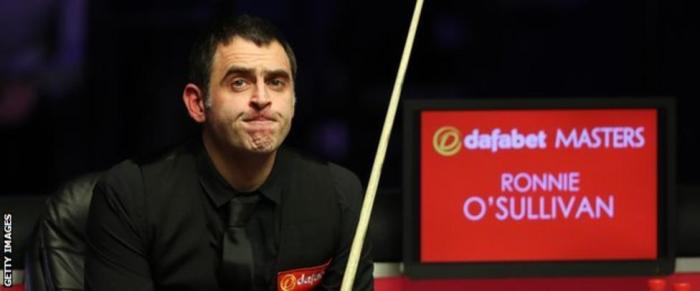
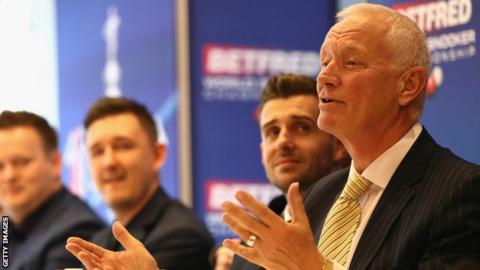
Ronnie O’Sullivan’s decision to pull out of the Masters is a “waste” and a call the seven-time champion will come to view as a career mistake, says World Snooker Tour chairman Barry Hearn.
O’Sullivan, 44, felt his spot at one of snooker’s showpiece tournaments should go to someone who will “give 110%”.
Hearn said he had “no idea” why the 2019 runner-up would want to miss out.
“The Masters is a special place. It’ll miss Ronnie and Ronnie, in a reflective mood, will miss the Masters,” he said.
“It is probably one of those decisions I think we have all made in our lives that you look around now or later and say ‘I shouldn’t have done that, that was a waste’,” Hearn told BBC Sport.
“It’s extra disappointing because he has a fabulous record at the Masters. He doesn’t have to travel very far, it’s his home tournament and he has a legion of fans who will be disappointed.
“I feel more sorry for Ronnie missing than anyone else because I feel it is a huge career mistake for him.”
O’Sullivan, a 36-time ranking event winner and five-time world champion, won his first Masters crown in 1995 at the age of 21.
Last year he reached his 13th final but was brushed aside 10-4 by Judd Trump in a one-sided contest at London’s Alexandra Palace.
Trump’s stylish victory was the start of a fabulous year which also saw him win the World Championship for the first time.
Is ‘flag-waver’ Trump ready to replace Ronnie?
O’Sullivan gave his runners-up medal to a spectator after his loss to Trump in last year’s Masters final
Hearn said the time could be right for Trump to take on the mantle of snooker royalty from O’Sullivan and his fellow greats.
“Who knows what the future holds for young Mr O’Sullivan,” Hearn added. “But whatever it does, he has been a wonderful addition to the world of snooker for many, many years and we wish him well in everything he does.
“Ronnie has been around for so many more years so has built a brand value. This is Ronnie O’Sullivan – a genius. He is his own man and does what he wants to do. And maybe he has reached the time in his life where he has fallen out of love with snooker.
“Everyone benefits from the big personalities at the top. Every snooker player has benefited from Ronnie’s personality and skill. But no one lasts forever.
“Ronnie’s a sad loss for the Masters, there’s no two ways about it. But he is not an irreplaceable loss because Judd is world number one and there are lots of other great players at this event.
“I do need a flag-waver – and Ronnie has done that job brilliantly well. We have always had one like Stephen Hendry and Steve Davis. But a really successful sport has depth of talent as well and people, while they want excellence, do not want to see one-way traffic.
“Judd is clear world number one, the first player to earn more than £1m in a season. He has a very good image for snooker. He is a young, vibrant attacking player. He has a great lifestyle and is someone that a kid could aspire to be. He ticks an awful lot of boxes as far as the personality is concerned.”
“There are a few older boys – the ‘Class of 92’ with Mark Williams and John Higgins – who are still very capable players but are reaching their sell-by date.
“Time waits for no one. And you look at Kyren Wilson and Jack Lisowski and you think these will be good replacements. They are lively, attractive players with good personality that we can develop.
“We are in a good place with talent coming through. Ding Junhui winning the UK Championship has reignited China – if it needed reigniting.
“Our job is to make sure we have an army of people that want to be the next Ronnie O’Sullivan – both on the table and from a personality perspective as well.”
The 2020 Masters, which consists of the world’s top 16 players, takes place at Alexandra Palace from 12-19 January, and is live across BBC TV and online.
Barry Hearn says every snooker player has benefited from Ronnie O’Sullivan’s “personality and skill”
The part in bold ( bold added by me) is both heartwarming and a bit worrying. But we shall see what the rest of the season brings. Ronnie had been in and out of love with snooker for most of his life. I doubt that he will be able to stay away from it entirely one day.
Two “groups” of the Championship League Snooker 2020 were played earlier this week, with Anthony McGill and Judd Trump booking their spot in the Winners Group.
As usual this competition threw some strange results. For instance, Mark Williams was absolutely flying in the Group 5 round-robin stage, winning 6 matches out of 6. He then lost in the SF … and finishied 5th in Group 6. That said, it’s a lot of snooker condensed in 4 days, and players tend to treat it as a bit of paid practice.
Gao Yang from China won the 2020 WSF Junior Open in Malta
The15-year-old Chinese talent becomes the first winner of the prestigious new junior event and will earn a two-year main tour ticket to the World Snooker Tour from the start of the 2020/21 season. The competition saw 55 of the best young snooker players in the world aged 17 or under compete over six days to become champion.
Gao, who previously competed at the WSF Championship in 2018 and recently appeared as a wildcard at the 2019 World Open in Yushan, qualified from a tough group in second place before surviving deciding-frame encounters against Scotland’s Dean Young and later his compatriot Yi Ze Wu to progress to the final.
Awaiting him in the final was England’s Maddocks, who starred in the groups dropping just one frame before reaching the title match with victories against Bradley Tyson, Antoni Kowalski, Jovan Todorovic and Irish prospect Aaron Hill.
It was Maddocks who made the stronger start to the final, taking two of the opening three frames to lead 2-1 as he looked to go one better his performance at Q School last year which saw him narrowly miss out on joining the professional ranks.
The fourth frame would however prove to be a key turning point as trailing 54-26, Gao cleared the table in two visits to draw level at the mid-session interval. This would prove to be the start of a four-frame winning run as he hit the front for the first time with a match-high break of 72 on the resumption of play, before adding the next two to secure victory.
Remarkably, there were only two Chinese players in the draw – Gao Yang and Wu Yize – and they met in the semi finals, before the winner of their match went on to win the whole event. This and the 5-2 score over Sean Maddockx, in my eyes, confirm that currently, the young best amateurs come from China and the current structure of the tour is what prevents them to dominate snooker. As I explain in my previous post, the “World” tour remains very UK centric and bias in favour of UK players.
The highest break of the tournament was a 121, made by Julien Leclercq from Belgium. Julien, 16, reached the last 16 of the tournament, narrowly losing by 3-2 to Wu Yize. This is a very good result for Julien who doesn’t benefit from as strong an amateur scene as his UK fellow juniors to play in. Julien did much better than the more fancied Ben Mertens. He’s one year older than Ben, and more mature. That matters in a tournament like this one. He will play in the “main” WSF event as well, as will Ben.
Regarding Gao, he’s only just 15, and will not been 16 yet at the start of next season. So, he may not be able to take his tour card immediately, because he may not be able to obtain a visa and a work permit in the UK until he’s 16. I read in Lewis comments that he might lose part of his prize money in this case. If this is true, it’s unfair. I would understand that a player who is in a position to take his newly earned tour card, but chooses to opt out, would get a reduced prize money, but not if it’s because of external circumstances like in Gao’s case.
Update I just spoke with Matt Huart who confirmed that half of the prize money is indeed dependent on the commitment of the player to take their tour card. Gao is determined to turn pro next season and has pulled out of the main event. Matt wasn’t sure what would happen if he was prevented to do that by circumstances beyond his control.
Snooker’s commercial arm has relaunched as the World Snooker Tour (WST) to reflect its global growth over the past decade.
Previously known as World Snooker, WST runs the professional circuit around the planet, with a tour of 25 events and total prize money of £14.6 million.
A new logo and branding for the tour have been created, which will be used going forward at all events and on all digital platforms, including the official website WST.TV
WST has grown rapidly over the past decade; during the 2009/10 season there were just six world ranking events and total prize money of £3.6 million.
In 2010, World Snooker was taken over by Matchroom Sport, chaired by Barry Hearn. Today, snooker has vastly improved opportunities for the players to compete in lucrative events across the world, and for the fans, with 500 million people watching the sport’s linear and digital broadcast.
Hearn said: “Our decision to relaunch as WST with fantastic new branding is part of our vision for snooker as we reflect on a decade of change and look forward to a bright future.
“Over the past ten years we have exploited the massive popularity of our sport across the planet. We have created new events with lasting legacies and worked with broadcasters to bring snooker to an ever growing audience. We have modernised our sport, particularly through social media, to appeal to a young generation of fans, and our new branding reflects that.
“We have tripled prize money over the past decade, and looking ahead to the next ten years I believe we can double it again, towards £30 million. Rather than resting on our success, we have plans in place to continue our development with relentless ambition.
“Recently we announced a new event in Saudi Arabia which will set a new record for prize money for one event, and it is a ten year deal with the intention to grow snooker at grass roots level in the region.
“As well as expansion into the Middle East we are pushing hard into India where we think there is enormous potential. North America, South America and Africa are also potential markets with a bright future. Soon we will announce plans for an exciting new online platform which will bring snooker to even more fans in every corner of the globe.
“Perhaps our greatest asset is our inclusivity. Anyone can play snooker regardless of age, gender or nationality, the only criteria is ability. There are great incentives for any young player across the world to rise through the ranks, while they are inspired by their heroes who have reached the top level.
“This is an exhilarating time to be a WST player or a fan of the sport, and as we look ahead we are limited by nothing other than our own imagination.”
WST: The Statistics
Global TV audience
500 million people
120 countries
1.6 billion households
22 broadcasters
64,400 linear broadcast hours
13 digital platforms
168 million live video views
There are players from 21 different countries among the 128 on the World Snooker Tour.
There are 104 national snooker federations worldwide. An estimated 120 million people across the globe play snooker.
World Snooker Tour total prize money, season by season
2009/10 £3.6 million
2010/11 £5.3 million
2011/12 £6.2 million
2012/13 £7.0 million
2013/14 £8.3 million
2014/15 £8.1 million
2015/16 £8.0 million
2016/17 £10.3 million
2017/18 £13.6 million
2018/19 £13.2 million
2019/20 £14.6 million
Number of ranking events, season by season 2009-2019
2009/10 6
2010/11 8
2011/12 9
2012/13 11
2013/14 12
2014/15 11
2015/16 10
2016/17 19
2017/18 20
2018/19 20
2019/20 19
Impressive? Yes it is but…. I’m an European and I can’t help to think that there are some fundamental changes needed before it’s a WORLD tour. Currently it’s still essentially a UK centric tour. Why? Well consider this:
All three majors are held in the UK
All flat draw events that are played at the main venue are held in the UK
All qualifiers are held in the UK
The Q-school is held in the UK
This basically means that young aspiring players, who aren’t millionaires, have to live in the UK, something BTW that could become more difficult for EU citizens with Brexit coming.
China injects a lot of money in the sport, yet their young players have to come to the UK to qualify for their home events. Is that right?
Just imagine for a minute that it would be the other way around. Just imagine that UK players would have to qualify for the Home nations, the UK Championship and the World Championship in some obscure remote town in China. How many would succeed? How many would go and live in China, learn the language, accept a totally different culture, different food, be separated from their families, deal with the time difference? How many would cope? Be honest, not many. Especially when you hear people like Mark Allen and Ken Doherty telling you how hard it was to expat themselves from … Ireland, a country sharing the same language, culturally close, with no time difference and one hour away by plane. If it was the other way around, the circuit would be dominated by Chinese and Asian players, make no mistake, because they have much better stuctures to support and develop their young talents. The current structure of the tour is massively biased in favour of UK players. Yes, they are a majority, but the whole system is designed to keep it that way. That has to change if there is a real ambition to be a WORLD tour.
all flat draw events should be played at the final venue from round 1
if there are “tiered” events, the qualifiers should be played in a location geographically close to the main venue, and right before the main event , as is the case for the World Championship
the main tour qualification process needs to change. For the near future, “de-localised” Q-schools would be the easiest option. It would be a long term project, and would need a change in mentality, but, possibly, an “ELO” type of rating system – replacing the current rankings – could eliminate the need for the Q-school entirely. And before you tell me it’s impossible to use in snooker, it IS used in table tennis.
Barry Hearn: Snooker’s elite can ‘go or pass’ on Saudi Arabia tournament
By Owen Phillips
BBC Sport
Barry Hearn took over as World Snooker chairman in 2009, when he said the sport was “dying”
Snooker’s elite players are under no pressure to play in the lucrative but controversial new tournament in Saudi Arabia, World Snooker Tour chairman Barry Hearn has said.
The ranking event with the biggest prize money will take place in Riyadh in October, with the champion earning £500,000 from a total fund of £2.5m.
Hearn said the decision to go was made for the “betterment of our sport” and “we go, invest and create”.
“Every player can go or pass,” he said.
The Saudi Arabia Snooker Masters will see the country host a ranking event for the first time in 2020 as part of a money-spinning 10-year deal.
However, human rights organisation Amnesty International has highlighted the country’s “abysmal” human rights record. Heavy restrictions on freedom of expression and women’s rights have been raised, as has the use of the death penalty for offences not recognised as crimes under international law.
The Kingdom has sought to stage sporting and entertainment events in a bid to attract visitors and move away from its oil-dependent economy.
Anthony Joshua’s world heavyweight title victory over Andy Ruiz Jr took place there in December, and boxing is far from alone in staging events in Saudi Arabia, with football, motor racing, tennis, golf and WWE wrestling all recently being held in the Gulf state.
But despite accusations that the event is a cash-chasing exercise and also part of a calculated attempt by Saudi Arabia to cleanse its image through ‘sportswashing’, Hearn is adamant the long-term vision has honourable motives.
Hearn says it is a chance to bring about change and offers, as a sign of progress, the fact that female referees will be used.
“We are all aware of the situation, but sport knows no boundaries in our view and we are there to spread the gospel of sport, and in this case the gospel of snooker,” the 71-year-old said.
“There are probably half a dozen countries in the world that have human rights issues. Whether you consider that to be a transitional stage of a country’s development or whether you say ‘I am not having anything to do with them’ – I would rather communicate, have conversations and try to move forward.
“Sport can be a conduit for achieving that, given time. But it does take time.
“The fact we are using women referees is a major step forward.
“I am impressed with the attitude of the Saudi government and their investment in sport because they are making a push to make their younger people more active and that can only be beneficial. Sport is an issue that moulds countries together. It forms character in young people. It gives expression and an opportunity to those that may not have it. There is a bigger picture.
“It’s important to realise that every country has their own culture. There will be countries where we don’t agree with their culture and there will be countries that don’t agree with ours.
“So rather than get it over-complicated, I find it is easier for me to concentrate on what I am good at, which is the development of sporting opportunities. And perhaps, part of the by-product of the success of that venture will be a general change that makes everyone feel more comfortable.”
Hearn, who has just passed the 10-year anniversary as chairman of snooker’s commercial arm, wants to double snooker’s current prize pot of £17m in the next 10 years and continue its “globalisation”.
A rebranding from World Snooker to World Snooker Tour is designed to give a new look, “probably following on the lines of the tennis ATP Tour and golf’s PGA Tour” and give “a significant standing within the sporting world”.
Hearn added: “We have had a fascinating and fabulous 10 years. We have woken up this sleeping princess and have done well.
“We have gone from prize money of £3.5m to £17m. There are more tournaments than ever before; we have ticked a lot of boxes.
“The relaunch is a statement that the journey has only just begun. We have achieved all our ambitions in 10 years and now we set ambitions for the next 10. We believe we are a significant player and the future is bright.”
A Saudi spark
Hearn hopes the move into Saudi Arabia will increase competition and bring about “a natural progression” of even bigger and better tournaments.
“We are there to create an infrastructure of snooker via coaching, via academies, through player visits and universities and schools,” said Hearn. “We are trying to motivate a country and the brief of the Saudi government is we want to be more involved in sport generally.”
World number eight Kyren Wilson, 28, told BBC Sport that the huge prize money on offer and snooker’s global development was “great for the players”.
“Going to new places and growing the sport is wonderful,” said the former Masters runner-up.
“The political side and the ethical decisions are not something that I am involved in. That is down to those in control. As players we often live in a snooker bubble.
“The good thing is that the tournament has a long-term plan, with coaching structures and plans in place to get youngsters involved, which is brilliant. Using women referees in Saudi Arabia is also a big step in the right direction.”
Hearn added: “The bigger picture for us is establishing a global footprint. Saudi Arabia is an escalating contract for 10 years so we have a chance to really make a mark in that territory and we hope other territories will follow.
“People have egos and demands and desires and want to show their country to the best possible audience around the world.
“Anthony Joshua went to Saudi Arabia and it had massive ramifications around the world, with other countries coming on and saying ‘what about us?'”
The British heartlands
Hearn insists the traditional snooker strongholds in the UK and Ireland will not be overlooked. The Chinese market is still a key target and India remains a major focus, but the WST will not be “turning eyes away from any opportunity anywhere in the world”.
“We respect the traditional heartlands,” he explained. “We have a lot of support there and they have history. The new markets don’t have history yet, but given time they will do.
“We are looking at the world, not just our parochial attitude with where we have been and come from. Every major sport has followed the same pattern. There is a big market out there and in today’s world it can be quite easily monetised which takes it to the next level in terms of prize money.
“Our job is to maintain our Triple Crown events [the World Championship, the UK Championship and the Masters]. They have so much history that we still have an obligation to make sure they are still of relevance.
“But professional sport is governed by prize money and opportunity, and if we are trying to be an aspirational sport for young people around the world, we have to set our bar high. You are only limited by your own imagination.”
Barry Hearn: “Every player can go or pass”, in theory, yes, practically, if they are under strain ranking wise, no, they can’t and Hearn knows that very well. He’s not a liar, he’s still an hypocrite.
Kyren Wilson: “The political side and the ethical decisions are not something that I am involved in. That is down to those in control. As players we often live in a snooker bubble.” You have children don’t you Kyren? What kind of world do you want for them? You think you are safe? Let me tell you this: your attitude is the same one that allowed the Shoah to happen (*), and other atrocities and disasters as well. Basically, “It’s not my business, it’s not impacting MY life anyway”…. for now.
That said Saudi Arabia opening itself to sport may actually force them into some changes, create a “de facto” mentality opening that they will not be able to control and “close” again. If so, great.
(*) … I can almost hear a good few thinking “what the fuck is the Shoah?”
Following my article yesterday about the petition to get Stephen Lee back in the game I have got a lot of reactions, positives and negatives, amongst them a significant number questioning why some other players were allegedly treated more leniently for the same offence. Names were put forward, Jamie Jones, Stuart Bingham, John Higgins being the once most frequently cited.
I think this deserves an answer, and it’s actually quite simple: none of those three did actually fix matches, so they weren’t guilty of the same offence.
Whilst reflecting on the past decade, I covered the John Higgins case in some depth when I wrote about the year 2010 . Please read it. In short, John Higgins went to Kiev, having lost in round 2 at the Crucible, without knowledge of what his manager had been up to, namely arrange matches to be fixed and make profit from it. Of course, this was a setup, but Mooney didn’t know it, and Higgins knew even less. Higgins was guilty of cowardice – he could and should have refused to play along during that meeting – and of taking a very bad decision by not reporting the approach immediately. He always claimed that he never intended to fix matches. Whether this is the truth or not, we will never know for sure. What is definitely fact is that he did not fix any match, and was not aware of his manager’s doing until very shortly before that meeting.
Stuart Bingham banned over betting on snooker matches
24 October 2017
Sharethis page
Former world snooker champion Stuart Bingham has been banned for six months for betting breaches.
Bingham, 41, was found guilty of breaking World Professional Billiards and Snooker Association (WPBSA) rules on betting on matches involving himself and other players.
The world number 10 must also pay £20,000 in costs.
The WPBSA said there was no suggestion that he aimed to “influence matches or engage in any corrupt activity”.
Half of his ban will be suspended.
The organisation said the estimated total of his betting on snooker in the past seven years is £35,771, including several bets on his own matches.
The WPBSA said he often used proxy accounts to bet, meaning it is not possible to establish whether he won or lost from his betting activity.
WPBSA chairman Jason Ferguson said: “It is very disappointing to see such a high profile player fall foul of the WPBSA betting rules.
“Stuart is a great competitor and I have no doubt he has always played to the best of his ability. This case shows that there are no exceptions to the rules.
“Players must understand that they cannot bet on snooker at all, even if they are not involved in a match or event. Any player found to breach the betting rules will face the most serious of consequences.”
Analysis
By Frank Keogh, BBC Sport
While Bingham has the right to appeal, this is a costly suspension – ruling him out of three of the most lucrative events on the calendar – the International Championship, UK Championship and the Masters.
A popular figure, who is ranked 10 in the world, he had previously claimed he did not know the rules prevented him betting on other players’ matches.
And while there is no suggestion of corruption, his suspension is a warning from snooker’s governing body that it won’t take breaches of its betting rules lightly.
In July, Joe Perry was given a suspended three-month ban after placing nearly 200 bets on matches. Perry said he did it “purely out of boredom or distraction”.
What bets did Bingham place?
He bet on snooker using an account in his name in 2009-10 to a total of £424.44, with losses of £280.20.
He bet on snooker using an account in his name in 2012-13 to a total of £20, all of which were losing bets.
He placed bets on snooker matches that he was playing in using his manager’s account. There were 36 matches between 2003 and 2015 to a value of £4,636.
Between 25 August 2009 and 11 January 2017 he bet on snooker using an account in his manager’s name.
Between 1 January 2012 and 11 January 2017 he bet on snooker using a different account in his manager’s name.
A second party placed bets for Stuart Bingham’s direct or indirect benefit to a value of £1,706.85.
Between 1 December 2014 and 8 November 2016 he placed bets with a third party to a value of £4,000 that his highest break in a competition would be beaten. All of these were winning bets, making a profit of £7,000.
I have put in bold the most significant parts.
Jamie Jones din’t fix any match, nor did he bet on snooker, he was guilty of not reporting an approach aimed at a fellow player, David John.
Jamie Jones: Player cleared of match-fixing but breached snooker’s rules
By Frank Keogh
BBC Sport
11 January 2019
Snooker player Jamie Jones has been cleared of match-fixing but admitted failing to report a corrupt approach.
The Welshman, 30, was suspended in October after being accused of being part of a plan to fix a match between David John and Graeme Dott in 2016.
But a disciplinary panel found that he had not breached the betting rules.
Ex-professional John admitted fixing two matches in which his opponents were unaware of the plots. John and Jones will be sanctioned at a later date.
Jones, the world number 39 at the time of his suspension, admitted failing to report an approach to his compatriot John to fix the match against Dott.
“The committee considered this to be an extremely serious matter in itself, particularly in the context of the responsibility of a professional player to ensure as far as possible the integrity of the game,” said a statement from the World Professional Billiards and Snooker Association.
However, he was cleared of more serious charges under the organisation’s betting rules.
He could still face a suspension but his punishment is unlikely to be as severe as John’s, who fixed a 2017 match against Joe Perry, in addition to the Dott match. There is no suggestion of any wrongdoing by his opponents.
The verdicts follow one of the biggest corruption cases in the sport’s history – the BBC revealed last month that two Chinese players had been given lengthy bans from the game.
Yu Delu was banned from snooker for 10 years and nine months, while Cao Yupeng also pleaded guilty to fixing and was banned for six years, although three and a half years of his sentence were suspended.
Again, I have put the most important sentences in bold. The consequences for Jamie Jones were particularly severe: he lost his tour card and now needs to requalify for the main tour.
Of course there were cases where players got away with what appeared to be plain match fixing. The most prominent probably being the last 32 match between Stephen Maguire and Jamie Burnett at the UK championship in 2008, pre Barry Hearn era. Both were arrested, but no charges were brought. The core reason for this outcome was the fact that WPBSA at the time didn’t act with the required diligence. Therefore the “victims” – the bookies – brought the case to the police for investigation. The difficulty with this is that the level of “proof” needed to bring charges is very different from the one required when the case is dealt whith by the sports authorities, in this case WPBSA. When a case is referred to the Crown Prosecution, the proof must be deemed “beyond reasonable doubt”. That means, for instance, that abnormal betting patterns – which are “circumstancial” – or the analysis of the shots by a panel of experts – which is to an extend is subjective” – aren’t enough. As a result, charges are rarely brought in this kind of cases.
Stephen Maguire and Jamie Burnett will not face criminal charges after the Scottish Crown Counsel decided that there is “insufficient evidence to justify prosecution” over match fixing allegations, after a two-and-a-half year investigation into the pair.
Suspicions of match fixing were fuelled by an unusual pattern of betting on Maguire’s 9-3 victory over Burnett in the UK Championship in December 2008.
Strathclyde Police assembled betting information from bookmakers and shot analyses from snooker experts, although it is understood that the latter was always viewed as potentially too difficult for jurors with little or no knowledge of snooker to follow.
However, with the completion of the police investigation, a World Professional Billiards and Snooker Association disciplinary enquiry will begin. Its chairman, Jason Ferguson, said: “We will be given access to the evidence connected with the case and our disciplinary committee will review that evidence thoroughly. We are treating this case very seriously.”
Whereas the standard of proof for a criminal prosecution is “beyond reasonable doubt”, that for disciplinary proceedings is “the balance of probabilities.” If disciplinary charges are preferred, shot analysis evidence could be considered by people with long involvements in the game
The sad reality is that, in the years before Barry Hearn era, the WPBSA wasn’t acting fast or diligently when made aware of possible problems. This in turn resulted in players not reporting issues as they had no faith or hope that they would be dealt with adequately.
I’m not sure where this came from, nor who is behind this and why, but a petition is out to get Stephen Lee back playing professionally , and it was relayed on news feeds I follow.
Petition calls for banned Stephen Lee to return to professional snooker
Nigel Slater / 15 hours ago
Hundreds of snooker fans have backed an online petition calling for the return of banned snooker star Stephen Lee.
The former world ranking event winner has not played professional snooker since 2013 when he was given a 12-year ban by the sport’s governing body after he was found guilty of match fixing a number of high profile games.
Lee’s suspension will be complete on October 12, 2024 – the date of his 50th birthday. However, given his age it would be fair to say it is unlikely he will make a snooker comeback at that time.
A World Professional Billiards and Snooker Association (WPBSA) tribunal concluded that Leedeliberately lost matches against Ken Doherty and Marco Fu at the 2008 Malta Cup and agreed to lose the first frame against both Stephen Hendry and Mark King at the 2008 UK Championship.
He also lost matches by a pre-determined score to Neil Robertson at the 2008 Malta Cup and to Mark Selby at the 2009 China Open.
Lee, who won five ranking events, denied the allegations. No criminal proceedings were taken against Lee.
But now a petition has been set up on the change.org website calling on World Snooker chairman Barry Hearn to reinstate him as a professional player or at least to give him a chance of returning to the main tour.
The petition, written by Jon Roberts, has a total of 783 supporters and calls on World Snooker to show Lee some “forgiveness”.
It reads: “The intention of this petition is to ask Barry Hearn and World Snooker to consider bringing an end to the suspension on Lee and allow him to return to the non-professional or professional game. In doing so, a great talent can be given a chance to redeem himself and add something to the beautiful game he has committed his life to promoting.
“With his huge natural talent, phenomenal cue power and potting ability, he can add massive value to the brand of worldwide snooker.
“World Snooker should show that forgiveness is possible, and use his reinstatement to enable him to become an ambassador for fair play in our beautiful game.
“Come on World Snooker, do the right thing! Bring back Stephen Lee!”
There is no doubt that Stephen Lee is/was hugely talented and a joy to watch when on form. But should that really be an argument to “reinstantiate” him in our sport? I don’t think so. That would mean that “lesser” players should be treated more harsly than hugely talented players just because they weren’t blessed with similar natural gifs. That would be plain unfair.
The text on the Change.org website states that John Higgins got a much more lenient treatment for a similar offense. That isn’t actually the case: John Higgins was filmed apparently accepting to fix matches, but the matches were never played and therefore there is no certainty that John Higgins would have fixed those matches if he had been faced with the actual situation. Stephen Lee did actually fix matches, and more than once.
Also it wasn’t Stephen only “dishonest” behaviour.
• Lee sold cue to a fan in Hong Kong but never sent it • Former world No5 fined £1,815 after pleading guilty
Stephen Lee, the disgraced snooker player, has been fined for the fraudulent sale of his cue. The Trowbridge-based former player agreed on Facebook to sell his John Parris Ultimate for £1,600 to Marco Fai Pak Shek, a fan in Hong Kong.
But despite Shek paying the money into the bank account of Lee’s wife, the cue never arrived – and the 39-year-old Lee continued to use it.
Lee said he had always meant to send the cue but was distracted after becoming “embroiled in a number of difficulties” relating to his professional life, Swindon magistrates court heard.
This month Lee was ordered to pay £125,000 in costs after failing in his appeal to overturn a 12-year ban from snooker for match-fixing. The five-time ranking tournament winner and former world No5 was handed the ban after a 2013 tribunal found him guilty of fixing seven games in 2008-09.
Magistrates ordered Lee to pay £1,815 after he entered a guilty plea to the charge of fraud by false representation between 1 July 2013 and 21 January this year.
John Fryer, chairman of the bench, told Lee the fine would be deducted from the £133 he receives in benefits each fortnight. “In arriving at our sentence at this matter we have taken into account a number of things – your previous good character, you have not appeared before the courts before, and we have given you credit for your early guilty plea,” Fryer said. “We also note that you are on benefits and your income is significantly lower.”
Lee was fined £110 for the offence and told to pay Shek £1,600 in compensation, along with £85 prosecution costs and a £20 victim surcharge.
When asked if he could pay the £1,815 fine immediately, Lee replied: “I can’t pay that today, no.”
Fryer made a collection order for the amount, telling Lee: “If the payments stop, someone will be knocking on your door.”
Stephen Lee: Banned snooker player avoids prison in Hong Kong
8 June 2018
Stephen Lee, who won five ranking titles between 1998 and 2012, initially arrived in Hong Kong on 9 April
Banned snooker player Stephen Lee has avoided prison despite admitting to working illegally in Hong Kong.
Lee, 43, was arrested in April and has been on bail since initially pleading not guilty to breaching the conditions of his tourist visa.
However, the case was dismissed after his lawyers and the prosecution team agreed to a 12-month good behaviour bond of HK$1,000 (£95).
If found guilty, Lee had been facing a minimum three-month prison sentence.
“I just want to thank the legal team. It’s been a tough last month or so. I thank them for all the support. I’m looking to go and relax for a couple of days,” said Lee.
The former world number five was banned for 12 years in 2013 after being found guilty of match-fixing charges.
The undercover officer & the one-on-one lesson
Hong Kong’s Immigration Department had been informed Lee, who arrived on a tourist visa on 9 April, was offering one-on-one lessons and an undercover officer entered the billiards hall on 12 April.
Lee provided the lesson to the officer, who then paid with marked bills before revealing his identity and arresting the Englishman and two others.
On the first day of the planned two-day trial, Lee confirmed the prosecution’s version of events and agreed to the 12-month good behaviour bond.
This leaves Lee with no criminal record in Hong Kong because he was not found guilty.
The offence of breach of condition of stay carries a maximum fine of 50,000 Hong Kong dollars (£4,570) and two years in prison.
‘Relaxed Lee relieved by verdict’
Martin Yip, BBC News Chinese
Lee arrived at the court looking relaxed in a black jacket despite heavy rain and temperatures reaching 30C.
The trial was meant to run for two days, but lasted less than half an hour. Lee stood at the back of the courtroom and listened to the indictment read to him by the clerk of the court. The magistrate explained to Lee the conditions of a binding over arrangement and asked if he would agree. Lee simply said “yes”.
While waiting outside of the court office for some final paperwork, Lee expressed relief to reporters before being ushered away by his lawyer.
Stephen Lee has four children, so, obviously, they are innocents who were made to suffer because of that ban. So, should Lee be given another chance?
Well, personally, I’m not sure. Stephen Lee was a top player, he was making a very decent living out of his sport. He was apparently debts ridden, but that was because, himself and his wife were trying to sustain a lifestyle that was above what they actually could afford, despite very comfortable incomes. There were also rumours about addictions. Whether those rumours were true or not, I’m not entirely sure. I am however inclined to believe them going by what I have observed myself, but maybe Stephen was suffering from some medical condition that would explain what I have seen.
For me, the core question is “Was it a mistake or a crime”? By mistake, I mean a behaviour, a decision, that wasn’t right but wasn’t fully assessed as being wrong, or taken under difficult circumstances that weren’t (entirely) the result of the “offender’s” behaviour and were obscuring their judgement. By “crime” – not necessarily a crime in law – I mean an action that the “offender” knows to be plain wrong, but still takes action because they are driven by greed, revenge, hatred …
In John Higgins’ case, it was probably a mistake – a massive one, driven by lack of courage too – but still a mistake because when he tagged along to Kiev with his then manager, Pat Mooney, he didn’t know anything about what Mooney had been “negotiating”. I still believe that he got away lightly, but he wasn’t the initiator of the approach.
If you look at Yu Delu and Cao Yupeng, there was a huge difference between their respective circumstances: Yu was as good as a “professional hustler”, someone who had made a living out of money matches in his own country, Cao was a player who had been going through a very bad spell and was under extreme financial pressure. To me, Yu committed a “crime”, Cao made a “mistake”. The difference in their respective situations was taken into account and that resulted in very different punishments.
Jamie Jones definitely made a mistake and payed a high prize for it. In a culture where “grassing on your mates” is seen as extremely deloyal, a betrayal, players who become aware that one of their friends or practice partners are getting involved in match fixing are put into an very difficult situation.
Lee was arrested and bailed on suspicion of match-fixing on 11 February 2010,[17] following a police investigation into suspicious betting patterns relating to a match played in 2009, believed to have taken place at the UK championship.[18] On 2 October 2012, the World Professional Billiards and Snooker Association (WPBSA) released a statement confirming that the Crown Prosecution Service would not be taking further action against Lee over the claims.[19] A week later, on the 11th, Lee was involved in another controversial match which resulted in a 2–4 defeat by John Higgins at a Premier League fixture, having previously led 2–1, which caused fellow professional Judd Trump to question the integrity of the result on Twitter, especially since Lee squandered a golden opportunity to level the match at 3 frames all.[20] The following day—on his 38th birthday—Lee was suspended by the WPBSA following reports by at least two bookmakers of irregular betting patterns connected to the Premier League match, pending a full inquiry.[18] Lee appealed against the decision made by the Chairman of the WPBSA; Robert Englehart QC—appointed by Sport Resolutions UK to consider Lee’s appeal against suspension—dismissed it, deciding the suspension should remain in place until either the conclusion of the investigation or any resultant hearings.[21]
On 14 February 2013, the WPBSA brought charges against Lee concerning his group matches at the 2008 Malta Cup, two matches at the 2008 UK Championship, his match at the 2009 China Open, and a match at the 2009 World Snooker Championship. He was charged with violating sections 2.8 and 2.9 of the Members Rules and Regulations, which concern divulging information not already in the public domain with the express purpose of it being used for match-betting, and entering into an arrangement to influence the result of a game.[22][23] Lee applied for permission to play in the 2013 World Championship in the event that the proceedings against him would be brought to a close before the draw was made,[24] but it later transpired that he would be unable to participate in the tournament after learning that his hearing would not take place before the qualifying draw.[25] On 10 April, the WPBSA announced that they would no longer be proceeding with the investigation into the Premier League match, although the inquiry into the remaining match-fixing charges would still go ahead.[26] While suspended from WSA tournaments, Lee continued to compete in independently organised events, winning the RKGKhar Gymkhana Snooker Masters in May.[27]
The case was heard by independent tribunal, Sport Resolutions UK, in a three-day hearing chaired by Adam Lewis QC, starting on 9 September 2013 and concluding on the 11th.[28][29] The verdict was delivered on the 16th, with Lee found guilty of influencing the outcome of seven matches in 2008 and 2009.[30] On the 25th, he received a twelve-year ban from WSA events, backdated to the beginning of his suspension on 12 October 2012 running through to his 50th birthday on 12 October 2024, and ordered to pay £40,000 in costs.[31] Lee subsequently appealed against the “finding of the tribunal, the sanction and the costs awarded”.[32] Sport Resolutions appointed Edwin Glasgow QC to chair the appeal, with the Appeals Committee determining that the appeal should be heard in two parts.[33] Originally set for 30 January 2014, the appeal was adjourned to 17 February.[34][35] In the first stage of his appeal Lee challenged the independence of Adam Lewis, chairman of the original tribunal. Lewis had previously represented Leyton Orient F.C.—owned by World Snooker’s CEO, Barry Hearn—in a legal dispute and Lee’s legal team argued there was a conflict of interest. The argument was rejected on the 25th, and he was ordered to pay a further £30,000 in costs. The appeals panel recused itself from the second part of the appeal—in which Lee would challenge the guilty verdict itself—after finding him to be an unreliable witness.[36][37] On 15 May, Nicholas Stewart QC presiding over the remainder of the appeal dismissed it and increased the costs awarded against Lee at the Adam Lewis hearing from £40,000 to £75,000.[38][39] Stewart also awarded further costs of £20,000 against Lee for the second part of his appeal, bringing the total costs awarded against him to £125,000.[40] He was removed from the snooker tour and world rankings in June 2014.[41][42]
It’s pretty damning.
I was taking pictures at his last ever professional match in the Premier League in 2012, and TBH, I had no knowledge of any rumours regarding the match in progress but was baffled by some of his shot selections, especially in the last frame. I wasn’t the only one. Some players, watching the match, reacted on twitter as it was going on. Amonst them Judd Trump.
Players who have won all three events in snooker’s Triple Crown Series will be sporting a new icon on their waistcoats at the Dafabet Masters.





 Ronnie O'Sullivan