Championship League Snooker 2020 (2) – Groups B and D

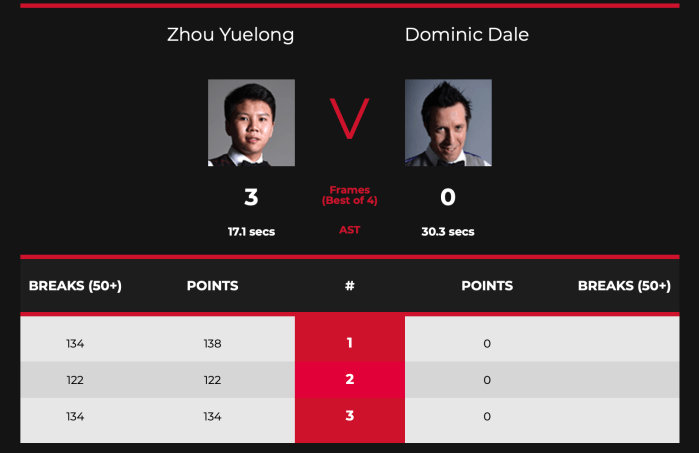
Mark Selby and Zhou Yuelong  booked their place into the Finals day of the tournament.  They both played well. The highlight of the day was this…

CLS 2020 - Zhou three centuries v Dale

Has anyone before won a best of 4 or best of 5 by 3-0, with three centuries, nevermind three break over 120? Snooker anoraks please,  look-up you archives and almanachs.

Here is the report by WST:

Selby And Zhou Go Through

Mark Selby and Zhou Yuelong will join Judd Trump and Zhao Xintong in Group 1 on Finals Day of BetVictor Championship League Snooker after topping their respective Stage Two groups at Stadium MK on Tuesday, live at Matchroom.Live.

Having already beaten both Rory McLeod and Jamie O’Neill 3-0 in Group D, Selby knew a point would be enough against Graeme Dott. The Scottish potter had also defeated O’Neill 3-0, but drew 2-2 with Rory McLeod, meaning he’d have to beat Selby to progress.

Dott opened the deciding match with a break of 84, but Selby levelled with a 128, his fourth century of the day. The Leicester man then took the second frame with a 69 to ensure at least a point, which meant he progressed despite Dott levelling the match at 2-2 in the last.

“I feel like I played well all day,” said Selby. “The first frame against Graeme for me was huge and he made a great break to put me on the back foot. The second frame became even bigger because if he had won it, I’d need to win the last two so to win one of the first two was key for me and I managed to make a good break myself in the second.

“I got a little bit fortunate in the third and managed to win the frame after a fluke; sometimes it goes for you, sometimes it goes against you.

“This format, every group is tough. Playing four frames you can lose to anyone, and on Friday everyone will be a great player.”

Zhou was in equally good break-building form in Group B, beating Matthew Selt 3-0 before making three centuries in defeating Dominic Dale by the same scoreline.

Shaun Murphy had suffered a 3-1 reversal against Dale in the group opener, but a 3-1 win over Selt meant the group was taken to its final match. Murphy, however, would have to beat Zhou 3-0 to prevent the Chinese player from topping the group. The Magician made a 102 in the opening frame, but Zhou hit back with a 114 to ensure he would top the group, before the match eventually ended 2-2.

BetVictor Championship League Snooker Winners’ Week continues on Wednesday with Groups E and F. Group E features Thepchaiya Un-Nooh, Xiao Guodong, Jordan Brown and Ken Doherty. Group F will be Kyren Wilson, David Gilbert, Scott Donaldson and Mark King.

Coverage of both tables will be available at Matchroom.Live, with UK television coverage on Freesports.

Group fixtures, results, standings and details of how to watch can be found at http://www.championshipleaguesnooker.co.uk/.

FINAL GROUP STANDINGS

GROUP B

P

W

D

L

FW

FL

+/-

PTS

Zhou Yuelong

3

2

1

0

8

3

5

7

Shaun Murphy

3

1

1

1

6

6

0

4

Matthew Selt

3

1

0

2

5

7

-2

3

Dominic Dale

3

1

0

2

4

7

-3

3

GROUP D

P

W

D

L

FW

FL

+/-

PTS

Mark Selby

3

2

1

0

8

2

6

7

Graeme Dott

3

1

2

0

7

4

3

5

Jamie O’Neill

3

1

0

2

3

7

-4

3

Rory McLeod

3

0

1

2

3

8

-5

1

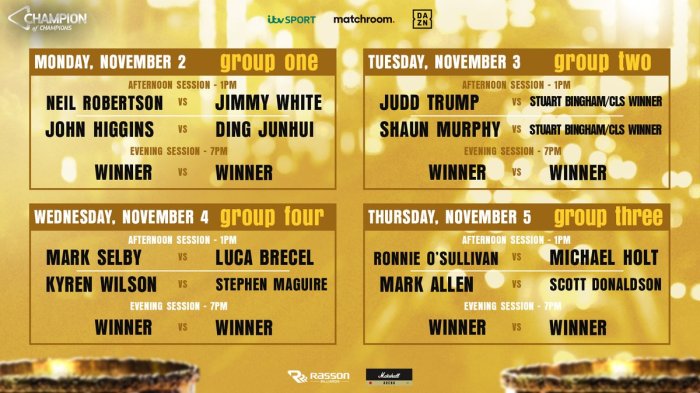
Champion of Champions 2020 Draw

The draw for the Champion of Champions has just been made and here it is:

Champion of Champions 2020 Draw

There are no easy draws in this one of course. Neil Robertson, the defending champion has probably the easiest first match, but, should he win it, will face a serious challenge in the QF, with John Higgins or Ding Junhui waiting.

Ronnie hasn’t a too bad draw, but will need to be sharper than he was in his first two events if he wants to go deep in the tournament. He plays on the last day of the Group stage, hence minimising his stay in the “bubble”.

Here are more details about group 2, as published on the event site

CHAMPION OF CHAMPIONS DRAW MADE WITH ROBERTSON TO FACE WHITE IN TOURNAMENT OPENER

The draw for the 2020 Champion of Champions has been made, with defending champion Neil Robertson set to get the tournament underway against Jimmy White on Monday, November 2, live on ITV4 from Marshall Arena, Milton Keynes.

Monday’s group will also see former Champion of Champions winner John Higgins face UK Championship winner Ding Junhui, while reigning World Champion Ronnie O’Sullivan begins his attempt to win a fourth Champion of Champions title against Michael Holt on Wednesday.

The event begins with a quarter of four-man groups, with one group played each day from Monday until Thursday. The afternoon sessions feature two best-of-seven Group Semi-Finals, before the best-of-11 Group Final in the evening session. The tournament carries a £440,000 prize fund with £150,000 going to the winner.

Players were split into three seeding pools for the draw, based on their current WST World Ranking, with players in Pool One automatically allocated to the group which corresponds with their seeding. Robertson is the defending Champion of Champions and will take his place in Group 1 on Monday as the tournament’s No.1 seed. World No.1 Judd Trump will be in Group 2, with World Champion O’Sullivan in Group 3 and World No.4 Mark Selby in Group 4.

One player from Pool Two (Mark Allen, Kyren Wilson, Shaun Murphy and John Higgins), was drawn at random into each group. The remaining eight players were placed into Pool Three, with two players from that pool drawn into each group.

Judd Trump and Shaun Murphy are the seeded players in Group 2, where they will be joined by Stuart Bingham and the winner of this week’s Championship League Snooker. Group 2 fixtures will be confirmed on Friday night, with the highest ranked non-seed to face Murphy, and the lower ranked player to face Trump. Should the Championship League Snooker yield a repeat winner, David Gilbert will take the remaining place in the Champion of Champions as the highest ranked player not to have qualified already.

Wednesday’s action sees Mark Selby face Luca Brecel before Kyren Wilson plays Stephen Maguire in Group 4.

Group action concludes on Thursday with three-time Champion of Champions Ronnie O’Sullivan facing Michael Holt and Mark Allen against Scott Donaldson.

CHAMPION OF CHAMPIONS DRAW & SCHEDULE

MONDAY, NOVEMBER 2 | GROUP 1
1pm | Group Semi-finals (best of 7)
Neil Robertson v Jimmy White
John Higgins v Ding Junhui

7pm | Group Final (best of 11)
Winner v Winner


TUESDAY, NOVEMBER 3 | GROUP 2
1pm | Group Semi-finals (best of 7)
Judd Trump v Stuart Bingham/CLS Winner
Shaun Murphy v Stuart Bingham/CLS Winner

7pm | Group Final (best of 11)
Winner v Winner


WEDNESDAY, NOVEMBER 4 | GROUP 4
1pm | Group Semi-finals (best of 7)
Mark Selby v Luca Brecel
Kyren Wilson v Stephen Maguire

7pm | Semi-Finals (best of 11)
Winner v Winner


THURSDAY, NOVEMBER 5 | GROUP 3
1pm | Group Semi-finals (best of 7)

Ronnie O’Sullivan v Michael Holt
Mark Allen v Scott Donaldson

7pm | Semi-Finals (best of 11)
Winner v Winner


FRIDAY, NOVEMBER 6
7pm | Semi-Final 1 (best of 11)
Group 1 Winner v Group 4 Winner


SATURDAY, NOVEMBER 8
7pm | Semi-Final 1 (best of 11)
Group 2 Winner v Group 3 Winner


SUNDAY, NOVEMBER 9
The Final (Best of 19)

Championship League Snooker 2020 (2) – Groups A anc C

Judd Trump and Zhao Xintong emerged the winners of their respective groups yesterday. Judd was pushed hard by Barry Hawkins. Zhao played well all day, his task maybe made a bit easier by a terrible performance by Stuart Bingham who finished last of the group with two defeats and a draw.

Here is the report by WST:

Trump and Zhao Reach Finals Day

Judd Trump and Zhao Xintong are the first players through to Finals Day of BetVictor Championship League Snooker after topping their respective Stage Two groups at the start of Winners’ Week at Stadium MK on Monday, live on Matchroom.Live.

The 32 players who won Stage One groups return to the baize this week for Stage Two, which features eight groups of four players from Monday to Thursday, with each group winner advancing to Stage Three on Friday. Two more groups of four will then produce the two BetVictor Championship League Snooker finalists, who face off in a best-of-five final on Friday evening.

Trump went into his final Group A match against Barry Hawkins knowing only a win would see him advance, while ‘The Hawk’ could progress with a draw. However, Trump gave his opponent few opportunities and took just 36 minutes to complete a 3-0 win which included breaks of 124 and 110.

Hawkins fought back in the third frame but a visit of 62 wasn’t enough to stop the World No.1, who came back to the table to clear after Hawkins had missed frame ball.

“The first two frames against Barry were really, really good,” said Trump. “I had a couple of chances in the last frame, was a bit unlucky when I went into the pack and played a bit of a crazy shot. But I got away with it in the end when Barry missed a ball he probably should have got and I made a nice little clearance.

“It is nice to be through to Finals Day and try and qualify for the Champion of Champions as many times as possible!”

On table two, Zhao beat Stuart Bingham 3-1 to top Group C with seven points having already beaten Luo Honghao 3-1 and drawn with Alexander Ursenbacher. Had Zhao failed to win, a whole host of permutations would have opened up with one game to play, but his victory meant he could not be caught at the top of the table. Zhao will now join Trump in Group 1 of Finals Day.

BetVictor Championship League Snooker Winners’ Week continues on Tuesday with Groups B and D, the winners of which will join Trump and Zhao in Group One on Friday. Group B features Shaun Murphy, Dominic Dale, Zhou Yuelong and Matthew Selt. Group D is Mark Selby, Rory McLeod, Graeme Dott and Jamie O’Neill.

Coverage of both tables will be available at Matchroom.Live, with UK television coverage on Freesports.

Live scoring can be found at www.wst.tv. Group fixtures, results, standings and details of how to watch can be found at http://www.championshipleaguesnooker.co.uk/.

Follow BetVictor Championship League Snooker on Facebook, Twitter and Instagram for all the latest news and scores from Stadium MK.

FINAL GROUP STANDINGS

GROUP A

P W D L FW FL +/- PTS
Judd Trump 3 2 1 0 8 3 5 7
Barry Hawkins 3 2 0 1 6 3 3 6
Ryan Day 3 1 1 1 5 6 -1 4
Robert Milkins 3 0 0 3 2 9 -7 0

GROUP C

P W D L FW FL +/- PTS
Zhao Xintong 3 2 1 0 8 3 5 7
Luo Honghao 3 1 1 1 6 6 0 4
A. Ursenbacher 3 0 3 0 6 6 0 3
Stuart Bingham 3 0 1 2 3 8 -5 1

I watched mainly Group C. Luo Honghao and Alexander Ursenbacher both showed excellent fighting qualities, but made some unexpected mistakes. Alex finished the day undefeated, but still only third in the group.

Championship League Snooker 2020 (2) – Winners Week starts today

So this starts today …

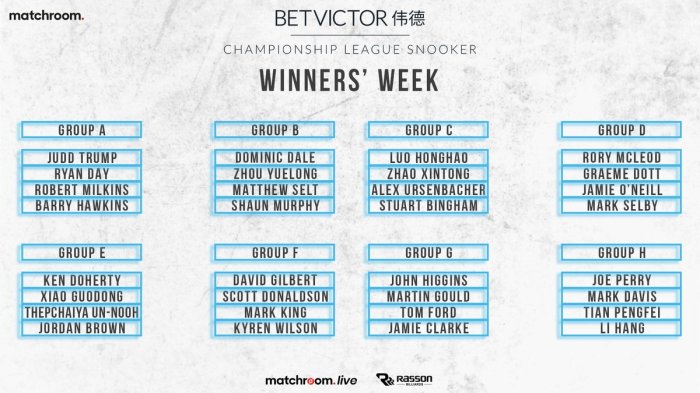
CLS2020WinnersWeek

Not exactly winners predictions but here goes…

Group A: expect Judd Trump, wish Barry Hawkins
Group B: expect Shaun Murphy, wish Zhou Yuelong or Shaun Murphy
Group C: expect Stuart Bingham, wish Alex Ursenbacher or Luo Honghao
Group D: expect Mark Selby, wish Graeme Dott or Mark Selby
Group E: expect Theppy, wish Theppy
Group F: expect Kyren Wilson, wish Scot Donaldson or Kyren Wilson
Droup G: expect John Higgins, wish Jamie Clarke or Martin Gould
Group H: expect Joe Perry, wish Mark Davis

Matt Huart’s view on the dominating players over the last three decades

Matt Huart looks at the class of 92, and how the likes of Mark Selby and Neil Robertson compare to them:

A Class Apart?

With each passing year, the legend of snooker’s ‘Class of ’92’ – Ronnie O’Sullivan, John Higgins and Mark Williams – grows ever larger as the legendary trio continue to compete at the very highest level of our sport.

But what of another notable duo who have also gone on to enjoy sustained success over a 15-year period? Below we consider the achievements of Mark Selby and Neil Robertson and ask whether they are underestimated when ranking snooker’s all-time greats.

With the dominance of Steve Davis still fresh in the memory and a new star in the form of Stephen Hendry in the midst of his golden era, the early 1990s would usher in a new generation of players, many of whom continue to compete to a high standard some 30 years on.

Of those, Ronnie O’Sullivan, John Higgins and Mark Williams in particular have made an indelible mark upon our sport, sharing a combined 89 ranking event titles between them, including 13 of the last 23 World Championship crowns won. The trio have long since earned their places in snooker’s hall of fame and remain firmly ranked within the world’s top 16.
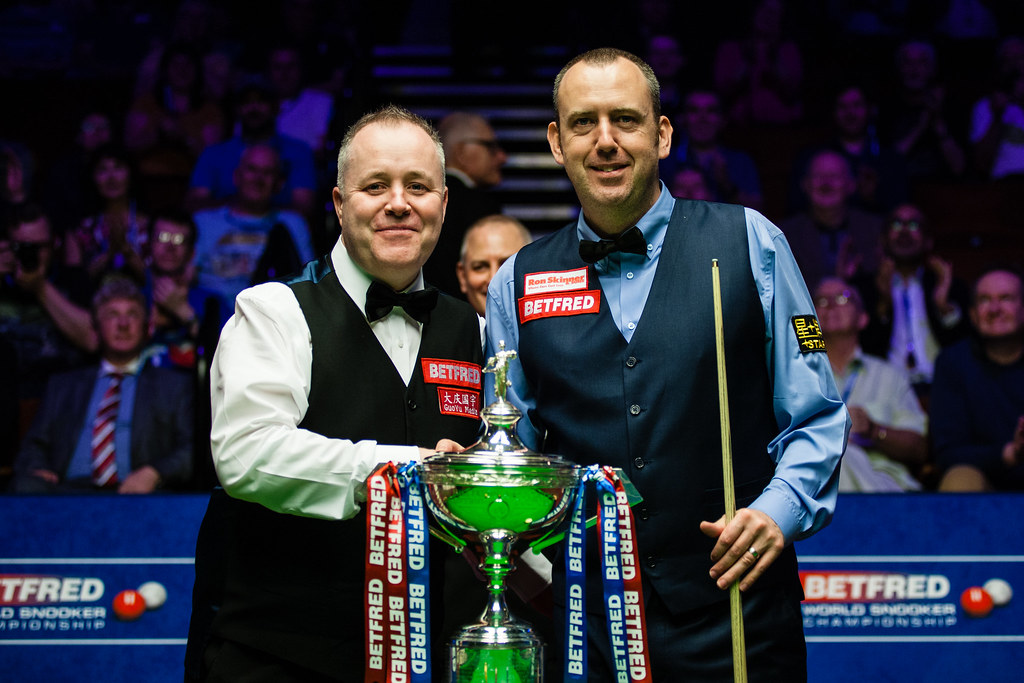
But while the Class of ’92 are perhaps snooker’s most famous trio, they will also be associated with some of the players that turned professional at a similar time.

In 1994 the circuit welcomed future world champion Graeme Dott and two-time runner-up Matthew Stevens, with Stuart Bingham and Paul Hunter following a year later. A further four current professionals turned professional in 1996, with Barry Hawkins and Ali Carter both going on to reach World Championship finals.

The Next Generation

It is perhaps the intake from 1998-1999 which marked the start of the next generation however, with six ranking event winners, including three world champions having first turned professional during these years.

Marco Fu, Ryan Day and Stephen Maguire have each won multiple ranking events, while Shaun Murphy has gone further still by winning nine ranking event titles to date, including each of snooker’s fabled Triple Crown Series tournaments during his career.
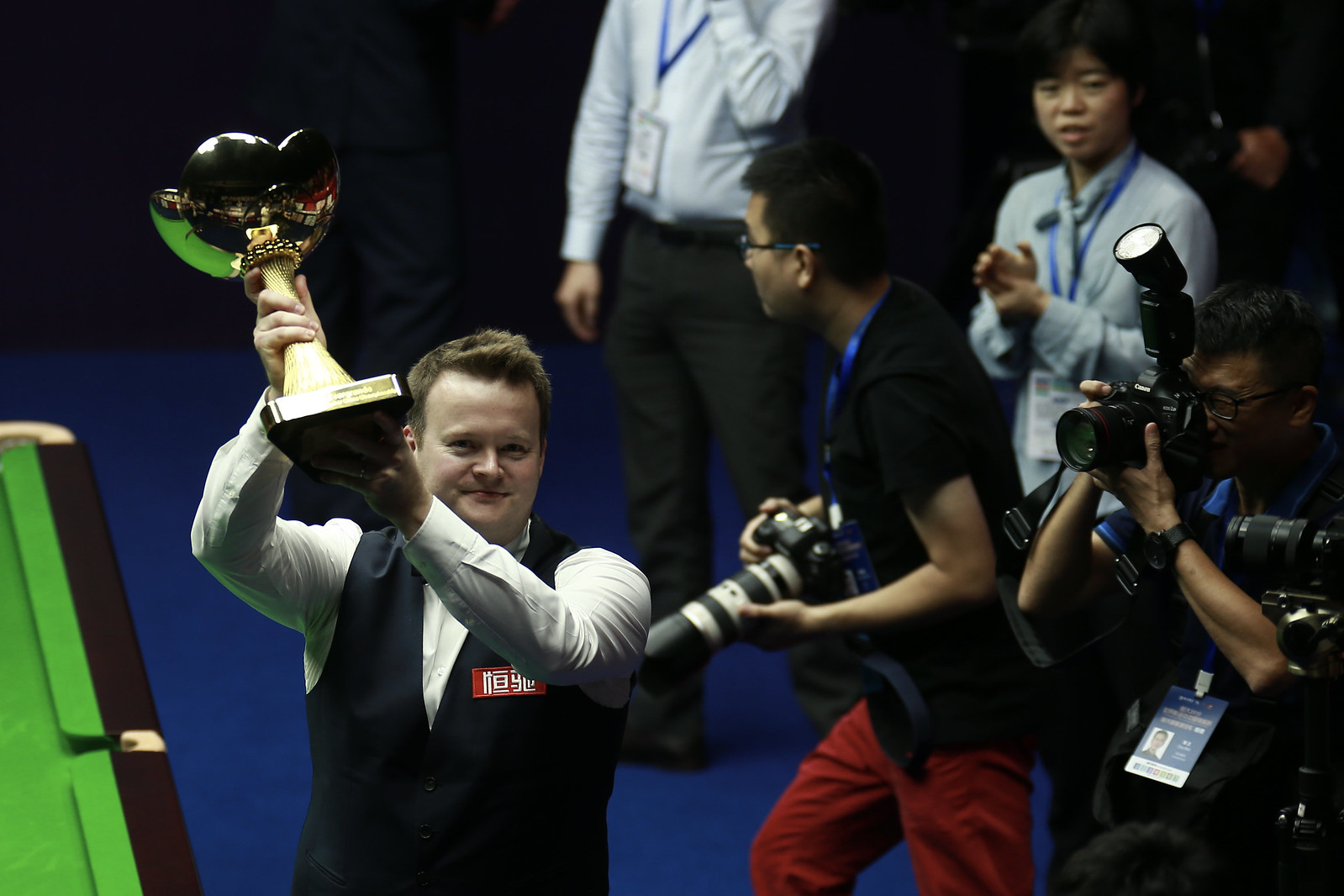
But – in terms of volume of ranking events won at least – there are two players who stand out with both Mark Selby and Neil Robertson having each gone on to enjoy highly successful careers in the sport. To date, the pair have each earned 18 ranking crowns and gone on to become world number one, two of the many parallels in their respective careers.

Neither had an easy journey to the top. In Robertson’s case he had the oft under-appreciated challenge of moving halfway around the world to compete in what was at the time a UK dominated sport. Twice he was relegated from the main tour, before in 2003 regaining his place and ultimately staying there ever since.

For Selby, the Leicester man had to contend with the death of his father just two months before he turned professional at the age of 16 in 1999. Already his mother had walked out on him eight years prior.
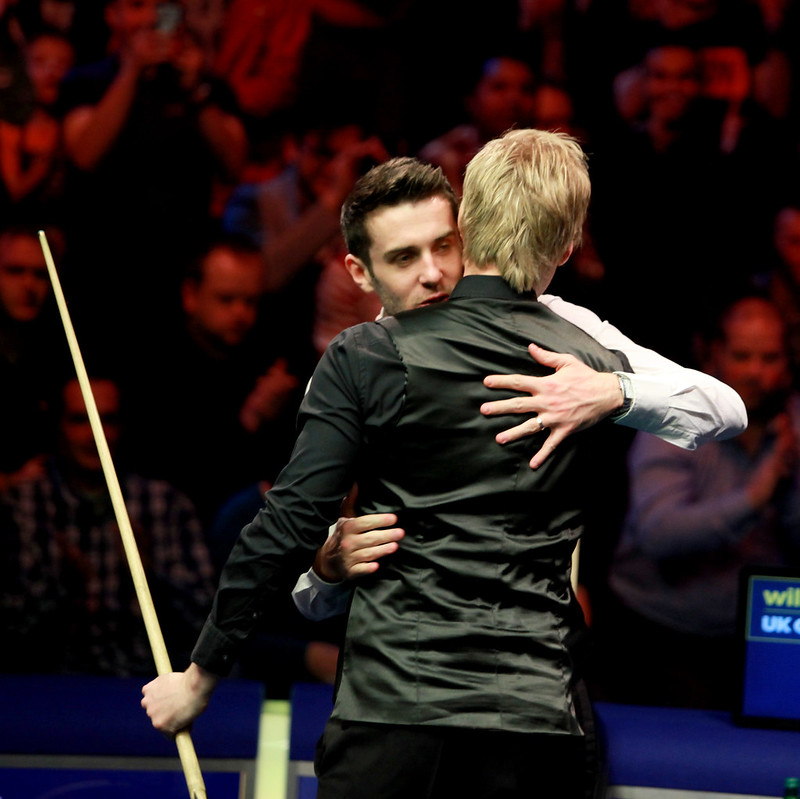
It was in 2003 however that both made a breakthrough on the World Snooker Tour, Robertson by qualifying for the Masters for the first time by winning the qualifying event, while Selby reached his first ranking final at the Scottish Open. Two years later the pair both made their Crucible debuts by qualifying for the final stages of the World Championship for the first time.

Robertson would be the first to claim a major ranking event title with his capture of the 2006 Grand Prix, with Selby reaching his first world final later in the season and going on to claim his first silverware in 2008 with the Masters and Welsh Open titles.

Since then the pair have gone on to thrive in one of snooker’s most competitive eras, both ascending to the top of snooker’s world rankings and going on to life multiple triple crown titles. They share a close head to head record, Selby ahead overall (19-15), with Robertson edging their ranking encounters (7-6).

  • 36 ranking event titles (57 finals)
  • 12 triple crown titles (18 finals)
  • 2 Champion of Champions titles
  • 11 Minor ranking event titles

Without any doubt the pair have been among the most important players of the past decade and continue to remain a force at the highest level, Selby having already claimed silverware this season and Robertson having narrowly missed out at the English Open.

But how do their figures stack up against the big three?

The Impossible Comparison

For followers of any sport the quest to rank its greats is impossible to ignore. Whether Messi or Ronaldo, Federer or Nadal, Hamilton or Schumacher – or in the case of snooker Hendry or O’Sullivan, opinions will inevitably remain divided.

This is especially so when comparing players of different eras and though Selby and Robertson have shared their careers with the Class of ’92, the circumstances when they turned professional were already significantly different.

But we are not looking to say that they were better or worse, but to try and uncover whether their own achievements are comparable and what conclusions can be drawn.
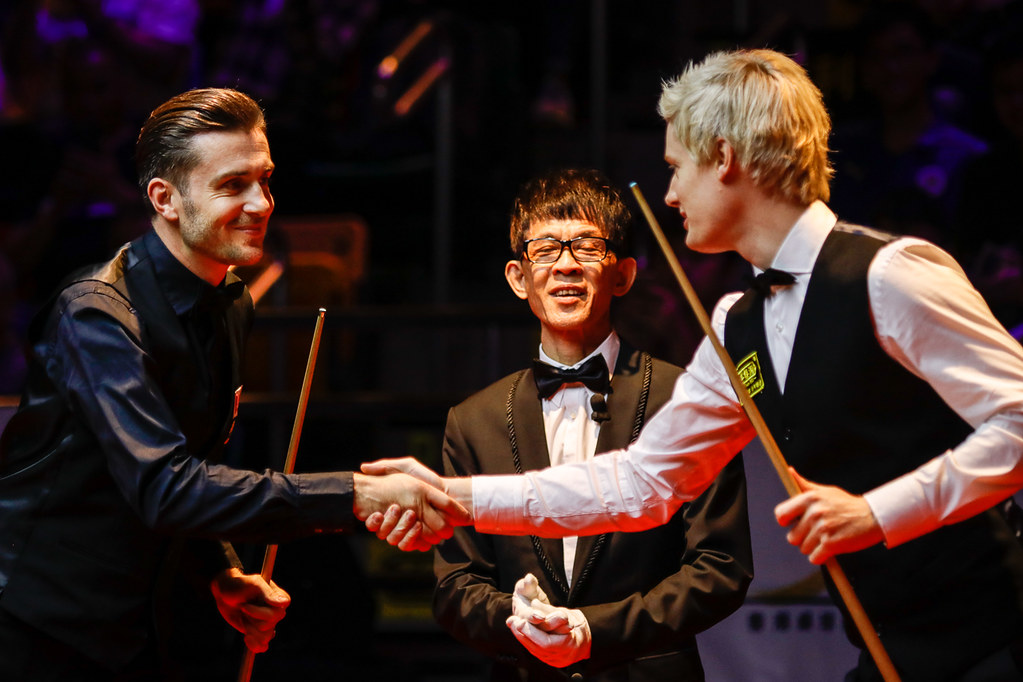
2006-2020

From the start of the 2006/7 season, in other words the winning span since Robertson’s first ranking title to Selby’s recent victory at the European Masters in August, we can see that the pair match up well with the Class of ’92.

During that most recent period the pair have won 36 ranking titles between them, just two short of the 38 claimed by Ronnie O’Sullivan (19), John Higgins (13) and Mark Williams (6).

With 13 triple crown titles won alone by O’Sullivan, added to four by Higgins and one for Williams, the Class of ’92 hold an 18-12 lead at the sport’s majors, while Selby and Robertson lead 11-8 on minor ranking event titles – i.e. Players Tour Championship and European Tour competitions.
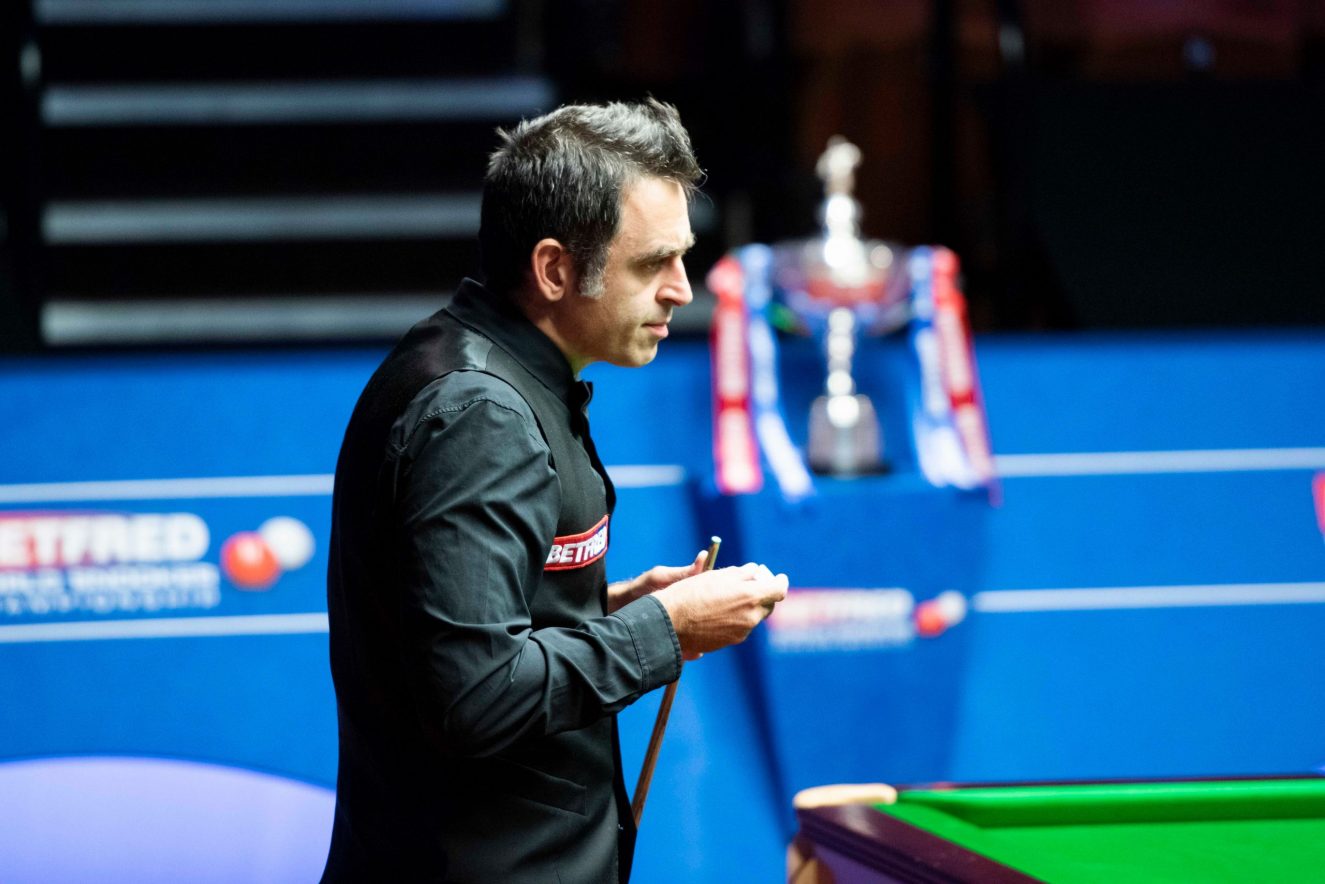
The Early Years

But of course, the above comparison is not like for like, comparing arguably the peak years of Selby and Robertson, to the later years of O’Sullivan, Higgins and Williams.

From turning professional in 1992, the big three secured a staggering 52 ranking titles during their first 15 years, with an even division among the trio of O’Sullivan (18), Higgins (18) and Williams (16). By comparison Selby and Robertson had won just eight between 1998-2012, six by Robertson before Selby truly hit his stride after his maiden World Championship success in 2014.

As with the previous comparison, the picture is not as clear as it would first appear as the snooker landscape has changed significantly since the early 1990s – not least because of the impact of the Class of ’92 themselves and the differences in general standard and number of tournaments available.
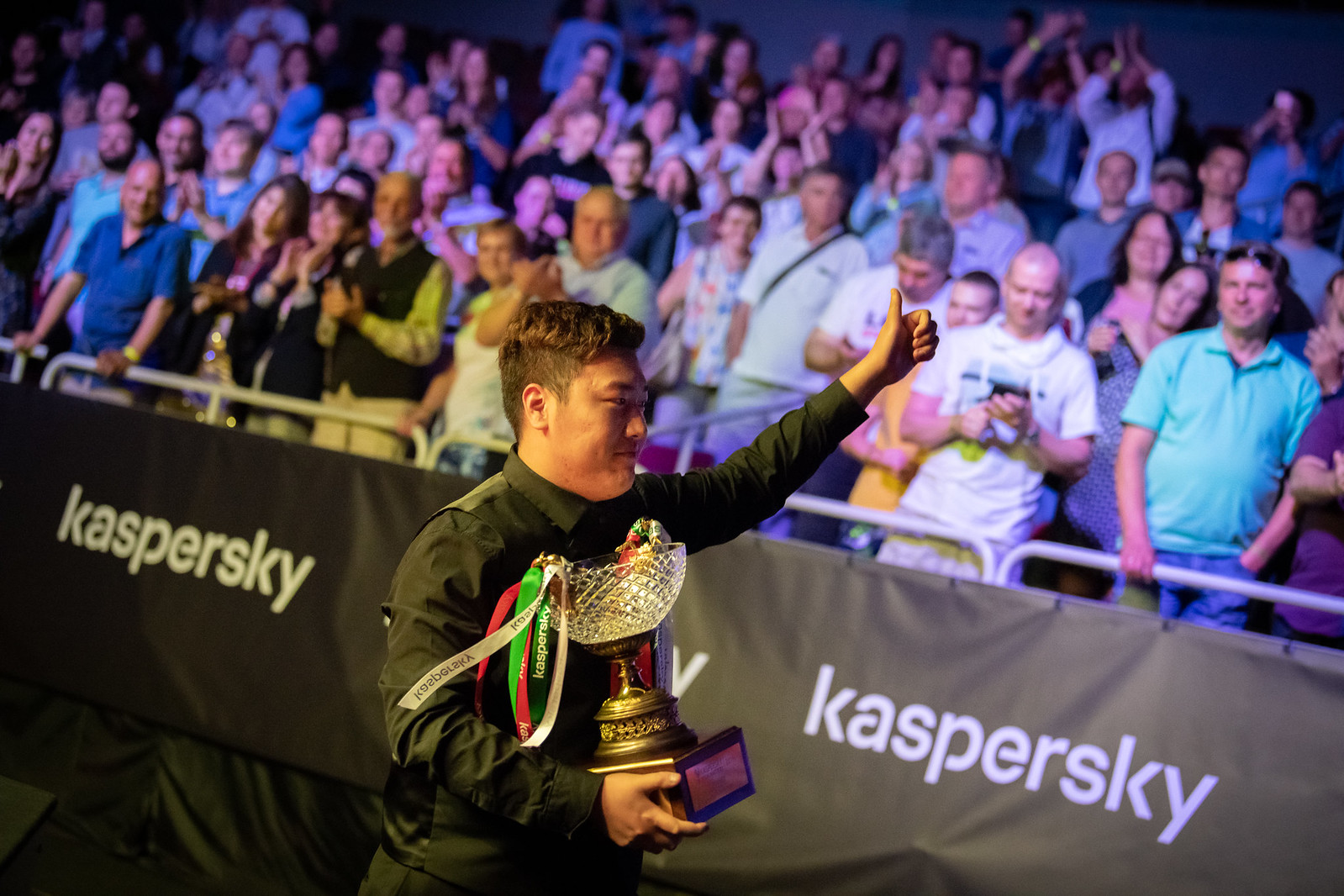
While it was once not uncommon to see teenagers or players in their early 20s lifting major silverware, it is now far more uncommon than in the past with Yan Bingtao’s win at the 2019 Riga Masters representing the first teenage win since Ding Junhui’s success at the 2006 Northern Ireland Trophy.

When Steve Davis claimed his six and final world title at the age of 31, or Stephen Hendry his magnificent seventh barely four months on from his 30thbirthday, few would have expected the success of the ‘older’ players that we have seen in the years since as the ‘peak’ of a player continues to be redefined.

It was not until turning 29 that Judd Trump would capture snooker’s holy grail for the first time in 2019 and he is a player now widely expected to be a leading contender for top honours for many years to come.
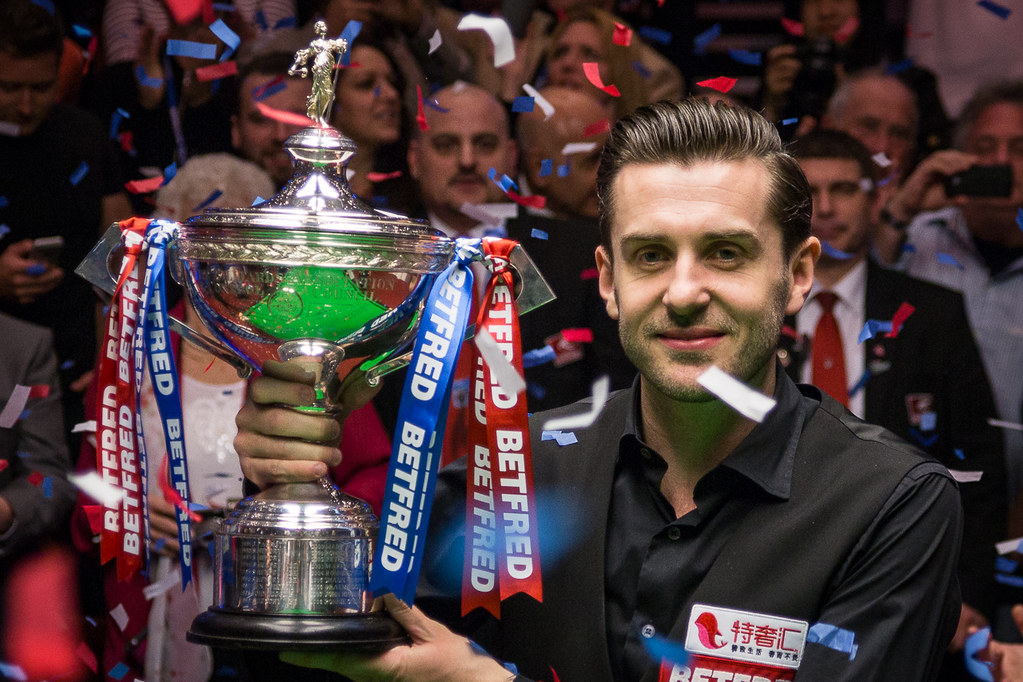
The Compromise

Perhaps then the most interesting comparison is of the winning span of Selby and Robertson since 2006, to the comparable period for the big three from O’Sullivan’s famous victory at the 1993 UK Championship.

On this basis the 36 titles secured by Selby and Robertson compares favourably to the 52 won by snooker’s holy trinity, while their 12 triple crown titles is on average only slightly edged by the 20 claimed by O’Sullivan, Higgins and Williams.

By 2002 the Class of ’92 had each enjoyed a spell at number one, at a time when the rankings were updated once a year, while Selby and Robertson achieved that feat in 2011 and 2010 respectively.
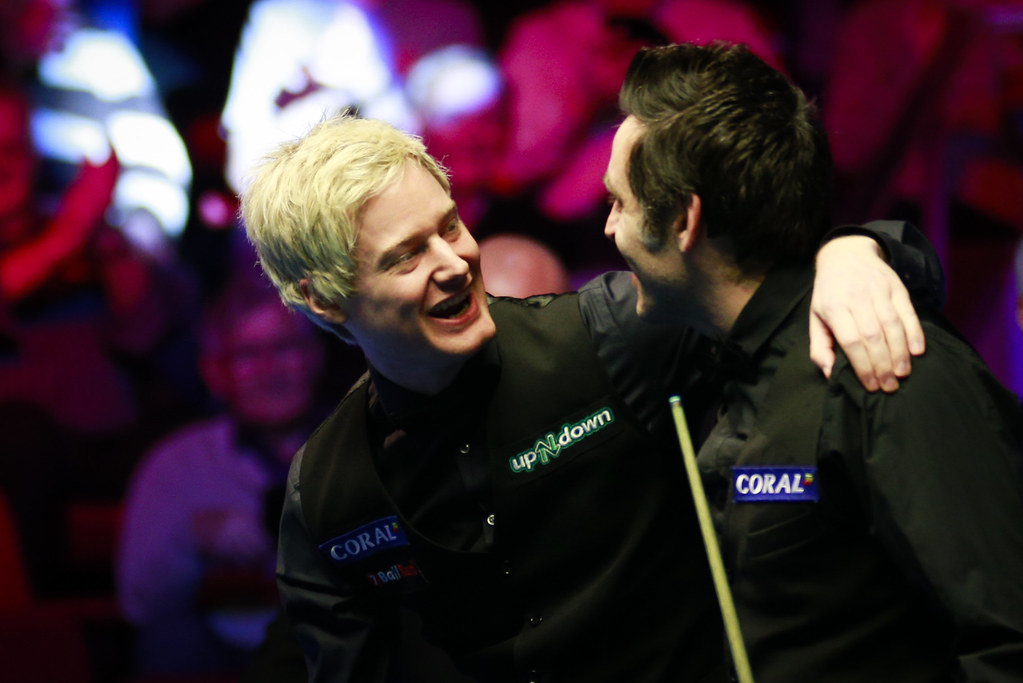
Do They Compare?

Ultimately any such comparison is never equal and of course the legacy of any player will extend beyond mere statistics with the opposition each faced, the respective head to head records and style of play coming into the consideration.

However while the records of the legendary Class of ’92 will endure long after they are gone, it is also fair to say that the achievements of both Mark Selby and Neil Robertson during the current era should also not be taken for granted, nor underestimated.

With all five players still ranked firmly inside of the world’s top 16 in 2020, time will tell as to how their respective achievements will be viewed in the future and what the legacy will be of not only the Class of ’92, but the leading graduates from the class that followed…

Article by Matt Huart (@ProSnookerBlog).

It’s an interesting article, and very cautiously written, but one that I’m afraid is “flawed” in a way. Why? Because the class of 92 is always looked at as a kind of  indivisible entitity, however, the three of them have quite dissimilar records:

  • Ronnie has won 37 ranking events, 6 World titles, 7 UK titles. He’s also won 7 Masters.
  • John Higgins has won 30 ranking titles, 4 World titles, 3 UK titles. He’s won the Masters 2 times.
  • Mark Williams has won 22 ranking titles, 3 World titles, 2 UK titles. He’s won the Masters 2 times.

It’s obvious that Ronnie’s “weigth” in these statitistics is an important factor, especially when it comes to “majors”, whilst Mark Williams has a comparatively weaker record.

Looking at the Selby-Robertson tandem

  • Mark Selby has won 18 ranking titles, 3 World titles, 2 UK titles. He’s won the Masters 3 times.
  • Neil Robertson has also won 18 ranking titles,  1 World title, 2 UK titles. He’s won the Masters just once.

Their records are more similar although Mark Selby has performed better in majors. In fact, Mark Selby has almost won as much as Mark Williams despite being 8 years younger and he has actually won more majors.

If the comparison was made between two “tandems” – Ronnie & John Higgins vs Mark Selby and Neil Robertson – the balance would still clearly be in favour of the “92” one.

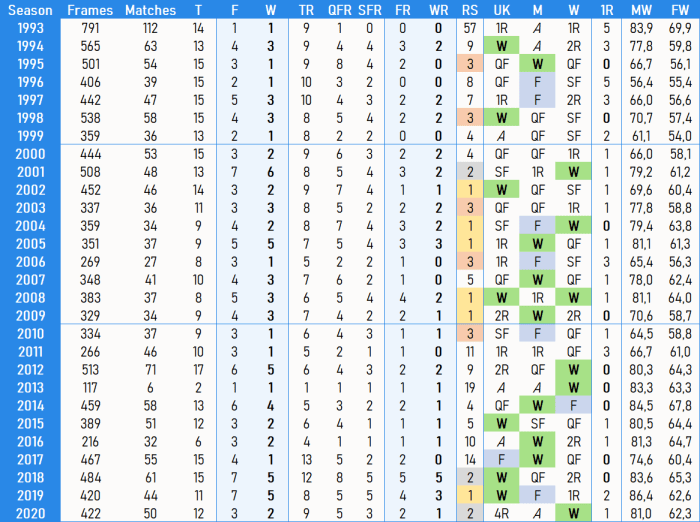
Yesterday, this stat was shared on twitter:

Ronnie'CareerStats

It’s Ronnie’s career stats.

It reads like this:

T- tournaments played
TR- ranking tournaments played
QFR,SFR,FR,WR- ranking tournaments results results
RS- raning. in the end of season
1R- number of losses in 1st round of ranking tournaments
MW- matches won(%)
FW- frames won(%)
A- didn’t participate

Actually from the start of his career, Ronnie has won at least one professional event every season, and has won at least one of the “triple crown” events in 18 seasons out of the last 27, that’s 2 out of 3.

No other player has comparable stats over the span of nearly three decades. He, REALLY, is in a class apart.
News from China …

Mei Xiwen and Zhang Anda chose to stay in China, and skip the World Championship. For the latter it meant that he was relegated from the tour.

WST went to speak to them:

Mei And Zhang Ponder Future

Chinese players Mei Xiwen and Zhang Anda have both put their snooker careers on hold while they take time at home.

Mei is ranked 63rd in the world but has not played a competitive match since the Gibraltar Open seven months ago and is yet to enter a tournament this season.

The 38-year-old returned to his home in Shenzhen when the coronavirus pandemic took hold in March, and has decided to stay there for family reasons. He became a father for the first time in February, and he also helps run a snooker club in his home town.

Mei and Zhang both recently played an exhibition event at a shopping mall in Lanzhou, giving tips to young players

“I made good use of the lockdown period and spent some quality time with my family,” said Mei, who beat Ronnie O’Sullivan on his way to the quarter-finals of the English Open last year. “I spend most of my days with the baby and practise in the evenings. I like this type of life, and it helps both my family and my work.

“My job in the snooker club is mainly teaching and helping snooker lovers improve their games. I’m so happy that I’m able to help Shenzhen to develop the game of snooker as a professional player. I see some young kids at the club and they practise with me now. They have the hunger to play in competitive matches. I have reliable facilities to practise now to get prepared for the upcoming events.”

Mei intends to resume his pro career but is yet to decide when to return to the UK. “It took me four years to get to world number 55,” he added, “It feels so complicated, as I want to play in tournaments so much. I need to do that for my ranking, and also to stay match sharp.”

Zhang Anda

Zhang first turned pro in 2009 and has played at the Crucible three times. He opted not to travel to the UK to play in the Betfred World Championship qualifiers last season and was relegated from the tour. Just like Mei, he has recently become a father.

“I wanted to stay in China and recharge. I’m only 28, so I have time, I can take a year out and return to snooker in the future,” said Zhang. “My newborn son and my family need me. I always feel homesick when I’m away.

“I’m trying to make a living, not for myself but for the three of us, so I’m making the most of everything at the moment. Snooker is my job, at the moment, but it doesn’t necessarily have to be lifelong. It’s good to be living your dream.”

Zhang does intend to play in Q School in 2021 and revive his career. “I believe I can get through it, I know I have the ability,” he added. “But to be ranked 60 to 70 after spending a decade on tour, that’s not what I want. Making it through Q School is much easier than staying on tour and I don’t think I’m capable of doing the latter yet.

“I need a gap year to figure out my future plans, and I have to make some changes if I’m going to dedicate myself as a professional player. I tried a few changes in the past but I’m not the kind of person who gets used to new things quickly. There are a lot of tournaments every season and I always find myself going into one tournament without accepting the loss from the previous one.

“It will not be a bad decision, taking a year out. Maybe the only down side is not staying competitive, because I can’t stay match sharp without playing in tournaments.”

Mei has always devoted a lot of time to the younger players. He’s well respected for what he does to help them. Zhang turned pro in 2009, reached the Crucible at his first attempt and very nearly beat Stephen Hendry in the first round; the match went to a decider. It’s a bit surprising that he hasn’t done better after that. There is probably a good clue in there with him saying that he finds it hard to get over defeats and start new tournament with a “fresh mindset”. It’s also interesting that he thinks that it’s easier to get through the Q-school than to stay on the tour. I must say that the poor results of a number of “returning” players over the years tend to vindicate that opinion.

Good luck to them both, whatever they decide to do in the future.


Steve Feeney about Stephen Hendry

Steve Feeney spoke to WST about his work with Stephen Hendry 

Hendry Has Point To Prove – Feeney

Snooker coach Stephen Feeney, who has been working alongside Stephen Hendry ahead of his return to the professional scene, believes the seven-time World Champion will have doubters to prove wrong when he takes to the baize.

King of the Crucible Hendry was afforded the opportunity to return to the World Snooker Tour last month, taking up the offer of a two-year invitational tourcard. However, the Scot is yet to make his first appearance of the season. Hendry’s last professional appearance came at the 2012 World Championship, after which he announced he was retiring.

SightRight coach Feeney has been working with 51-year-old Hendry for a number of months and has been instrumental in his decision to return to the circuit.

We’ve caught up with Feeney to find out how Hendry’s preparations are going on the practice table…

First of all Steve, how has the work you’ve been doing with Stephen been going so far?

“In terms of play, the sessions that we are having are regular. He is going through the same process as Ronnie O’Sullivan and Mark Williams. We have a fixed plan. The planning for what we need to do is robust. The one main objective is for him to enjoy it. Every session we have, there is disciplined stuff and there is fun stuff.

“He still knows the shots to play. He still knows the game inside out. So he still has all of that knowledge. All that had happened is that the skill had deteriorated. His long game in practice has been phenomenal. I know when I can put somebody’s long game back together, it can translate into the rest of the game as well.”

What do you feel are achievable objectives for Stephen this season?

“Can we do what Peter Wright did in darts and win the world title at the age of 50? Stephen wouldn’t talk that way. He just loves playing the game. He is deeply competitive though. As the work goes forward, I would hope he would believe that even if it is a small one, there is a chance. The first thing is to help him really continue enjoying the game. Such is the spirit and competitiveness of this guy that winning will help him enjoy it more. For him to compete at the top level would be the icing on the cake. If he feels he can compete at the top level, he will probably feel he can win at the top level.”

How much work do you feel needs to be done for Stephen to reach his best level?

“There is work to be done, you almost look at it like a boxing match. How many hours does a person need to train to be able to put up with three minute rounds of boxing? Snooker is a worldwide competitive sport now. We know that there are some strong competitors ahead. We know he will not play until he is ready to go in at the top level. We know he is not going to want to lose and only wants to win. There is a part of it which is making me want to up my game even more than with Mark and with Ronnie. We are having great fun. I love seeing him pump the chest out when things are going right.

“I think for my part we are having conversations that matter. Conversations that respect the huge legacy that he has. To continue it in any way shape or form is about winning. In the process if he could win big, that would be pretty special. Just to see him happy in the game we are already winning. He is playing some shots that he has said he couldn’t play before. I think we are adding to the mix that this guy knows how to win. The other guys at the top of the game know he knows how to win. If we can do our stuff right and he can carry the same composure out there into matches, people will have a problem on their hands and won’t want to be drawing him in the first round at tournaments. I’ve seen the best at work, close up, and this guy is special.”

Hendry after winning his seventh world title in 1999.

How motivated are you to help Stephen to achieve and be a success on his return?

“I look at it as a fairly exciting opportunity ahead. There is a fair bit of responsibility, in terms of delivering on promises. Stephen has trusted me in terms of what I’ve said I believe can be done. I trust in him as the individual and champion that he is. Is there stuff to prove? There probably is. The fans will love to see him play. Many of the pros will be waiting for proof. We are well aware of that.

“There are some top players who will believe Stephen can never win another ranking title again. When people say to me things can’t be done I tend to think, lets have a go. Can he? There is incredible skill there. He is a seven-time World Champion and we will see how the journey evolves.”

When do you anticipate Stephen entering his first event?

“I’d be prepared to wait as long as we need to. As long as the conditions are right. If the conditions are right in terms of the venue and the opportunity, as soon as he is ready, we go. My view with Stephen is that we want to get him back into top 16 status with the standard of his play as soon as possible. That is the only way that we can be comfortable. Every practice session is geared and targeted that way and we are working hard.

“If he was to win another title, or at least if he was to be in the mix at the Crucible. Wouldn’t that be a special thing for the sport? If Stephen making the Crucible again in his career, in his 50s, isn’t special enough for the sport, I don’t know what is. If he was to come out and be the player that everybody remembers him for, or even better, wouldn’t that be good.”

Can Stephen Hendry really get back to top 16 level? I’m not sure.

When Hendry came on the scene as a young lad, he started a revolution. No  pro player at the very start of the 90th had an answer to his ultra attacking game, to his exceptional ability to slot long ones from the baulk cushion, hold for blue or black, and clear the table in one visit. But of course, the younger aspiring players learned  from him and copied his game. Answers were found. Ken Doherty beating Stephen Hendry by 18-12 in the 1997 World Final, with a high break of just 85, whilst Hendry had five centuries was a huge moment although it may not have felt that way there and then. Before that match, Hendry had reached 37 ranking finals, won 28, lost 9. From there he still reached 20 ranking finals, won 8, lost 12. He only won one “major” after that defeat, the 1999 World Championship, he had won 17 of them previously. Hendry was only 28 when Ken beat him, there is no way he was “past it”. What happened? Well, in my oponion, two things: a number of younger players came on the scene when the game was opened, became able to “copy” Stephen’s game and play it at a high level whilst they also developped the safety side of their game, something Hendry was reluctant to do AND Hendry’s confidence – which played a huge part in his ability to be a serial winner – was seriously damaged. Countless times in the noughties, I have seen him start a match strongly, miss just the one shot, and spiralling down from there. And he hated it. It was all about winning and he wasn’t winning.

Can he accept that he will make mistakes, that he will be beaten and still be able to enjoy his snooker? If the answer is yes, it could be very interesting, if not, I can’t see him playing competitively much at all.