Honouring Ray Reardon

Six times World Champion and Welsh legend Ray Reardon was at the Welsh Open 2017 to present the Ray Reardon Trophy, and Worldsnooker took the opportunity to honour his career and contribution to the sport by publishing this great article.

Ray of course was Ronnie’s mentor in 2004 when he won his second World title and it’s a time that left both Ray and Ronnie with fond memories as you will read hereafter …

Sunday 19 Feb 2017 07:51PM

A look at the career of a snooker legend, who is being celebrated at the Coral Welsh Open by having the trophy named after him, which he will present to the winner…

The charismatic Welshman, Ray Reardon, was one of the driving forces behind snooker’s rise in popularity during the 1970s. In a sport which has been hallmarked by great champions – from Joe Davis in the pre-war years to more recently Ronnie O’Sullivan – Reardon was the first player of the modern era to take a stranglehold on the game.

His route to snookering stardom was certainly humbler than today’s superstars. Having grown up in the coal mining community of Tredegar, he left school at the age of 14 to follow in the footsteps of his father and work in the mines. During his time as a coalminer, the Welshman spent every spare moment he had in the local Workman’s Institute honing his snooker skills.

Eventually Reardon moved his family to Stoke on Trent, where he became a policeman. Despite being one of the most prolific amateur snooker players on the planet, it wasn’t until the age of 35 that he turned professional. It was around that moment that the profile of the game took a dramatic upturn.

In 1969, the then controller of BBC Two, David Attenborough was searching for a new programme to showcase the advent of colour television. The one-frame Pot Black programme was commissioned and was an instant success. Overnight snooker had become household television around the country and it was Reardon leading the baize-based bandwagon.

Reardon said: “I was fortunate enough to win the very first Pot Black. It was a funny experience because it was filmed in November time of 1968 and wasn’t shown on television until May of 1969. I had to keep it quiet that I’d won, you weren’t allowed to disclose it. When the programme came out, it was great publicity for me because I won my first world title not long after, a double whammy.

“Everyone who took part in it was gambling really, because it was the main snooker on television. Your reputation was determined by a one frame match. You could do yourself more harm than good entering it. The guys who lost often struggled to get exhibition work. I was lucky because it was a great thing for me winning the first one.”

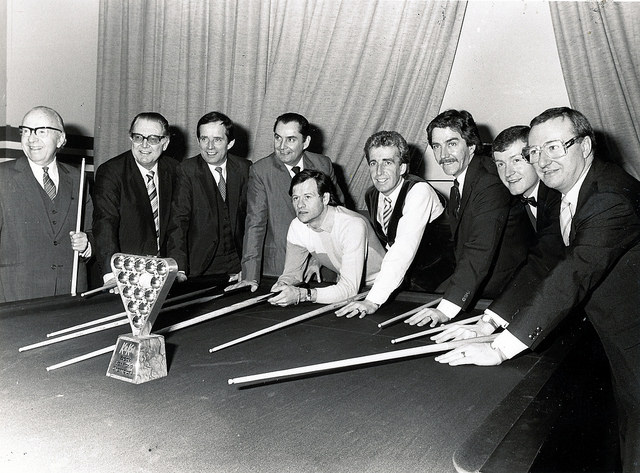
reardon-griffiths-1024x768Reardon with fellow Welsh legend Terry Griffiths

Reardon’s maiden world title, which came a year later, was over a considerably longer distance. He faced the seven-time World Champion John Pulman, in a marathon best of 73 encounter, at the Victoria Hall in London. Reardon emerged from the clash as a 37-33 victor.

“It was a very different sort of game because it was a week’s worth of play,” said Reardon. “It was very enjoyable, I didn’t get tired during it. I often hear people nowadays saying they are tired. I’ve never seen a tired winner. I’ve seen a tired loser, but certainly not a winner.”

The Welshman would go on to win a further five world titles, including a 25-18 win over South Africa’s Perrie Mans at the Crucible Theatre in 1978. His last appearance in the world final came in 1982 and was a memorable meeting with the enigmatic Alex Higgins, which he lost 18-15.

ray-reardon-3

From that point on, Reardon began to struggle with his game due to his eyesight deteriorating. His final match came at the 1991 World Championship, where he called time on his storied career following a 10-5 defeat to Jason Prince. The next world title he was involved with wasn’t his own, but that of a player he was mentoring: Ronnie O’Sullivan. Reardon mentored the Rocket in the lead up to the 2004 World Championship. With Reardon’s help, O’Sullivan clinched the second of his five world titles. The six-time World Champion felt that he could add another string to O’Sullivan’s bow.

“The problem was that he didn’t enjoy the tactical side of the game. He was a nice aggressive and open potter who thought he could just pot all the balls and win. Of course that was exactly what he did most of the time. But you want to be the best you can be. You want to be impregnable. He became that as a result of developing his tactical game. Suddenly he liked tactics and enjoyed it. It was a very gratifying feeling.

“It was fabulous to work with him. It gave me an extra ten years on my life. I felt as if I was playing again and it was a real buzz. I had the privilege of watching the best player I’ve ever seen up close.

“When I finished playing Steve Davis came along and I thought he was the best. Stephen Hendry then came along and I felt he was the best. They were the best of their era and I was the best of mine but when he is on form, Ronnie is the greatest of them all.

“If I was playing today I would definitely hold my own, but I wouldn’t dominate. Nobody does now because the standard is so high. There are a few outstanding players that win more often than others, but nobody just completely takes over. That will never happen again.”
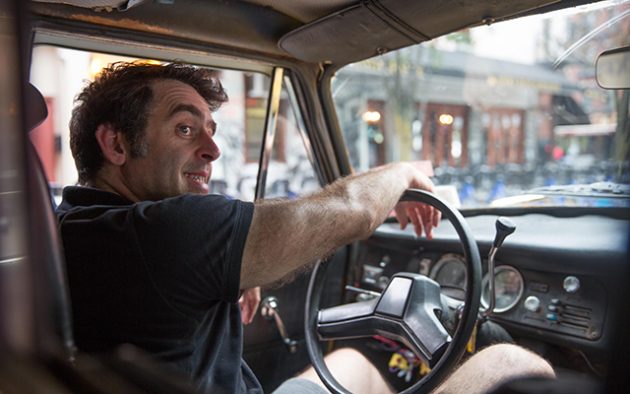
Not a happy Ronnie …

Ronnie isn’t happy and in his latest Eurosport  blog he tells Desmond Kane why

Ronnie O’Sullivan: Free speech is being stifled in snooker, I’m no longer willing to meet the cost

Ronnie O’Sullivan

Ronnie O’Sullivan explains why he can no longer accept being fined arbitrary sums for speaking to the media. In his latest exclusive blog, the five-times world champion tells Desmond Kane why he was left with a sour taste in the mouth after winning a record seventh Masters in London.

I was thrilled to win the Masters for a seventh time before another fantastic crowd at Alexandra Palace.

It meant so much to me considering all the ups and downs at the event. As always, I enjoyed the support of the fans so much.

One thing that has slightly taken the shine off my win was receiving another disciplinary letter from the governing body World Snooker about two situations affecting me at the tournament. I’ll try to explain my thoughts here.

Perhaps he was having a bad day at the office, but I felt the referee, Terry Camilleri, was not up to scratch during my semi-final match with Marco Fu at one of our sport’s major events.

And neither was a photographer, who was snapping pictures while I was on the shot.

When asked a question about my match with Marco, all I was giving was my opinion based on 25 years of playing the game. The referee and the photographer affected me so I gave an honest answer to the assembled media about why I wasn’t content with the situation.

What hasn’t been reported was that after the Masters, I made an offer to spend some of my own personal time with Terry to discuss the issue, or in a room with all the referees, to try to help them understand why situations like this occur during matches, and how we can work together to get it right so everybody is happy.

‘IMPORTANCE OF ETIQUETTE IN SPORT’

When I was leading 5-4 against Marco, a pivotal moment of the match, I was going for a very important pot at the start of the 10th frame.

As I’m down on the shot, the guy started moving his camera in my eyeline to get the picture he wanted. I got up off the shot to ask him to keep still while he was in my vision.

I had to ask him at least three times to stop moving while he was in my eyeline. In the end, I had to change the pot I was going for because he wasn’t listening. Is that fair?

He obviously didn’t know the etiquette of not moving in a snooker player’s eyeline while the player is on the shot. It happens a lot in golf, and golf is constantly stressing the need for photographers to respect players before they hit the ball. It should be the same in snooker.

I understand the demands on me to help project a positive image for snooker, but in a sport where we are told all players must be treated equally, the top 16 players the same as the world number 128, is it really fair that cameras are clicking on shots while other players are left alone to play without this distraction?

It is almost feels like you pay the price for getting further in tournaments when there is inevitably more interest.

Out of pure frustration, I said to the cameraman who was among the reporters: “you’re a f****ing nightmare mate, you obviously don’t know not to move in the players eyeline while the player is on a shot”.

I’m not excusing the swearing, and I apologise for that. I’m not trying to upset anyone, all I’m asking for is a sense of decorum during the match. We are all there trying to do our best to entertain, and I know photographers have an important role to play, but we have all have to respect each other.

I didn’t swear on TV, only to 10 or 15 journalists who record comments after the game. Nobody has even heard what I said because it was edited out by the BBC.

I’m not saying I was right to swear, but the photographer could have cost me the match. It was such a tight contest that could have gone either way.

It is appalling to think I could have played a shot that was prompted by a photographer not respecting the etiquette.

It would be good to know what steps World Snooker take to make sure new photographers know the etiquette before letting them snap away when they are only six feet from the table.

‘FINED FOR ANSWERING QUESTIONS HONESTLY’

I don’t know what the outcome is going to be of these two situations, but I will no longer be talking in depth in press conferences or interviews because when I share my thoughts, I risk being fined.

This is not the first time this has happened. There have been several fines I’ve had to pay in the past, and they are not small fines.

For some reason, I appear to get fined more than all the fines the other players get for similar offences.

I’ll leave you to draw your own conclusions from that.

In fact, some other players don’t get reported for similar things they have done. Sadly, I feel some of it is a bit personal. Why? Because it has been going on for years.

From now on, when I don’t say much in my interviews regarding snooker, you know why. I will no longer put my head on the chopping block. I don’t need the PR good or bad.

I feel that I’m good to be used for headlines and promotion when it suits, and I think I do more than most in giving my time for interviews.

But then I’m quickly jumped upon the minute my opinions don’t suit them.

It feels like they want to give you it in one hand when you are winning prize money then take it away with the other with their arbitrary fines.

Are the fines worked out by a means testing system? If so, that is simply unfair.

I’m left with two options:

  • a) find a new tour to play on because I still love playing, but not with this constant silliness going on, or
  • b) not speak or give full answers when being questioned about snooker

This is a very sad place to be when you have to resort to that.

If I get fined for implementing the second option then I will no longer be prepared to perform all the contractual obligations we are asked to do for World Snooker.

‘TONE AND TIMING OF LETTERS’

It is not just about the fines.

It is the tone of the letters, and also the timing of them. I’ve received them one day before I’m due to play a big event. How is that helpful to a player preparing for a tournament?

I’m not prepared to continue accepting this when it is evident the governing body don’t seem to have set fines or proper explanations about why people are fined certain amounts.

n view of what’s happened, I think the best way for me to communicate my thoughts, and update everyone in my own words, is by issuing this blog every two weeks.

I think it’s important that I am completely transparent, and let people know exactly what is going on.

This is not a rant, but a measured and factual way that I can communicate with all the people out there without the meaning of my words being twisted and turned into something they are not.

If the president of the US communicates via social media, why can’t I?

Ronnie’s soundtracks

Ronnie shared this on his facebook …

Following the broadcasting of American Hustle Ronnie was interviewed about the soundtracks of his life 

Curious? Here they are …

Snooker legend Ronnie O’Sullivan: the soundtrack of my life

 Leonie Cooper  5:33 pm – Feb 2, 2017

ronnieosullivan_american_hustle_2-630x394

Ronnie O’Sullivan is a icon. A snooker legend. One of the greatest players of all time. And now he’s got himself a television show too – HISTORY’s American Hustle, which sees him exploring the Stateside story of pool. But what tunes are buzzing around in that beautiful brain? We found out. Read on for the Soundtrack Of My Life, Ronnie-style.

The first song I can remember hearing

Michael Jackson

‘Billie Jean’

“I must have been five or six years old. I became a huge Michael Jackson fan, he’s got so many great songs, but Billie Jean stuck out for me. I thought, ‘Wow, he’s a cool dude.’ He was a handsome, beautiful young man and so talented. He gave so much joy to people. He was a selfless man, because through his success he became quite isolated. It came at a price.”

The first song I fell in love with

Tracy Chapman

‘Fast Car’

“It’s a bit of a driving song and I love driving. I was in my first decent car and I was 17, 18 and I remember this song coming on and I thought ‘this is a buzz!’ I always have the CD in my car.”

The song I listen to with my son

Train

‘Drops Of Jupiter’

“It’s one of my favourite songs – they were on Sunday Brunch with us last month. I listen to it in the car with my 9 year old son – he loves it too and we play it five or six times on the trot.”

The song I wish I’d written

Ian Brown

‘F.E.A.R’

“My friend got me into him – I’d never heard of him before. We were in the car, driving to the UK Championships and he said ‘listen to this song’. Every sentence starts with F-E-A-R. I thought ‘this geezer is a lyrical genius’. He’s really thought about that one – or maybe he hasn’t, maybe it’s instinctive!”

The first gig I went to

Oasis

Knebworth, 1996

There were so many people there and everyone looked like Noel Gallagher! I went with my friend Stuart – he was a good lad. We went there and had a laugh.”

The song I do at karaoke

“I did it once at a club when I’d had a few drinks. I said to myself, ‘You will never, ever do that again’. It was embarrassing. I actually can’t remember what I sang, but I’m not a very good singer anyway because whenever I sing people say ‘you’re a terrible singer’. So that’s why I don’t sing. Once I tried playing guitar but for me it was like learning another language – I thought, ‘I ain’t got time for this!’ It didn’t really float my boat.”

The musician that reminds me of home

Rod Stewart

“He’s lives not far from where I live in Essex and when I was younger I remember my dad being into Rod Stewart and also Deacon Blue and people like that. My mum and dad were quite into their music; Tina Turner, Simply Red, Phil Collins. They were quite funky my mum and dad, they were always out – social animals!”

The song I want played at my funeral

Eminem

‘Lose Yourself’

“Sometimes you have to get so lost in something that you go into autopilot and start doing amazing things, but you have to be in the zone to do it. That’s what that song really means to me – if people can get to that space in their life where they experience that, then they’ve had a good life.”

Ronnie about how he got involved in American hustle

Despite the misleading title, this article in ShortList is mainly about Ronnie and what drove him to do this series in America.

Ronnie O’Sullivan interview: “Flappy Bird cured my fear of flying”

25 JAN 2017

ronnie

Ronnie O’Sullivan, one of the finest snooker players of all time, sucks at pool but rules at iPhone games. Flappy Bird, in particular.

Here Dan Masoliver chats with the British legend to find out why he’s so obsessed with the annoying game, as well as discussing his brand new TV show about pool hustling in America.

In your new series, Ronnie O’Sullivan’s American Hustle, you and broadcaster Matt Smith go to the US and hustle some pool. What attracted you to the idea?

It was the travel. Going to places and experiencing things that I wouldn’t normally do. Once my snooker season’s over, I sit on the couch, I chill out, I go running, cook barbecues every night and that’s it. That’s my world. This was an opportunity to go out to somewhere I’d never normally have gone.

You’ve dabbled in pool in the past, playing in the International Pool Tour in 2006. Why haven’t you persisted with it?

I’m just not very good at it. The balls, the cues, the equipment – none of it does what I think it’s going to do. The noise of the cue when it hits the ball [he recoils, cringing], I want to put ear plugs in. It’s like asking Federer to play table tennis – he’s going to be all right at it, but he’s going to say, “Where’s the feel? Where’s the touch?”

You meet 55-year-old Earl ‘The Pearl’ Strickland in episode one, where he declares that he’s one of the greatest athletes that’s ever been born. Bit strong, no?

Most people would think, “F*cking hell you’re mad, how could you be the greatest athlete in America?” But he’s up there. He’s mastered his sport. It’s not as big as tennis or golf or swimming or whatever, but he mastered his sport. How much higher can you go than being the best in the world at what you do, whatever that may be?

Ronnie O’Sullivan – American Hustle Trailer

What would be the reaction if you made similar declarations of your undeniable talent?

I’d be big-headed. We love it when an American says it, we think it’s funny, but if a British guy says it, you think, “Who does he think he is?”

Americans worship their sports stars – do you think that people here would rather see you fail?

I get a general sense that every snooker fan that loves snooker wants to see me do well. And then I get the feeling that the people that run the sport would like to do what they did with Alex Higgins. While he was good for viewing figures they accepted him, but as soon as he started to not do so well, they threw him out of the game. So the sport will use me while I’m good, but the minute I drop off, it’ll be like, “Get him out.”

You’ve always been a bit of a maverick. Where does that come from?

I was brought up never to get too big for my boots. If I’d won a competition, it was history. Forget about it, move on to the next one. I was always taught to be tough, to not show any emotion, to feel like it’s me against the world. And that had an influence on how I live my life.

Has it made you ruthless?

I’m not like that. I love human beings. If I see a homeless guy, I go and buy him a sandwich and I say, “Look, here’s a bit of food and there’s a tenner, get yourself a packet of fags.” So I have empathy for humans. But as a snooker player, I’ve been brought up, ever since I was 10, to just be a machine.

We hear you’ve got a peculiar way of coping with your chronic phobia of flying.

Flappy Bird is the only thing that got me over flying. I got on a plane once, I had eight per cent battery. I said to the lady, “You’d better get me something [to charge my phone].” She said, “We can’t,” so I said, “I’m a bad flyer, you don’t want to see me if I start kicking off, because your passengers won’t like it.” She said, “I’ll get you some charge.” I was sh*tting myself. That [battery] is normally at 100 per cent the night before I’m going to the airport. Flappy Bird is my greatest cure.

Hold on, the smartphone game where you tap the screen to keep a nearly flightless bird airborne – that cured your fear of flying?

I’m being serious. I love it [he pulls out his phone and starts to play]. It’s the most beautiful feeling ever, when you’re going through [the pipes]. Look: the timing, the angles, the precision. Look! The dip, and then you get up there and you let it drop. That’s an art.

You’re actually remarkably good. What’s your high score?

It’s 295 on my phone, but I have about 350 on my iPad. That’s not bad. And I only do it when I’m on the plane, so I won’t do it for months, and then, boom: within 20 minutes I’m 180s, 200s. I could get 1,000, if I really put my mind to it.

Ronnie O’Sullivan’s American Hustle starts on 26 January on History at 10pm

[Images: JonEnoch, Eyevine]

Masters 2017 – Day 1 as it happened and a good interview with Ronnie

Ahead of yesterday’s opening match at the Masters, the always interesting (and fair) Hector Nunns had published this interview on inside-snooker. It somehow went under the radar but that I find quite telling.

COULD LIANG ADVICE BACKFIRE ON THE ROCKET?

Hector Nunns January 15, 2017

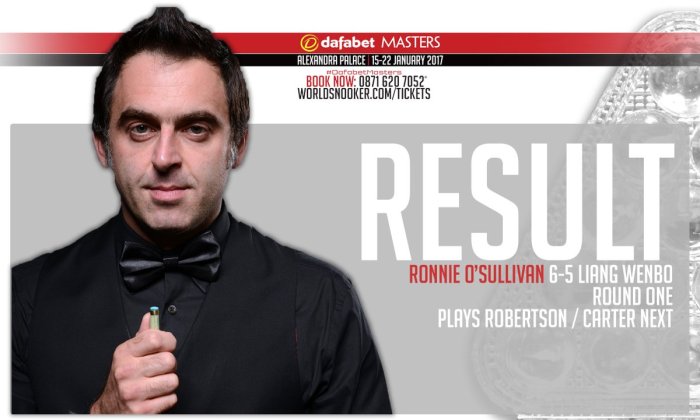
Ronnie O’Sullivan starts the defence of his Masters crown hoping some advice to opponent Liang Wenbo does not backfire on him on Sunday afternoon.

The Rocket is going for a record seventh title in the prestigious invitation tournament, staged at Alexandra Palace in north London.

And the two know each very well, having forged a close friendship following years as practice partners at the Grove facility in Romford.

Wenbo, 29, was challenging Ding Junhui for the China No1 tag some years ago and then lost his way in the game, badly underachieving given his unquestioned ability.

But he started to punch his weight by reaching the final of the UK Championship in 2015, and then finally claimed a first ranking title success at the English Open this season.

And five-time world champion O’Sullivan, 41, hopes some help contributed to Liang finding his way out of the wilderness.

O’Sullivan said: “I have known him for years, he used to practice eight hours a day in Romford and I told him he was overdoing it.

“I told him to go and have a life, do only two or three hours. He was doing all that time and still couldn’t pot a ball in tournaments.

“So I told him to go to Sheffield, see his Chinese mates, see his family – and not to do what I did at his age. And he has done it and never been happier.

“I have passed on a few mental skills and technique tips, and he is one of my close friends. I like to help people.

“And I have helped some of the younger Chinese players based here. I like to help people in my field, I know how tough it can be.

“They are nice kids, and have looked after me here, they are genuine. The bit I am giving them is the easy bit, the tough bit is going out and doing it.”

O’Sullivan also revealed that he is helping the young Chinese players passing through the Grove, that he still uses as an occasional base.

But worryingly he does not see many if any teenage talents in the UK equally worthy of the same kind of mentoring.

O’Sullivan added: “There is no one to pass it on to in the UK of the right age. If you look at what we have in England there is Kyren Wilson, but he is 25 I think.

“I don’t see no 15- or 16-year-olds out there, we used to know about people out there. That died really when the tobacco ban came in and clubs shut overnight

“The whole grass-roots of snooker was gone, and the amateur scene has almost disappeared. I used to play in amateur events every week, going round the country.

“When they opened up the pro game to anyone as they did, it killed the amateur game. You are seeing the repercussions of bad, quick knee-jerk decisions.

“The only players for me to pass what I know on to are in China. You spend a month out there, they want to use me.

“They are doing what we used to, there are academies with 20-30 tables with top players getting the best practice. The government subsidise it, and sort the families out.

“They invest in their youngsters with talent, in this country we bale out banks who rip the country off and bring it to its knees.”

This is something Ronnie does on his own initiative, not for money. Are those the words and deeds of a man who loathes his sport? I don’t think so, quite the opposite. But it’s clear that Ronnie doesn’t see a future for snooker right now out of China.

Also before the start of the tournament Rolf Kalb, Mr Snooker in Germany, had posted some fascinating stats on twitter:

masters2017stats

Now about the action in Ally Pally yesterday…

masters2017rosl16result

Everything about that one here.

masters2017dingl16result

Here is the report on Worldsnooker:

Sunday 15 Jan 2017 10:47PM

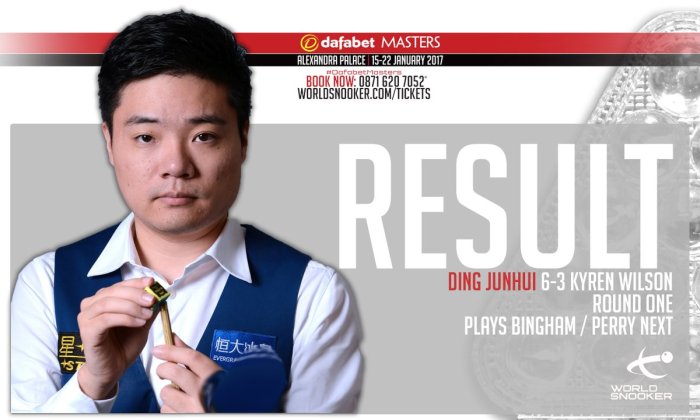
Ding Junhui won his first match in the Dafabet Masters since 2011 by beating Kyren Wilson 6-3 in the first round on Sunday night.

China’s Ding won this event in 2011, the last time it was staged at Wembley Arena, then endured five consecutive first round defeats after it was moved across North London. But he ended his Alexandra Palace hoodoo with an impressive display against Masters debutant Wilson to book a quarter-final clash with Stuart Bingham or Joe Perry on Friday evening (tickets available – click here for details).

World number six Ding is seeking his third title of the season having won the Six Red World Championship and Shanghai Masters in September.

Victory capped off an eventful day for Ding as, earlier, he did a live television interview for CCTV5 having been one of six nominees for China’s equivalent of Sports Personality of the Year, though he missed out on the award .

The 29-year-old started tonight’s match strongly by surging into a 3-0 lead. In the second frame he was on target for a 147, which would have made him the first player to make two maximums at the Masters, with Kirk Stevens and Marco Fu the only others to hit the magic number at this tournament. But after potting 15 reds with blacks, Ding ran out of position on the yellow on 120 and missed a tough pot to a centre pocket.

Kettering’s Wilson gained a foothold in the match by clearing from the last red to pink to win frame four, and he took a scrappy 39-minute fifth after Ding went in-off playing safety on the green.  Ding regained the momentum as runs of 65 and 73 put him 5-2 ahead.

Wilson pulled one back with a 103 and he led 42-0 in frame nine. But Ding went ahead with a break of 50, then secured victory after Wilson had gone in-off when potting the yellow.

“I scored quite heavily today,” said Ding. “I made a few breaks, but obviously missed a 147. It’s a tough game whoever you play in the Masters. I need to take the chances when they come and make good breaks.

“It’s nice, finally to win here at this venue. I always try to win here at the Masters, I tried really hard because I lost five times in a row.

“I have been practising a lot and I can improve my performance. Whoever I play next I will need to improve.”

(bold added by me)

Ding’s 147 attempt and Kyren’s marvellous 106  are the highlight moments of the match for me. I’m sure we will see more of Kyren in the Masters, he did well after a slow start.


Ronnie about the state of snooker, the state of this world and more …

Although he still loves to compete and still wants to win, as he told the BBC in this interview, Ronnie isn’t happy with the state of snooker, or the world we live in.

In an interview he did just after coming back from Goffs, he explains why he wouldn’t support his son into a snooker career, and why he might even consider going into politics. The interview has been reported in various media, but this article by Adam Crafton is the one I selected because of its completeness.

Ronnie O’Sullivan: I’ll support my son if he wants to be a tennis player, motor racer, doctor or student but anything to do with snooker, he’s on his own!

  • O’Sullivan does not want his son, Ronnie Jnr, to follow him into snooker
  • The 41-year-old begins defence of his Masters title in London on Sunday
  • Five-time world champ has had enough of the culture that surrounds sport 

It is when conversation turns to his nine-year-old son, Ronnie Jnr, that Ronnie O’Sullivan’s most cutting views on snooker come to the fore.

‘I’ve told him he won’t get my support if he plays snooker,’ O’Sullivan says bluntly. ‘That’s the deal. If you want to be a motor racer, or a tennis player, a doctor or lawyer or go and study, you get my support. But anything with snooker, I’m going to have to tell you that you’re on your own.’

It comes as a jolt when snooker’s iconic figure dismisses his sport so bluntly. Frankly, though, O’Sullivan has had enough of the culture that surrounds it, the injustice that now defines the game.

3c1b5ea000000578-0-image-a-1_1484339664237

 ‘I love competing, I love to win. But I’m not going to put myself 100 per cent into it when I don’t respect the way they treat players. I find it very difficult to see my fellow pros suffer and struggle. I see a lot of hopelessness there. It’s f****** difficult.’

There begins a passionate monologue as he condemns the sport’s inequity. While the big money may still be up for grabs for the world’s top 16, O’Sullivan — who begins the defence of his Masters title at London’s Alexandra Palace on Sunday — estimates that below the top 32 most struggle to get by.

‘I’m not going to support a system that doesn’t benefit the bottom-ranked players,’ he says. ‘It just keeps them on food stamps. It’s like the bankers. All the top players get everything and those at the bottom are in poverty. Some are on the tour but can’t afford to get there.

‘I don’t mind capitalism if everyone gets a fair living and can afford to put food in their fridge. At least give them basic rights so they can have a little house, be a snooker player.

‘Players can’t afford a pair of trainers for their kid, they can’t afford the train to a tournament. They can’t afford the hotel room. How is that right?

‘Then you see board members flying business class, drinking red wine, schmoozing, wearing nice suits, saying they are doing wonderful things for the game and it’s never been in a better place.

‘That’s what you’re telling the world but I see what these guys are going through. The system is not right. They don’t want to hear so I don’t want to be around or supporting or putting my own time and energy into that.’

O’Sullivan has always had an ambivalent relationship with snooker but over the past couple of years, he has broadened his horizons.

His younger years in snooker were punctuated by depression and drink. Now 41, he seems to be more at ease, helped by the renowned sports psychologist Steve Peters.

O’Sullivan now devotes only 20 per cent of his life to snooker, recently spending a few months in the USA to star in Ronnie O’Sullivan’s American Hustle and he is paid handsomely to be a pundit. O’Sullivan insists he won’t retire, saying he will use snooker ‘as long as it suits me’.

‘I’m less bothered about losing now,’ he says. ‘Sometimes, I think, “Sweet, I can do a bit of punditry”. There are so many tournaments it doesn’t matter if you lose.’ We can expect more television appearances. ‘Maybe there will be a Big Brother in me soon. I’ve spent so many years saying no to everything. I can see myself doing most things if the price is right and it’s a nice trip.’

So Strictly Come Dancing? ‘Nah, that’s 14 weeks. I don’t want to be locked in a room for six hours with some dancer telling me what I can and can’t do.’

Or the jungle? ‘I had bull’s c**k in China. Best thing on the plate. I’d be all right in the jungle psychologically. I’ve got Steve Peters. It’s a few weeks in the jungle, you’re having a laugh — some people in this country don’t know where their next meal’s coming from.’

O’Sullivan’s most stirring passion appears to be politics. Having witnessed China’s sporting development, he is angered by Britain’s failure. He does not rule out one day standing for election.

‘If I felt I could do a good enough job and give the time . . . you know, China do what we did 20 years ago. They are building schools for kids to practise snooker. The government invests in young people.

‘All we invest in is the f****** banking crisis and all this bull. It’s bringing the country to its knees and it’s sad. All the while, there’s some young kid out there with talent and we aren’t prepared to invest in him.

‘Then there’s an old lady out there who can’t pay her heating bill and told she has to do community service all because she can’t pay some bills. You think, ‘Hold on a minute, something’s not right here’.

‘There’s no jobs. Not here or America. Meanwhile, the boss of Walmart gets a £20million salary or whatever it is. People just want, want, want, take, take, take.

‘During the 2015 election, I went to a mining club with Ed Miliband for a snooker game. They are proper, working-class people and I relate to them. I can’t relate to a bunch of bankers sitting there, drinking wine and splashing money like it’s going out of fashion. It’s obscene, it makes me feel sick.

‘I see it all the time and in the snooker industry. I just think, ‘You talk a good game but really you’re just bull******** everybody’. I don’t want to be a part of it. I want to try and do good for people.

‘Our illnesses, struggles, suicides, drug addictions are brought on by hopelessness. Sometimes they think f*** this, I can’t deal with it any more. And I see it and hear it and know what they are going through because I have been through it a bit myself.

‘I know how they try to bring certain people down and then they give up. And I ain’t never gonna give up. They will never take my soul. They will never take my spirit. I just won’t have it.

‘My favourite film was Braveheart and as a character he signalled everything to me, which was freedom. We all should have freedom. That’s what I believe in and no one is going to take my freedom. No one. Ever.’

And there is also this one in The Telegraph  with a slightly different perspective.

Ronnie always was/is a bundle of contradictions, and he’s genuine within his own contradictions. It’s part of who he is, and most certainly part of why he’s fascinating.

There is one thing though I 100% agree with him: the current system in snooker is unfair, low/mid ranked players can’t make a living. There aren’t any young prospects coming through except from Asia, where they are supported by the authorities. I have seen this with my own eyes. It’s true what Ronnie says. And ultimately, if not addressed it will kill the game, at least in UK and Europe, because nobody lives on thin air and dreams only. And no parent in their right mind would encourage their child to engage in a career that looks like a dead-end with no prospect to make a half-decent living.

Don’t get me wrong, I love snooker, passionately and so does Ronnie. He wouldn’t engage in such passionate rants if he didn’t care. He DOES care, big time, and that’s why he talks.

 I also like this one in the Guardian.

And thanks to Hector for this one on inside-snooker

This is an excerpt:

Players, for example John Higgins in recent years, get rightly criticised when they do not fulfil their media duties either to the letter of the contract, or with the right level of enthusiasm and embracing the ambassadorial obligation that comes with being a top professional.

In fairness to O’Sullivan, he has done his bit over 25 years. Yes, he may have ducked the odd press conference, although you would be hard pushed to name more than one in recent years, but he has done more media over the years than most of the players put together. The fair ones know this, acknowledge it, and are often quite grateful that he is the lightning conductor.

The vast majority of players are superb ambassadors for snooker. They know that while it is their entire world, out there it is a minority sport fighting for attention with other, bigger sports, and they give of their time willingly and outside their contractual obligations for the good of the game.

To all those players we say thank you, and also O’Sullivan on this occasion – with a busy schedule, turning up admitting he “really didn’t want to be here”, looking dishevelled after a late night in Ireland at Goffs and an early flight, but answering the call to promote the Masters.

Another nice interview with the BBC this time

Ronnie was speaking with Owens Phillips from BBC Sport 

Masters 2017: Ronnie O’Sullivan wants to win with the style of Lionel Messi

By Owen Phillips

BBC Sport

Reigning Masters champion Ronnie O’Sullivan says entertaining fans is more important than titles and he wants to be the Lionel Messi of snooker.

World number 13 O’Sullivan begins his quest for a record-breaking seventh Masters crown against China’s Liang Wenbo in the first round on Sunday.

But the 41-year-old told BBC Sport: “I want to try to win playing an exciting, aggressive and attacking game.

“It is OK to win, but I want to win with style.”

O’Sullivan said he wanted fans to be able to say he doesn’t just win, but he “delivers entertainment as well”.

“I think I have done that over the over the last five or six years,” he added.

“I have put on some magnificent performances – performances I am very proud of.

“Sometimes people say you can’t play like that and win. Well, Michael van Gerwen has proved you can, Lionel Messi proves you can, Tiger Woods does, Roger Federer does. I want to try to be one of them.”

Victory for O’Sullivan at Alexandra Palace would move the 28-time ranking event winner clear of Stephen Hendry and see him retain the title he won by thrashing Barry Hawkins 10-1 in 2016.

“I still want to win tournaments – but for me it is about people coming to watch, people switching on their televisions wanting to see good entertainment,” he said.

“It would be great to get another Masters, not because it’s the seventh, but because it’s the Masters. I don’t think ‘I’ve got to break the record’, I just want to win another Masters.

“I want to win another Worlds and another Welsh and China Open. I just want to win more tournaments.”

Although he dominated a one-sided final against Hawkins last season, O’Sullivan said a back injury meant he struggled and feared for his career.

“I slipped a disc and I couldn’t get in the right position for my shots,” he said. “Fortunately I overcame that a couple of weeks after the Masters and it is not a problem now.

“But it was really hard mentally. I was struggling because I wasn’t sure if I would ever be able to play properly again because of my back.

“Winning the tournament is the main goal and that was a great box ticked, but my performance wasn’t great. I have played a lot better and lost tournaments. I think I got a bit lucky in some ways.”

This time around he is far happier with his fitness – and his form – after a difficult start to the season.

93561557_ronniecue_rex

“The first two months of the season were difficult because I didn’t really practise going into the season,” the Essex man said. “I didn’t really play for three months.

“I lost matches early on and it wasn’t losing the matches that bothered me, it was how I was playing. I was struggling and getting to the last 16 was a good result.”

O’Sullivan reached finals at the European Open final in Romania as well as the Champion of Champions event in Coventry, before losing a high-quality UK Championship final to world number one Mark Selby.

“From mid-November to mid-December I had a really good month where I was happy with my form and I was enjoying it,” he said.

Mastering the Masters

The invitation tournament is one of snooker’s triple crown events and features the world’s top 16 players competing for a top prize of £200,000.

“Sometimes it’s the easiest one to win because you are playing against the best players,” said O’Sullivan.

“You know what they will do and what they will bring to the table; you know their what their best game is like, what their worst game is like and what their middle game is like. You know everything about their games.

“The tougher matches are sometimes guys that you don’t know; you don’t know their strengths and weaknesses.

“With the Masters you know what you are getting involved in.”