Day 3 of “No Crucible” – Stephen Hendry and Ronnie have a chat on Instagram

Yesterday’s Eurosport vodcast was about the “Greatest of all times”.

Well, it’s between Steve Davis, Stephen Hendry, and Ronnie, and eventually both Neal Foulds and Jimmy White went for Ronnie, basically for three reasons: he’s won most triple crowns, he’s been a top player for 28 years and counting and he’s done it despite the permanent challenge of the likes of Hendry (for about 20 years), Higgins and Williams. I agree, but it’s a bit of a pointless debate, because sports change over time, as do the conditions, and you can only try to be the best possible in your era, which all three above have done.

It wasn’t the best debate, IMO, with Jimmy insisting from the start that it was Ronnie and not really wanting to consider the others in some depth, adding that Hendry himself would tell them that Ronnie is the GOAT.

The only slightly less usual thing when it’s about the GOAT debate was that both Neal and Andy remarked that John Higgins would almost certainly be in that conversation had he not been in competition with Ronnie and Mark Williams during their entire career. In contrast, Hendry and Davis didn’t really have “close” competitors during their prime years.

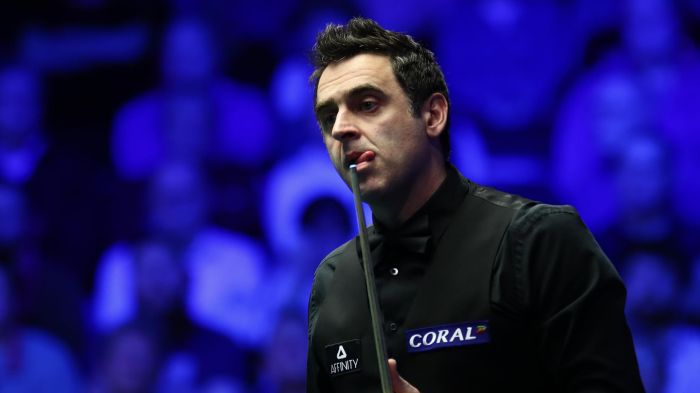
The highlight of yesterday to me was provided by Stephen Hendry who had a long, enjoyable and very positive interview with Ronnie on Instagram.

Ronnie-Hendry

Here are a few things that stayed with me

  • Hendry duly introduced Ronnie as the GOAT, which made me smile because of the coincidence with Jimmy’s statement earlier in the day
  • For the next two years, Ronnie is considering to play in every event he can possibly play and see if he can get back to his best level.
  • Playing well is was gives him enjoyment, not necessarily winning. In contrast with Hendry for whom winning was everything. And also working with Steve Peters, of course, has helped him to cope with playing bad in a less destructive way than in the past.
  • His greatest achievement is probably the 2012 World Championship. Why? Because he’s just had a very bad spell, on and off the table, had worked with Steve Peters for a few months, but wasn’t getting the results. He had started to doubt his own ability to win it again. He thought he was finished, and then he won the World for the fourth time. What Peters did fo him is to give him perspective, to get less hard on himself.
  • The 1000th centuries… that’s something Hendry really admires.
  • Ronnie doesn’t set goals. You just prepare and try your best. Winning tournaments is just a “by-product”.
  • Best performance. A final, European Masters, in Le Touquet, where himself and Hendry played each other at the top of their games.
  • No regrets about not playing at the Masters. Too close to home, with lots of people asking for tickets. And a lot of media work. Last year during the final the kept him for three hours doing filming and interviews after the SF.
  • Preferred tournaments? The Chinese tournaments, because of the hospitality, the way the players are looked after. Shanghai is his favourite. But the travel part is a bit difficult.
  • That led them to discuss the “old days” and the atmosphere there was backstage at tournaments and the hospitality. Now the standard of snooker is higher but there is no atmosphere at the tournaments anymore. (both players agreeing on that)
  • Best 147? the one against Ding in the Welsh final. And “that” last red to black is probably his best ever shot. The feastest 147 was an “inspirational moment” but not a good break.
  • He’d love to win another World. But his private life is/has been a bit complicated and been a “distraction” from snooker. But that’s not an excuse. But yes, he’d love to win another one.
  • Not going vegan! Eating more veggies and fruit, yes, but no, not vegan.
  • Worst loss. The Masters final against Higgins in 2006. That was hard to take.
  • The 1000th century … he would have loved to do it at the Crucible. But, then the opportunity came in a great final, in Preston (the venue of his first title) and he went for it and it was great.
  • Teaching, coaching? No, not really, it’s a different approach than playing, a different state of mind. Ronnie not sure he’s got that mindset.
  • World Championship behind closed doors? As long as it’s safe … although a Crucible final in an empty arena is a terrible thought. But any type of World Championship would be better than no World Championship.
  • No really regret to get to the Players Championship, although that series offers brilliant tournaments.
  • Both wondered at the fact that they never played in a World final. Ronnie remembers the 1999 SF, a defeat that changed his approach to the game. It was a very good match, but he went on the defensive towards the end and it was his downfall. A lesson learned.
  • Goals? Not really. At this stage of Ronnie’s career, it’s about enjoying it. that’s key to longevity.
  • Country Ronnie would love to play in? Iran.
  • Praising Trump. Currently, head and shoulder above anybody else. His brother Jack is a big factor in his success. They practice a lot together.
  • Talent or hard work? Talent without work will get you nowhere. Hard work without talent, you may win a few, but never get to the highest level.

And they might do another one … so many questions still unanswered.

Here it is:

It was really enjoyable, very friendly and lost of respect between them. And Ronnie’s memory when it comes to his past matches is amazing. Hendry asked him three questions, inspired by Cuetracker,  about matches from the 90th and he got all three right.

And the daily “Crucible Gold” about the four  “other” maximum breaks at the Crucible.
Day 2 of “no Crucible” and a very good vodcast with Ronnie

For me, the highlight of the second “No Crucible” day is the vodcast that Andy Goldstein did with Ronnie.

Here is the report on this vodcast by Eurosport:

Ronnie exclusive: Trump can dominate snooker for the next 10 years

Speaking on Eurosport’s new snooker vodcast, Ronnie O’Sullivan says that Judd Trump has the potential to dominate snooker for the next decade.

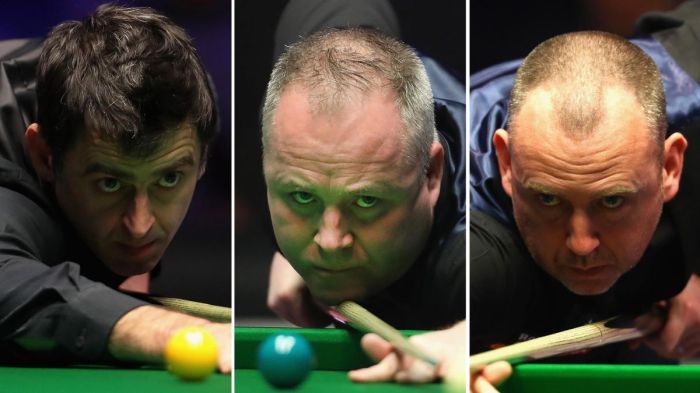
In a wide-ranging discussion with Andy Goldstein about the icons and rivals who have played a part in O’Sullivan’s great career, the five-time World Championship winner said that Trump is now in a position to pick up the baton from the ‘Class of 92’ – O’Sullivan, Mark Williams and John Higgins – and forge his own era of dominance.

….

Ronnie on Judd Trump carrying the torch for the next generation

Without a doubt, he plays a different game, he plays a brilliant game, the power play. He plays shots that no one else can play. He’s got the killer instinct, he’s hungry. He’s proven that after winning the World Championships. We all knew it wasn’t a fluke but there’s people out there saying “can he back it up?” He’s come in this season and he’s won six ranking events which is more than any other player has had to do. I know there’s more ranking events now than ever but still to win six is a fantastic achievement. So, for me, he’s a complete player now. He’s just going to get stronger and stronger. It’s like when Hendry came along, and he was pretty much head and shoulders above the rest. I think that Judd is head and shoulders above everybody else at the moment.

Ronnie on Trump’s chances of winning multiple World titles

Easy. In ten years, Judd will have a problem that I’m having now. There’ll be a few young ones come up behind him and he’ll have few battle scars and they’ll keep pushing up. Eventually, if you’re not mentally up for it or you’re just a little bit off you start to lose matches. So, he’s got the next seven to ten years to dominate really. I think it was a lot harder for Trump coming through than it was for Hendry coming through because Hendry didn’t really, apart from Davis, Jimmy on his day, there wasn’t anyone there that was going to frighten him really. Whereas with Trump when he came on you still had Hendry, you’ve got Higgins, Williams, me, Ding. It was hard to come in and dominate from that point on,but I think players have developed a little bit more slowly now. So, you learn your trade and every player gets ten years at 20-30 or 30-40. Judd’s started at 30 and I think he’ll go on to 40 playing some fantastic snooker.

Ronnie on Trump’s rivals

No one, no one. Well I mean if we played five times, I might win one, twice possibly, but he’s just going to get stronger and stronger and I think the best thing to happen to Judd is his brother. If he hadn’t had his brother there maybe Judd wouldn’t have made the changes that he’s made. He owes a lot to his brother and he’ll be the best thing to happen to Judd. I’m glad his brother came along now and not 10 years ago!

Ronnie on the influence of Davis, White and Hendry

Growing up I used to look at them and think they’re the best players around. You watch Steve Davis, he was like a robot, you never thought he was going to make a mistake. Jimmy White – the most exciting player you’ll ever see and could play every shot in the book. So, they were the two yardsticks, if you like, for me growing up. But if I was to watch them playing now in some of their matches, which I do sometimes, I look at it and just think the standard really wasn’t that high. So, it’s just all about perception and people raising the game to a higher level. But at the time, that was the highest level. But then this young Scottish guy Stephen Hendry came along, and he’s probably taken the game to as high… It would be hard to say that anyone has taken the game on further than Hendry. Hendry I still think if he was in his prime, we were all in our prime, he would still be winning many, many titles. So, you look at Davis and Jimmy, yeah fantastic players, but probably not good enough to stay with the current breed of players.

Ronnie on the ‘Class of ‘92′

I knew Mark WIlliams, we used to play each other quite a lot on the Pro-Am circuit. When we were 10, 11, 12,13 we used to go to Hemsby for junior tournaments,so we knew of each other. But the first time I’d seen John Higgins he was fourteen, so I hadn’t heard of him. The first I’d heard was that this Scottish kid had nearly had a 147 in the home internationals. So that was the buzz going round. I didn’t even know what John Higgins looked like but after we heard that we had to watch him play, and watching him play I thought this kid looks super, super good. Then from that moment on, I knew John Higgins was going to be a class, class player. So that was my first encounter with John Higgins but the rivalry from that day really has been on between the three of us. There was a lot of good players around, but we were hungry, we had the desire. We loved it, we wanted it. For a lot of snooker players, it was just a bit of a lifestyle, they used to go round there and have a bit of a laugh and a joke. But we took our business seriously. But I think it helped that the three of us came through together because I think we all motivated each other to try and do better. If one of us was doing well it would always spur the other one on to do well. So, it was a healthy rivalry really.

Ronnie on the added excitement of playing Williams or Higgins

Of course, we’ve been playing each other for nigh on thirty years. It’s always nice to see Nadal play Federer or Federer play Djokovic. Their careers, and their ages, and their statistics are so evenly matched that none of us have got anything to prove and the chances are that it’s nice to see greats play each other I suppose. So, I get why it’s exciting.

Ronnie on Mark Selby

I always thought Mark was a great match player. I watched him play and I could tell he was going to be a good player. But I see a lot of his faults, I had the same faults in my game that I think he had in his game and I knew how much of a struggle it was for me to try and play with those faults. One day you thought you were great and the next you were terrible, and that up-and-down inconsistency can mentally get to you. So, while I knew he was a fantastic player I never expected him to be able to go on and be as successful as he was. At one stage I said I didn’t think he’d ever win the world title because to win the world title you really can’t afford to have a bad session. But what Mark’s been able to do is that he’s able to play bad but he’s also able to make the other player play badly. I was never able to do that. If I played badly, balls were all there ready in the open and the opponent would just hoover them up. Whereas when Mark was playing badly there’d be balls on cushions, and you’d think where do I go from here? So, he was always able to play himself and stay in the matches. So, he found a way to still be able to win when you’re playing badly, and I never thought snooker could be played like that. I know Mark doesn’t like playing like that but if you sometimes have to do that to get the result and get to the next round you’ve got to do what you’ve got to do and no one in the history of the game has been better at that than Mark Selby. So, you have to take your hat off to him really.

Ronnie on his main rivals going forward

I don’t really put myself in to have a rival. You want them to be similar eras, it’s hard for me to be a rival with Ding or Trump because they’ve got 14 years on me. I just always think that I can still give Selby a game, I can still give Murphy a game, I still think I could probably give Neil Robertson a game because the age difference is not that different to me, John Higgins and Williams. But I just think when you look at the younger ones it’s a little bit harder because they’re so hungry and they’ve got so much desire. Every match that they play a John Higgins or a Mark Williams or a Shaun Murphy or a Neil Robertson, they might lose but it’s just a learning curve for them. So, it’s just making them stronger and stronger. Like me playing Hendry at the end of his career, I was getting a lot from it where it was doing him no good. I think eventually you get to the stage where it’s hard for you to keep battling away. So, for me my situation is just to keep playing for as long as I can really and hopefully, I can still win a few tournaments every now and again.

A very interesting interview. Of course, the written article puts the subject that is more likely to catch eyes first, although it’s the last one they discuss in the vodcast, but, really all are interesting.

One thing I feel listening to Ronnie out there is that he doesn’t have the hunger anymore that he had as a younger player, which, of course, is normal. However, that being the case, he will probably not win that much anymore and we, as fans, will have to accept that. Of course, he still has the desire, and the hunger might come back stronger in spells, and probably will. But he’s going to turn 45 this year, and his longevity has already been remarkable as it is. I hope, and believe, that he has more titles in him, although probably not a World title. We should just try to enjoy every match, and every victory while he is still playing, without putting too many expectations on him, and be grateful for everything he gave us over the years. It’s easier said than done… I know that only too well.

Ronnie said that he hasn’t really pot a ball for weeks. He’s not the only one. Higgins said the same. It’s hard to practice when there is no definite purpose and it’s even harder when you have been doing the job for nearly 30 years. When snooker comes back, be it in July or later, nobody will be match sharp. It could be interesting because it could well come about “how good enough is your bad/rusty game” rather than about “how good is your best game”.

Then the “Crucible Gold” on the day was about Hendry’s maximums

Incredibly, I was at the Crucible when the last one happened and I missed it because I was taking pictures on the other table. The curtain was down of course. By the time, I realised that something unusual was happening, it was too late. The “snapper box” on Hendry’s table was packed of course. I was just able to witness Hendry’s celebration on the TV screens in the media room. He was quite animated which was uncharacteristic. Of course, we came to understand Hendry’s unusual display of emotions a few days later when, heavily beaten by Stephen Maguire, he announced his retirement. He just came to the media room, sat down and quietly said: “I have played my last professional match”. For a few seconds, the media room went completely quiet, everyone was stunned. Hendry then calmly explained that he had taken the decision months before and had only spoken about it to a few chosen ones. He had given himself a season to see if he could get back near his best, he hadn’t, he didn’t want to continue to play if he wasn’t able to be a winner.

Also, this interview with Hazel Irvine was shared on social media.

It’s a short, but great piece. It was made last year just after the World Championship. Hazel is the ultimate professional, and yet, remains just very simple, friendly and approachable.

The BBC also reran the piece about Alex Higgins, “The People’s Champion”. I gave that one a miss. I understand how important the man is in the context of snooker and how he changed the perception the general public had of the game and made it popular. I can see why his daring style and swag fascinated. But, quite honestly, I can’t stand the person he was, and, sorry, mental health issues can’t the excuse for everything and anything. Reading his autobiography didn’t change my opinion. There were far too many episodes of violence, nastiness, selfishness and sheer dishonesty for my liking. He never accepted responsibility for his own faults and shortcomings, and too often spat in the face of those trying to help him.

Related to the last sentence above, there is an article by Jason Francis in the first issue of the Chalk, a new cuesports magazine, about his experience with Alex when he started the “Snooker Legends”.


From Saturday on Eurosport delivers two-week celebration of snooker

This was announced by Eurosport yesterday:

Eurosport delivers two-week celebration of snooker – and brand new vodcast

By Eurosport

16 hours ago

ESBanner-Ronnie and Trump

This article gives us an idea about the kind of stuff they will cover in these vodcasts 

Ronnie: My favourite rivalry and how my dad helped me on way to greatness

1 hour agoUpdated 9 minutes ago

ESBanner-Ronnie Rivals.jpg

Eurosport looking at the 10 best long potters

Yesterday, Desmond Kane was looking at the 10 best long potters.

All-time top 10: Who are snooker’s greatest long potters?

In the second of our weekly series, we look at the 10 greatest players in each department of snooker finishing with the Greatest Of All Time. We continue by looking at the game’s finest long potters.

1. Judd Trump (England)

Judd Trump

Judd Trump, with more potting ability than Percy Thrower, perhaps edges out Neil Robertson on the all-time long list for what he provided in the 2019 World Championship final. An 18-9 win over John Higgins was staggering enough, outmanoeuvring one of the game’s true titans, but the manner of the victory was probably the greatest levels ever reached on the sport’s grandest stage.

Cometh the hour, cometh the Bristolian. At one point, Trump seemed to be playing on autopilot, like the pockets were craters. Higgins has witnessed as much as anybody in the sport over 28 years, but was flabbergasted by the green baize hurting bombs TNT Trump unloaded over a bewitching two days.

It was breathless, incomparable one-visit snooker, including seven centuries and nine breaks over 50, in lifting his first world title in the final as he turned the Crucible Theatre into his own living room. With 12 or 13 frames won at a single visit, Higgins was privileged to be on the receiving end: “He doesn’t just overwhelm the opponent, he overwhelms the snooker table. I don’t think there’s been quite a player like him.”

Trump can pot balls, create angles and get movement on the cueball like no other player. He is quickly becoming the all-rounder with a tactical approach enhancing his wares, but it is his opportunism to create from distance that ultimately creates carnage.

If there has ever been a better long potter in snooker, one does not immediately spring to mind.

2. Neil Robertson (Australia)

Neil Robertson

Robertson forged his reputation as a formidable potter when he attempted to make it as a professional on the UK-based professional circuit three times in the late nineties and early noughties before returning to Australia out of pocket and out of form. When he eventually regained his own self-belief by winning the World Under-21 Championship in New Zealand in July 2003, including a victory over a teenage Ding Junhui, he would not be denied a fourth time. He remains a devastating, preening potter at his best, but has added a substantial tactical game to support his adroitness from beyond the balk line.

With one of the best all-round games in the sport’s history, the 2010 world champion Robertson remains as dangerous when he is lining up pots at distance as among them from close range. He holds the record for most centuries in a season with his haul of 103 in 2013/14 – a totemic moment in snooker folklore.

Only Ronnie O’Sullivan (1038), Stephen Hendry (778), John Higgins (772) and Judd Trump (712) have made more career centuries than Robertson’s 701. Like those four icons, the Aussie likes to provide for himself.

Which is perhaps understandable when he almost failed at the sport he lives and breathes.

Projecting a flawless technique, there is arguably no better long potter in the game than the Melbourne Potting Machine, a committed vegan who smells blood on a snooker table.

3. Mark Williams (Wales)

Mark Williams

Described as the best single ball potter in the history of the sport by his peers, Williams has spent 28 years at the very top of the game because of an enviable long game that enables him to dictate the narrative of a frame. He is not nicknamed the Welsh Potting Machine because of a reputation for tactical torpidity despite his innate ability to win at any cost.

Williams has lifted three world titles in 2000, 2003 and 2018 based on a penchant for snaffling up half chances. Only Williams, Stephen Hendry and Steve Davis have won the world title, Masters and UK Championship in a single season, but the man from Cwm in Blaenau Gwent arguably did it in a more taxing era.

He remains in esteemed company. “Long potting is all about confidence, and good eyesight,” he said.

“Think positive. If you’re feeling down or lacking a bit of confidence, your game goes. You start thinking about the balls you might miss more than the ones you are going to pot. “

At the age of 45, Williams has never been blighted by the fatigue of frames. Nor does he appear ready to slip quietly into the night.

4. Ronnie O’Sullivan (England)

Ronnie

O’Sullivan’s game has become more measured in recent years, but his all-round approach has always been supported by his ability to pounce on half chances from distance. He has never been overly keen on waiting for opponents to make errors, preferring to splatter the reds and limit long exacting frames with one-visit snooker.

The five-times word champion has produced a series of devastating sessions, but his 6-0 whitewash of an unsuspecting Ricky Walden in the quarter-finals of the Masters on the road to winning the 2014 invitational tournament among his overall total of seven was as close as you will see to green baize utopia. O’Sullivan was knocking in balls like he was playing on a pool table. O’Sullivan rolled in a record 556 points without reply, beating the 495 points set by Ding Junhui in 2007.

“Probably the best performance I have seen from anybody in all the years I’ve been coming to the Masters,” said 1997 world champion Ken Doherty. Of course, it is impossible to maintain such levels on every occasion, but O’Sullivan ranks high among the greatest long potters in the history of the sport.

When he gets it right, nobody does it better.

5. Stephen Hendry (Scotland)

Stephen Hendry

It is easy to forget how imperious Hendry was in his pomp. Such was his self-belief and dominance of the sport that he rarely became embroiled in tactical duels. While his great rival Steve Davis was more concerned about not leaving shots, Hendry was focused on making them.

It was a mindset that proved key in ending Davis’ dominance of the sport in the early 1990s. Hendry pioneered the new breed of attacking snooker player that we witness today when you study the world’s leading men. There was nobody like Hendry in the late 1980s or the 1990s. His one-visit approach would see him smash open the pack of reds as soon as possible with the blue to middle bag at pace to open up the table or controlled blacks a particular favourite of his canon. It was a manoeuvre that helped him to transform the game.

Hendry was a fearsome, focused sight on a snooker table bolstered by a razor sharp game from long range. He once compiled a 147 to overcome Ronnie O’Sullivan 9-8 in the final of the Charity Challenge in 1997 after his opponent had recovered from trailing 8-2 to restore parity at 8-8. Hendry’s long potting was the main stanchion of his snooker success. He had problems with technique that contributed to a steady decline in the noughties before he retired in 2012. He was also unwilling to fraternise with a safety game that could have extended his lifespan like Davis or O’Sullivan.

Yet it is astonishing to think of what his success might have been when he largely refused to see extended safety bouts as helpful to his cause. That all seven of his world crowns were donned in the nineties is also fascinating.

Hendry remains the winner of the most world titles in the modern era. His long potting was a key component behind his stockpile of silverware.

6. Shaun Murphy (England)

2776192-57345850-2560-1440
Murphy lifted the 2005 World Championship at the age of 22 as a 150-1 qualifier with a performance heavy on long pots and low on safety. Like Stephen Hendry, safety has never really been Murphy’s law. Sometimes when you study Murphy in action, you wonder how he has contrived to win only a solitary world title.
He has a ramrod straight technique, among the best snooker has paid testament to, that allows him to generate power and pace through the cue ball from distance. While a lack of a safety game and odd lapses in concentration has arguably harpooned his quest for greater riches, his potting ability has never been in doubt.
Murphy apparently toyed with the idea of retirement after a barren 2019, but has emerged a stronger figure for his travails lifting the China Championship and Welsh Open this season to increase his career haul to nine ranking event triumphs.
“There are times when the occasion gets the better of you. This time it all clicked,” said Murphy after demolishing Kyren Wilson 9-1 to lift the Welsh Open in February.

“It is dangerous to put too much stock on how you play. There is a small part of the mind that thinks about how you win rather than the winning itself and that can be very dangerous. However, it was nice to allow myself a little moment of enjoying the way I won and the performance in that match.”

7. John Higgins (Scotland)

John Higgins

Higgins merits a place in the pantheon of potters for his range of skills on a snooker table. Renowned as a formidable tactical player, mastering the safety side of the game is only beneficial if you can score heavily.

Higgins and Ronnie O’Sullivan studied Stephen Henry’s fixation with one-visit snooker, and arguably improved it, adding their own class to the theory of potting a long red, finishing plum on the black before devouring the balls to win frames with minimal fuss.

Higgins remains a devastating long potter. Armed with a technique made to weather the buffeting storms of self-doubt, the stats would back up his success. He has lifted four world titles with victories over Ken Doherty, Mark Selby, Shaun Murphy and Judd Trump illustrating an enduring class in all aspects of the game. He has also reached the last three world finals to roll back the years as much as the blacks.

To be a contender at the Crucible over three decades tells the story of a very special potter.

8. Alex Higgins (Northern Ireland)

Alex Higgins

Higgins stood out in the 1970s and 1980s surrounded by figures who were addicted to a percentage, tactical game such as Ray Reardon and Steve Davis. Higgins was also a fine safety player, but was a prodigious potter whose vibe was one of unpredictability. He was more interested in amusing himself and delighting the public with a unique brand of attacking snooker than reverting to the trenches.

While there are arguably more consistent potters in modern snooker than Higgins, it should not be underestimated the level of credibility the Northern Irishman brought to the green baize at the beginning of the televised era. Without Higgins, the mass market appeal of snooker would never have gained traction in the early days of television coverage.

His Hurricane nickname fitted with his ability to race through pots and frames without much thought. His break in the 1982 World Championship semi-final against Jimmy White shows how good a single ball potter Higgins was.

Higgins won two world titles, against John Spencer in 1972 and Ray Reardon in 1982, but the second was the solitary world trophy he carried off at the Crucible. In the semi-finals against Jimmy ‘Whirlwind’ White, he trailed 15-14 and 59-0 when he came to the table. On the cusp of defeat, he produced a series of unbelievable pots

“It was a mental break, it was phenomenal,” said White. “I didn’t think he would clear up, no. There were about four shots he played that were amazing. His name was on the trophy that year. Did it cost me the World Championship? At that time I didn’t care if I won or lost because I was having such fun. In 1979 and 1980, I went to Australia to play in the amateur World Championship which cost me two years of experience at the Crucible. Who knows? Maybe it was meant to be because I’m still playing now.”

That Higgins could do it under pressure and under the influence of several libations is even more impressive.

9. Jimmy White (England)

Jimmy White

Jimmy White will be recalled as snooker’s nearly man, but the same cannot be said for his potting ability in his prime. White lost six world finals in the 1980s and 1990s, but it is worth noting that he lost four of them to Stephen Hendry and another one to Steve Davis, two of the greatest players to play the game.

If not for those two pesky characters, White’s long game would have delivered multiple world titles, and he would have merited them. His potting ability was not hugely inferior to Davis or Hendry in their halcyon days. It was probably a bit less consistency in scoring, safety and temperament that did for him over a longer period of time. But the Whirlwind was a firm favourite with the snooker public because he played the game to entertain.

Like Alex Higgins, he was a pioneer of attacking play from long range. As a winner of the Masters in 1984 and the UK Championship in 1992, his place in the all-time list of prominent potters must respect his era as well as his role in the sport’s progression.

10. Cliff Wilson (Wales)

Cliff Wilson

A player ahead of his time and after his time. Wilson was a ferocious potter, who played at breakneck speed and put the emphasis firmly on entertainment. At the age of 54, he was remarkably ranked at 14 in the world in 1988 despite battling fading eyesight and ill health. There are certainly more consistent candidates to include in a top 10 of out-and-out potters, but Wilson stood out in his era, and provided his successors with a blueprint on a different way to approach the game.

From Tredegar, the same Welsh town as six-times world champion Ray Reardon, Wilson won the Welsh Amateur Championship in 1956, 1977 and 1978, but worked in the steelworks at Llanwern until he turned professional at the age of 45 after claiming the World Amateur Championship in 1978. He usurped Ronnie O’Sullivan 9-8 in the 1992 UK Championship two years before his premature death at the age of 60 due to ill health. He was once coached by the great Joe Davis, but probably played snooker in the wrong era.

If Wilson was a twentysomething today, he would be a clear and present danger.

Desmond Kane

Where to start with this one?

Well, maybe, with this question: how do you define excellence in long potting? It’s not as straightforward as it reads.

Judd Trump and Neil Robertson, the two players topping this list, go for and get a fair percentage of difficult, and spectacular long pots.  However, if you pay attention to stats, they often have a lower long pot success rate than their opponents. If you don’t believe me, open your eyes and ears whenever snooker is back and they play. This, of course, is because they go for more, and more difficult ones than most others on the tour. Also, both of them have tremendous cue power and frequently play in such a way that the cue ball comes back to relative safety in the baulk area. Therefore, they aren’t punished that often when they miss. What we, fans, tend to remember most, are the misses that proved costly. Shaun Murphy also has a similar style.

Stephen Hendry, John Higgins and Ronnie are different. Stephen and Ronnie in particular were/are very attacking, they go for a lot, they didn’t/don’t want to be caught in long drawn out affairs. But, contrary to the ones above, they almost always play for position as well as attempting the pot. Usually, playing either for black or blue. Because of this, they know that they will likely be punished, should they miss. That adds a lot of pressure. As mentioned in the above article, confidence is a huge factor in long potting success, and pressure will always play on your mind, no matter how good you are. In the last year and a half, Judd Trump has also been playing that way more often than he used to do.

A lot of players are fearless when young, and as they age, battle scars undermine their confidence. That was blatant with Stephen Hendry, and it happened as early as in his late twenties. I can’t help to believe that his defeat to Ken Doherty in the 1997 World Final was a turning point in Hendry’s career. He won only one major after that and he was only 28. He won his last World Championship at 30, the age Judd Trump is now, played for another 12 seasons and won only five more titles, none of them “majors”. I’m convinced that losing to Ken that year, and the way of it, delivered a killing blow to Stephen’s confidence, and effectively to his career at the very top. He still remained a top player for years, but no more a serial winner. Think about it this way: Stephen made 5 centuries in that final, his highest break was 137, whilst Ken highest break was 85. Yet, eventually, Ken won by 18-12; the match wasn’t even really close. His all-attack strategy, and “safety is overrated” moto hadn’t worked. Ken had shown that he could be beaten and how.

A  lot of very young players are excellent long potters because they have very few battle scars. Other parts of their game may let them down, but usually potting in general isn’t the issue.

One player who, IMO, should be in the list above is Kyren Wilson.

Then you have this weird concept of “single ball potter” that inevitably comes in the conversation when Mark Williams is mentioned. I write “weird” because potting just one ball isn’t really an efficient approach in snooker. What it means in Willo’s case is that, more often than most, he goes for a ball, without intending to gain position. What he wants is to gain the initiative, and control over the next shot, often combined with getting rid of a “danger” ball, one that could possibly give his opponent an opening.


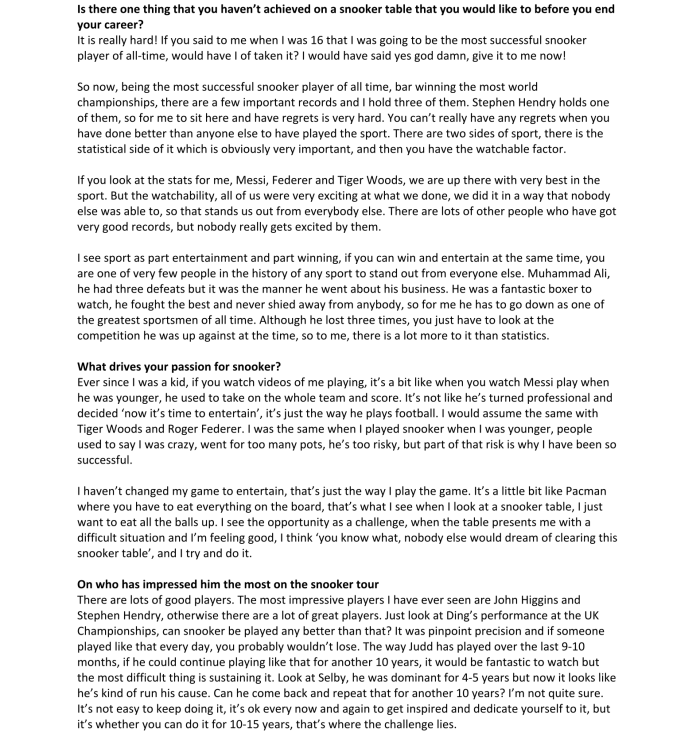
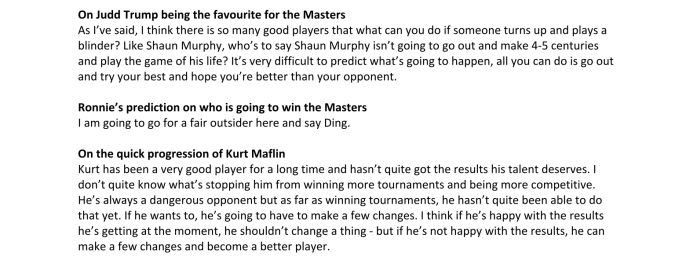
An interview with Ronnie ahead of the Masters 2020 and a Preview

This interview was conducted by Eurosport before the Christmas break.

Thank you for making it available to me.

ROSMaster2020Interview-1ROSMaster2020Interview-2ROSMaster2020Interview-3

And now for a bit of last 16 preview for what it’s worth… 

Judd Trump v Shaun Murphy

Judd Trump is the defending champion and, surely, he starts the tournament as favourite given how well he has played over the last year. In fact it was his 10-4 win over Ronnie in last year final that started it in earnest. That said he couldn’t really get a tougher opponent than Shaun Murphy in his first match. Shaun had a nightmare season in 2018/19 but is playing much better this season. Judd hasn’t been at his best just before the holidays break, he’s lost to Nigel Bond of all people in York and failed to qualify for the European Masters. Now, he was probably very tired and in need of a break. Yesterday, he won Group 6 in the Championship League Snooker. He looked in good form but CLS form doesn’t mean much: in 2010 Ronnie and Mark Selby played in Group 2, just before the Masters, finished 6th and 7th of the group, both relegated, only to meet in the Final of the Masters the next week. Shaun has been very solid this season, making it to three big finals, winning one. However, one of the finals he lost was a 10-3 defeat to Judd. I expect Judd to win, but the match to be close, probably 6-4 or 6-5. 

Ding Junhui v Joe Perry

I can see only one winner here and it’s Ding. Ding has won the 2019 UK Championship last month, playing really well. He also qualified for both the 2020 European Masters and the 2020 German Masters. During the last month of 2019 he has beaten Ali Carter, Ronnie, Yan Bingtao, Stephen Maguire, Matthew Stevens and Peter Ebdon (never easy). In fact, over the last two months he’s lost just one match. Joe Perry on the other hand has had an indifferent season so far, and was dreadful in the CLS over the last two days. His only hope is that Ding has gone off the boil completely during the holidays break. My prediction: a comfortable win for Ding: 6-2 or 6-3.

Mark Selby v Ali Carter

Mark Selby has been a bit in and out so far this season, as he has been since mid 2017, but he still won two ranking events over the last months, including the last one of  2019, the Scottish Open. He has also qualified for both the 2020 European Masters and the 2020 German Masters. He should feel reasonably confident again. Ali Carter hasn’t got past the quarter finals in any event this season so far, and that only quarter final came at the six-reds World Championship. Add to that the fact that when things don’t go his way, he’s prone to getting frustrated and throwing his toys out of his pram. I can see only one winner, Mark Selby. I won’t predict a score. Depending on Mark’s form it could be close or totally one-sided.

John Higgins v Barry Hawkins

Neither players have been at their best so far this season. John Higgins though has reached a semi final twice, where he lost to Judd Trump both times, Also, he hasn’t lost to any low ranked player all season: the only players out of the top 16 who beat him were Graeme Dott, Kurt Maflin and Yan Bingtao. Barry Hawkins is going through a terrible season. He won the 2019 Paul Hunter Classic, but other than that he didn’t go past the QF in any event, and he only reached that stage twice, in the 2019 Shanghai Masters and in the 2019 China Championship, rather early in the season. Their head-to-head is pretty close: it’s 9 wins to Higgins for 8 to Barry, and Barry actually won the last of their encounters, and the only one that was played this season. So it’s hard to call. John Higgins has got slightly better results this season, but his record at the Masters is not great. I will go for 6-4 either way.

Neil Robertson v Stephen Maguire

Both Neil Robertson and Stephen Maguire have blown hot and cold this season. Neil won the 2019 Champion of Champions, beating Judd Trump by 10-9 in the final, and Ronnie by 6-5 in the semi final, both very high quality matches. He’s also reached the semi finals in the 2019 Shanghai Masters where Ronnie beat him by 10-6, but in the ranking events he hasn’t got past the last 16. Stephen Maguire has won the 2010 six-reds World Championship, and was runner-up in the 2019 UK Championship but other than that hasn’t gone past the last 16 in any event. So, this match is very hard to predict. Neil Robertson though is coming to Ally Pally with a goal…

NeilMastersTweet

A very honourable goal. I believe that this will motivate him big time. Because of that, and because he’s been doing really well in invitational events so far, I will go for a 6-4 or 6-3 win for Neil.

Mark Allen v David Gilbert

Mark Allen has got a very strange season so far. He’s reached the semi finals 6 times out of 11 tournaments he’s played in. In the others he lost in the last 64 twice, in the last 32 twice and in the last 16 once. David Gilbert’s season has been just as bizarre: he’s made it to one final, one semi final, 4 quarter finals … but also lost in the first round 5 times.  The main factors in this match will probably be, one, that this is David Gilbert first ever Masters and the London crowd is usually quite animated and loud, and two, that Mark Allen was bitterly disappointed by his performance last year and will want to redeem himself. The rowdy atmosphere should suit him. Prediction: 6-3 or 6-2 to Mark Allen. 

Kyren Wilson v Jack Lisowski

If one forgets the Paul Hunter Classic, Kyren Wilson’s season has been rather poor: one semi final at the 2019 World Open, one quarter final at the 2019 Shanghai Masters and a couple of last 16. Jack Lisowski’s season has been similar: a final at the 2019 Scottish Open, a quarter final at the 2019 Shanghai Masters and a couple of last 16. It’s also Jack’s first Masters and, in my opinion, Jack tends to be a bit overawed when facing a big stage for the first time. This is a very big stage with a unique atmosphere. Because of this I expect a comfortable win for Kyren: 6-1 or 6-2. Now I wish I’m wrong here.

Mark Williams v Stuart Bingham

Now this one promises to be hard fough match, but not necessarily high quality. Mark Williams season hasn’t been great but there were signs in the recent months that he is back practising and playing well again. He lost to Shaun Murphy by 10-9 at the 2019 China Championship, and won 6 matches out of 6 in the round-robin phase of CLS Group 5 earlier this week. The problem with Williams is that he doesn’t seem to be able, or find the necessary motivation, to do it consistently. Stuart Bingham hasn’t got past the quarter finals in any event, and reached that stage only twice, one being at the six-reds World Championship. Not great. I expect Mark Williams to win by 6-3 or 6-4.

That’s for the first round. What about a winner? Ronnie goes for Ding; it’s a prediction he does with his heart I’m sure but I genuinely believe that Ding has a good chance. Actually, should they both win, he will face Judd Trump in the quarter finals, which is better than facing him in the final. I expect the winner of that QF to go and win the title. Other than those two, I think that Mark Selby and Neil Robertson are serious contenders.


Crucible 2019 – The Press Day

Traditionally the Friday before the World Championship is the Press Day. The top  16, the officials and the sponsor meet the members of the press.

Here are some images and videos that emerged today on social media

Meeting the press:

Ronnie remembers his best and worse Crucible moments with Eurosport

And he’s been talking to the sponsor…

As always, Ronnie sounds a bit low-key, but I honestly believe that this is part of trying to ease the weight of expectations a bit.

Meanwhile the fitters are getting the arena and practise room ready

Whilst Matt Huart has been working on a blog about the rankings (now there’s a surprise!)

Four to Fight for Season End Top Ranking

19th April 2019

Four players head to the Crucible from this Saturday looking not only to claim the Betfred World Snooker Championship title, but also to end the season as snooker’s world number one ranked player.

View the latest provisional end of season rankings

For the last seven successive seasons the honour has gone to three-time world champion Mark Selby, however having already been deposed as world number one by Ronnie O’Sullivan in recent weeks and with the prize money from his 2017 Crucible success due to fall from him ranking, there is a real possibility that this run will come to an end this year.

O’Sullivan favourite

Leading the race to finish the campaign ranked at number one for the first time since the end of the 2009/10 season is current top ranked player Ronnie O’Sullivan. The five-time world champion heads to Sheffield with a provisional total of £1,196,500 to his name, almost £200,000 clear of his closest rival.

Leading the chase is defending champion Mark Williams, who is the only player other than Ronnie whose prospects of claiming top spot remains in his own hands. This is because winning the tournament once again would guarantee that the Welshman would return to the top of the list, even if O’Sullivan were to reach the final.

Outside chance

The other two players who can still mathematically regain top spot are Neil Robertson and Mark Selby, however both would need some help by way of an early exit for O’Sullivan.

Both players would in fact need to win the tournament to stand any possible chance of leapfrogging the top two, with O’Sullivan also losing before the semi-final stage.

If O’Sullivan were to reach the last four, only Williams would be able to deny him a place at the top of the season-end rankings for what would be the sixth time in his career, while Williams is looking to finish there for a fifth time.

Also a £50000 prize has been announced for a 147 at the Crucible.

The prize for making a maximum break at the 2019 Betfred World Championship will be £50,000.

Snooker’s biggest tournament starts on Saturday and runs for 17 days, with 32 players battling for the title. And a 147 at the Crucible will be worth a £50,000 bonus.

Maximum breaks are usually rewarded from the rolling pot for 147s but with that pot down to £5,000 following Stuart Bingham’s maximum at the China Open, World Snooker and WPBSA have decided to boost the prize up to £50,000.

There is also a high break prize of £10,000.

147s at the Crucible

Cliff Thorburn 1983
Jimmy White 1992
Stephen Hendry 1995
Ronnie O’Sullivan 1997
Ronnie O’Sullivan 2003
Mark Williams 2005
Ronnie O’Sullivan 2008
Ali Carter 2008
Stephen Hendry 2009
Stephen Hendry 2012

147s this season

Michael Georgiou – 2018 Paul Hunter Classic
Jamie Jones – 2018 Paul Hunter Classic
Thepchaiya Un-Nooh – 2018 English Open
Ronnie O’Sullivan – 2018 English Open
Mark Selby – 2018 Champion of Champions
John Higgins – 2018 Scottish Open
Judd Trump – 2018 German Masters qualifiers
David Gilbert – 2019 Championship League
Neil Robertson – 2019 Welsh Open
Noppon Sanegkham – 2019 Welsh Open
Zhou Yuelong – 2019 Indian Open
Stuart Bingham – 2019 China Open

Yes, that’s 7 years ago. A maximum at the Crucible remains a rarity because a number of factors, notably the pressure because of the importance of the event and of course nobody will take unduly risks . With the big bonus gone, there wasn’t much incentive for the players to try to make one. They finally understood that it seems.

And everyone else has been doing previews. Here is mine.