Bai Yulu Completes UK Hat-Trick to Reclaim Top Ranking
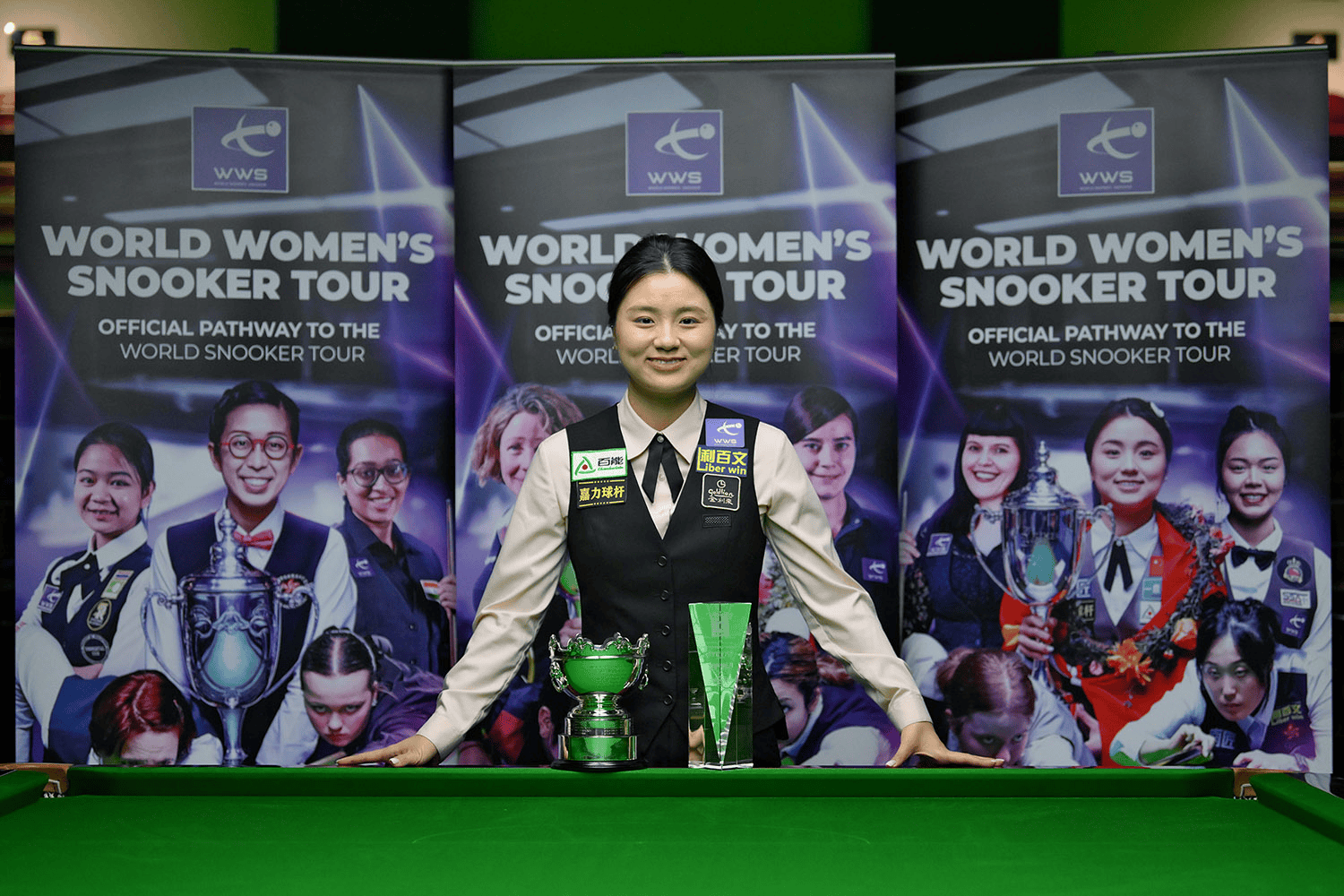
China’s Bai Yulu has defeated Reanne Evans 4-1 to lift the Taom UK Women’s Snooker Championship title for a third successive year and in doing so reclaim the world number one ranking at the Northern Snooker Centre in Leeds, England.
Bai was in dominant form throughout the three-day event as she dropped just two frames from her seven matches and compiled three century breaks during the final day, including a tournament-high run of 125, to move into second position on the all-time list.
Winner of the UK Championship in both 2024 and 2025, Bai extended her winning streak at the event to 18 matches to lift her ninth career ranking title, equalling the total of Thailand’s Mink Nutcharut and in doing so securing enough ranking points to return to the summit of the world ranking list for a second time.
For Evans, defeat in an unprecedented 17th UK Championship final nevertheless represented a strong start to the season and her second consecutive ranking final, following her run to the title match at the World Championship back in May.
The pair progressed from a high-quality field which included all of the world’s top 10 current ranked players and saw an exceptional standard of snooker played with six century breaks across the weekend and several other significant breaks across the three days.
Bai scored notable victories against three-time former champion Tessa Davidson, two-time UK finalist Rebecca Kenna and former US Open finalist Anupama Ramachandran – who had impressed with a comeback from 0-2 down to world champion Panchaya Channoi in the quarter-finals – to reach a fourth UK final.
For Evans, her route included wins against Selina Dean, rising 17-year-old star Liu Ziling and outgoing world number one OnYee Ng in the semi-finals as she eyed a record-extending 13th victory at the second-oldest event on the calendar.
It was Bai who made her intentions clear with a run of 103 in the opening frame, before Evans responded with a top run of 31 to draw level at 1-1.
China’s Bai reclaimed the lead following a close third frame, before adding a blistering run of 117 to move to within a frame of the title, which she would duly seal with a top run of 34 in what would prove to be the fifth and final frame.
Phoemphul, Davidson Defend Titles
In the Under-21 and Seniors titles there were repeat victories for Thailand’s Narucha Phoemphul and England’s Tessa Davidson, who successfully defended their titles from last year.
For top ranked Phoemphul it would be an eighth career under-21 title after she overcame Laura Killington and Liu Ziling – in doing so avenging her defeat to Liu at the last 16 stage of the main competition the previous evening. The win sees her consolidate her position at the top of the Under-21 rankings, for which she was presented with a special award for having finished last season as the top ranked junior.
It was a similar story for Davidson, who overcame Sarah Dunn 2-0 in the final to secure her fourth UK Seniors title and her 21st in total since January 2022, moving her to within two of the all-time record currently held by Jenny Poulter.
In the Challenge Cup competition for players who did not progress to the final day of the main competition, there was victory for Latvia’s Anna Prisjažņuka, who had narrowly lost out to Mink Nutcharut on a pink ball battle at the last 16 stage the previous evening.
The World Women’s Snooker team would like to express its thanks to all who contributed to a landmark event, including our sponsors, venue, live streaming production, commentary and media team for helping to make the weekend possible.
The Tour continues with the Australian Women’s Snooker Open, which runs from 17-20 October at Mounties, Sydney, Australia. Entry for the event is currently open via the ABSC website.
Many fans look down at women snooker with contempt1 and it is true that the standard is nowhere near what is produced by the top male players. The usual explanation by the “male supremacists” is that women are just somehow “inferior beings” …
Why Are There So Few Female Snooker Players at the Highest Level?
If you watch a snooker table long enough, you notice an undeniable fact: the snooker cue balls do not care who is holding the cue stick, and the pockets do not distinguish between the genders. Regardless of who strikes it, a straight blue ball aimed at the middle pocket presents the same level of difficulty and yields the same result.
Yet, when the spotlight falls on top-tier professional snooker tournaments, the field remains overwhelmingly male. Why is this the case? The simplest explanation might point to physiological differences between men and women, but that overlooks a more significant part of the story. The reality is far more complex and, in many ways, far more hopeful.
Women are not barred from open professional competitions. The World Snooker Tour is gender-neutral, and the World Professional Billiards and Snooker Association (WPBSA) actively encourages men and women to compete against one another. In fact, female players have not only competed in the World Championship and won matches on the professional tour but have also produced high-scoring breaks that would command the respect of any seasoned snooker player.
The issue is not an inability for women to play snooker; rather, it is that historically very few girls have had access to the prerequisites for reaching the elite level: opportunity, encouragement, professional coaching, match experience, and financial support. This distinction is crucial.
After all, if generations start from different positions, it is hardly surprising that the podium ends up dominated by a single group.
It Is Not a Closed Door But a Narrow Pipeline
One of the most important points to understand is that women’s snooker and men’s snooker are not simply two completely separate worlds. The main professional circuit is open to both men and women. In March 2026, the WPBSA confirmed that all players can compete in open tournaments, while World Women’s Snooker provides a dedicated development and competition pathway for women and girls.
This means a talented female player does not need to wait for someone to create a separate professional sport for her; the route to the elite stage already exists. The real challenge lies in getting enough girls onto that path.
According to World Women’s Snooker, there are currently over 170 players from 30 countries competing on its tour. While this figure is encouraging, the disparity becomes glaring when compared to the vast number of men who have historically participated in competitive snooker.
To a certain extent, competitive sports are a numbers game. If 100,000 boys seriously commit to a sport while only 1,000 girls do the same, the larger group is naturally more likely to produce a greater number of top-tier players. This is not a matter of innate talent, but of opportunity.
1. The Biggest Problem Starts at Grassroots Level
Most world-class snooker players do not suddenly discover the sport and decide to pursue a professional career at the age of twenty; their fundamental skills are usually established much earlier.
Young players spend years mastering their stance and cue action, learning to judge ball speed and control the cue ball, and perhaps most importantly learning to anticipate and plan their shots several moves in advance.
By the time future professionals step onto the stage of major tournaments, they have often logged thousands of hours of practice at the pool table. Historically, however, very few girls have gone through this process.
This creates a simple but powerful cycle:
Fewer girls playing → fewer junior competitors → fewer elite prospects → fewer female professionals → fewer visible role models → fewer girls inspired to start.
It becomes a vicious cycle that is difficult to break. To break it, merely paying lip service to women’s participation is far from enough. They need places to play, coaches who provide serious instruction, a variety of tournaments, and parents who recognize snooker as a genuine sporting opportunity; above all, they need to see people like themselves standing in the spotlight at major events.
2. Where Are the Female Role Models?
This is perhaps one of the most easily underestimated factors. Just imagine the situation for a 10-year-old girl who loves snooker but has never seen a woman competing at the Crucible, the iconic home of the World Snooker Championship.
It is difficult to envision yourself becoming something you have never seen before. That is precisely why players like Reanne Evans, Ng On Yee, Mink Nutcharut, Bai Yulu, and Panchaya Channoi are significant far beyond their individual match results.
They are powerful proof that “anything is possible.” Reanne Evans is perhaps the quintessential example. The English player is the most successful female snooker athlete in history, having won a record 12 World Women’s Snooker Championship titles and 58 WWS (World Women’s Snooker) ranking event titles. Furthermore, in 2010, she successfully navigated the qualifiers to become the first woman to reach the main stage of the World Snooker Championship. This was not merely a footnote in snooker history, but a genuine milestone. Moreover, the story is no longer just about Evans alone.
China’s Bai Yulu has emerged as another pivotal figure. She won the World Women’s Championship in both 2024 and 2025, becoming the first Chinese player to claim the title and thereby earning a professional tour card for the World Snooker Tour (WST). In 2025, she recorded a break of 145 at the International Championship, setting the record for the highest break ever achieved by a female player in a WST event at the time.
Then, 2026 brought another remarkable breakthrough. At just 18 years old, Thai player Panchaya Channoi defeated Reanne Evans 6–2 to claim the 2026 World Women’s Championship title and secure a two-year WST professional tour card. She thus became the youngest women’s world champion since Ann-Marie Farren in 1987.
These stories matter because the next generation needs more than just posters; they need tangible examples.
3. The Professional Gap Is Also a Financial Gap
Becoming a professional snooker player is expensive, involving expenses such as travel, accommodation, tournament entry fees, training time, coaching, and cue equipment. Furthermore, countless hours spent at the table often yield no financial return. For a player striving to break through, the financial pressure presents a challenge every bit as daunting as facing a tricky black ball during a match.
Historically, prize money and commercial exposure in women’s snooker have lagged behind mainstream professional events. This creates a dilemma for aspiring players: how can one maintain professional-standard training when financial means cannot support the daily life of a professional athlete?
A player with financial backing can devote more time to training and traveling to tournaments, whereas another might have to work during the day, squeezing in practice whenever possible and traveling to compete on weekends. Both may be exceptionally talented, but realizing that talent takes time. That is precisely why sponsorship is so crucial.
Increased investment means more than just writing bigger checks for established stars; it means giving promising newcomers opportunities to grow into the superstars of the future. Coaching stipends, youth development programs, travel support, equipment sponsorship, and tournaments with richer prize purses all help broaden the talent pipeline.
4. Competitive Experience Is Difficult to Replace
Snooker is a unique sport because training differs vastly from actual match play. Even if you can make century breaks in practice, you might still lose in the first round of a competitive match; pressure changes everything. The silence of the arena is different, the atmosphere created by the crowd is different, and the sensation of your opponent sitting across from you is different. In an instant, a simple red ball, one you’ve potted five hundred times before, can suddenly seem impossibly out of reach.
It is precisely by navigating these moments time and again that elite players develop. They learn to reset their mindset after missing an easy shot, to close out a frame, to win even when their form isn’t at its peak, and to manage their nerves. For a long time, the small pool of female players meant that women and girls rarely had the opportunity to immerse themselves in such a competitive environment over the long term.
This is why establishing dedicated women’s tournaments is crucial. A robust women’s tour is by no means a “consolation prize”; rather, it acts as an engine for talent development. It provides regular match experience, a ranking system, healthy competition, and a pathway to the professional circuit.
Today, the World Professional Billiards and Snooker Association (WPBSA) recognizes the World Women’s Snooker (WWS) Tour as an official qualification route to the World Snooker Tour (WST). All signs indicate that this system is already yielding results.
For the 2026/27 season, Channoi and Bai Yulu have been nominated to compete on the World Snooker Tour (WST) alongside established professionals Ng On-yee and Reanne Evans, a perfect example of the kind of bridge the sport needs.
5. Does Physical Difference Matter?
Some think physical differences explain the disparity; others think physical differences don’t matter, and the truth is more nuanced. Snooker is not a sport where strength determines victory or defeat. Precision, timing, concentration, tactical judgment, cue ball control, and consistency are very important.
However, physical characteristics can affect certain aspects of the game. On average, men are taller and stronger than women. Sometimes, more reach can make a particular shot more comfortable, and extra power can be produced when the shot calls for it.
But it would be a mistake to take these average differences as a comprehensive explanation of the occupational gender gap. There are many players in snooker whose success relies on touch rather than brute force. Smaller players can use technique, balance, cue extension, table knowledge and smart shot selection to overcome physical limitations.
The evidence from women’s snooker itself tells an important story. Female players regularly produce strong drives and high-level positional play. Reanne Evans has twice shot 140 on the WWS rankings, while Bai Yulu has scored at an elite level on the Open Pro Tour.
So, biology can influence certain physical properties, but biology cannot explain the entire situation. Far more importantly, it does not explain why so few girls start playing seriously in the first place.
6. What About the Cueing Stance and Body Shape?
There has also been a long-running claim that women’s body shape makes certain aspects of cueing more difficult. This is an area where caution is needed. There is no good reason to suggest that women’s bodies inherently prevent them from developing an effective snooker technique.
Players will naturally adjust their stance, bridge, cue position and alignment to fit their body shape. Every player is slightly different. Some are very tall. Some are very short. Some people have very broad shoulders. Some are very slim. Some people have very long arms. Others rely on compact movement.
Good coaches find a repeatable technique that works for each player rather than forcing everyone into the same pattern. In other words, the question shouldn’t be: “Does a woman’s body prevent her from playing snooker?” It should be: “Has she received enough instruction and practice to discover a technique that works for her?” That’s a more useful question.
7. The Importance of Starting Young
If there’s one lesson other sports have taught us, it’s that elite development takes time. Players who start training seriously at the age of eight or ten have a huge head start over players who start playing competitive snooker at 18 years old.
This doesn’t mean that people who start late can’t succeed. They can. Nutcharut Wongharuthai is a good reminder that development does not always follow a clear timeline. But the sooner players receive quality coaching and meaningful competition, the better chance they have of developing elite habits.
That’s why junior snooker deserves serious attention. If the sport wants to have more women at the top in 10 or 15 years, it needs more girls around the snooker table today. Not next year. today.
8. Women’s Snooker Is Already Producing Elite Talent
There is no need to make snooker easier for women; there is no need to change the tables, there is no need to change the rules, there is no need to pretend that competition doesn’t matter. What the sport needs is a bigger, stronger, more supportive pathway for women to meet the same standards. The available evidence gives us good reason to believe it will happen.
It is easy to talk about the problem and forget the progress. That would be a mistake. The women’s game has produced players with extraordinary records.
Reanne Evans has dominated women’s snooker for more than two decades. Ng On Yee became the first player from outside the UK to reach world number one in the WWS rankings in 2018. Mink Nutcharut became world number one in 2023. Bai Yulu reached number one in 2026 and became a two-time world champion. And in May 2026, 18-year-old Panchaya Channoi became world champion after defeating three previous world champions on her way to the title.
That is not a sport without talent. It is a sport with a talent pool that is still growing.
9. The Numbers Are Moving in the Right Direction
There is another reason to be optimistic. The women’s game is becoming increasingly international.
The current WWS rankings feature players from England, China, Hong Kong, Thailand, India, Mongolia, Australia, Latvia, Iran and other countries. That matters.
Snooker becomes stronger when talent is discovered in more places. China is an especially interesting example. Bai Yulu’s rise demonstrates how investment, local interest and a growing competitive environment can help produce elite players.
The 2026 World Women’s Championship was staged at a purpose-built venue in Dongguan Changping, with the event secured at the venue for a longer-term period through 2031. This is how a movement grows, not overnight, not with a marketing campaign, but by building an ecosystem.
10. What Would Help More Women Reach the Top?
There is no single magic trick. Instead, the sport needs to strengthen several parts of the pathway at the same time.
More Girls Playing at Grassroots Level
Schools, clubs and junior programmes can introduce snooker to girls before the old stereotypes have a chance to take root. The earlier snooker becomes “a sport I play” rather than “a sport boys play”, the better.
Better Access to Coaching
A promising young player needs someone who can spot potential and teach the fundamentals properly. Good guidance can save years of trial and error.
More Female Role Models
Young players need people to look up to. Every time Evans, Bai, Channoi, On Yee, or Nutcharut appears on a major stage, another young player can think: “Perhaps I could do that too.” That thought is worth more than it sounds.
Stronger Financial Support
More sponsorship and prize money would allow more women to treat snooker as a serious professional career rather than an expensive hobby.
More Media Exposure
The sport needs to tell the stories behind the players. A viewer may not understand every safety exchange on their first night watching snooker. But they can understand ambition. They can understand pressure. They can understand a teenager chasing a dream. They can understand an experienced champion refusing to give up. Stories bring people into sport.
The Future Should Not Be About “Men Versus Women”
Perhaps the most important change is the way we frame the discussion. The goal should not be to prove that women are “better” than men or that men are “better” than women. That misses the point. The real question is: How much female talent has never been discovered because the opportunity to develop it never existed? We simply do not know the answer. And that is precisely why the future is exciting.
If more girls start playing at eight, nine or 10 years old, if more girls receive quality instruction, if more girls compete regularly, if more girls can travel and practice, if more girls see women succeeding on the biggest stages, then the talent pool will get deeper.
Then, and only then, will we have a much clearer picture of how close the very best women can come to the very best men in open professional snooker. Perhaps the next great female player is already out there. Perhaps she is eight years old, holding a cue for the first time. Perhaps she has just made her first decent break and is quietly thrilled because the white ball finished exactly where she wanted it. Perhaps nobody has noticed her yet. That is where the real opportunity lies.
Choosing the Right Snooker Cue for Female Players
If there’s one thing that deserves clarification, it’s this: there is no “women’s snooker cue” that every female player should use. A good snooker cue should fit the player, not the label.
Women can and do play snooker with standard full-size cues, and many experienced female players are perfectly suited to using 57″ or 58″ snooker cues. A better question is not “Which cue is made for women?” but “Which cue allows me to cue naturally, comfortably, and consistently?”
This distinction is important, especially for younger players, beginners, and people of smaller stature. Prompts that feel too long or awkward can make a technically difficult game feel harder than it needs to be. The right pool cues, on the other hand, feel like an extension of your arm: balanced, predictable, and reassuring.
Start with Height and Cueing Position
Height is one of the most useful starting points when choosing a snooker cue, although it should not be considered an absolute rule.
The length of a standard snooker cue is usually around 57 inches to 58 inches, which is a perfect length for many adult players. However, smaller players may find a 56-inch cue more comfortable, especially if they are learning to establish a stable stance and bridge.
The goal is simple: When you hit the ball, you should be able to assume a natural position without feeling like you’re stretching your body to control the cue.
A shorter cue can be especially helpful if you regularly find yourself:
Struggling to maintain a comfortable stance
Feeling that the butt of the cue gets in the way during your backswing
Crowding the table when addressing certain shots
Finding it difficult to keep your cue arm and bridge hand relaxed
Losing consistency because you are concentrating more on handling the cue than playing the shot
For junior and smaller-stature players, this becomes even more important. A 51″ or 53″ junior snooker cue can provide a much more manageable starting point than immediately handing a young player a full-length cue.
Cue Weight: Control is More Important Than Numbers
Weight is another aspect of personal preference that is very important. There is no magic cue weight that automatically makes a cue better for female players. Naturally, lighter players may prefer lighter cues, but body size alone won’t dictate what feels best. Some women enjoy a substantial cue because it gives them a solid, planted feeling through the shot, while others prefer something lighter and more responsive.
What matters is whether you can successfully deliver the prompt. A cue that feels too heavy may cause unnecessary tension in the cue grip and cueing arm. One that feels too light can sometimes feel less stable, particularly when playing longer shots or applying more pace.
For growing players, balance and control are often more useful considerations than simply chasing a specific number on the scale.
Is a 9.5mm Tip Suitable for Female Players?
For traditional snooker, 9.5mm is a very suitable cue tip size for both male and female players. The smaller tip than many American pool cues allows for precise contact with the cue ball and provides ample control for positional play, spin shots, stun shots, and delicate touches.
The key is not whether the player is male or female. This is a hint as to whether it is appropriate for the game you are playing. The well-prepared 9.5mm tip provides a useful balance between control and forgiveness, especially for players learning to manage the motion of the cue ball. Players looking for a different feel can also consider the professionally installed ELK Master Tip upgrade.
although they wouldn’t look down with contempt at their boobs when they are down on the shot, if given the opportunity. 😎 ↩︎
4 thoughts on “Women Snooker News and a VERY interesting article about Women and Snooker”
Why isn’t the prize money for the women’s events clearly known? It’s always so hard to find out, and the Wikipedia pages don’t have the info either. Like the UK Championship that Bai just won, how much money did she win?
Loading...
I have no clue, I couldn’t find the information either.
Loading...
That article bears many hallmarks of having been composed either wholly or with the aid of a large language model AI ‘assistant’, and should therefore be viewed with extreme caution.
Loading...
It may possibly be AI edited Andy, but what it says is still valid. There was a time when I traveled to the snooker events a lot to take pictures, and that included many of the women’s tour events. These events are good for young female beginners players. The atmosphere is friendly to them and that is important. I have been a many PTC events as well and a few females played in them. Some behaviours from fans towards female competitors were really unacceptable but there wasn’t always a referee around to intervene because tables in early stages didn’t have a dedicated referee, instead there were “roving” referees supervising several tables. There was verbal abuse, usually with sexual innuendo, often as they were right on the shots. There was kneeling just in front of the table as they prepared from break-off, to explicitly peak into their bodice. The guilty party usually stated that this was only joking, a bit of fun. It certainly wasn’t fun for the targeted girls and it didn’t help their concentration on the match either.
Loading...
Comments are closed.
Discover more from Ronnie O'Sullivan
Subscribe now to keep reading and get access to the full archive.


Why isn’t the prize money for the women’s events clearly known? It’s always so hard to find out, and the Wikipedia pages don’t have the info either. Like the UK Championship that Bai just won, how much money did she win?
I have no clue, I couldn’t find the information either.
That article bears many hallmarks of having been composed either wholly or with the aid of a large language model AI ‘assistant’, and should therefore be viewed with extreme caution.
It may possibly be AI edited Andy, but what it says is still valid. There was a time when I traveled to the snooker events a lot to take pictures, and that included many of the women’s tour events. These events are good for young female beginners players. The atmosphere is friendly to them and that is important. I have been a many PTC events as well and a few females played in them. Some behaviours from fans towards female competitors were really unacceptable but there wasn’t always a referee around to intervene because tables in early stages didn’t have a dedicated referee, instead there were “roving” referees supervising several tables. There was verbal abuse, usually with sexual innuendo, often as they were right on the shots. There was kneeling just in front of the table as they prepared from break-off, to explicitly peak into their bodice. The guilty party usually stated that this was only joking, a bit of fun. It certainly wasn’t fun for the targeted girls and it didn’t help their concentration on the match either.