1. Transcending snooker: The perfect 147

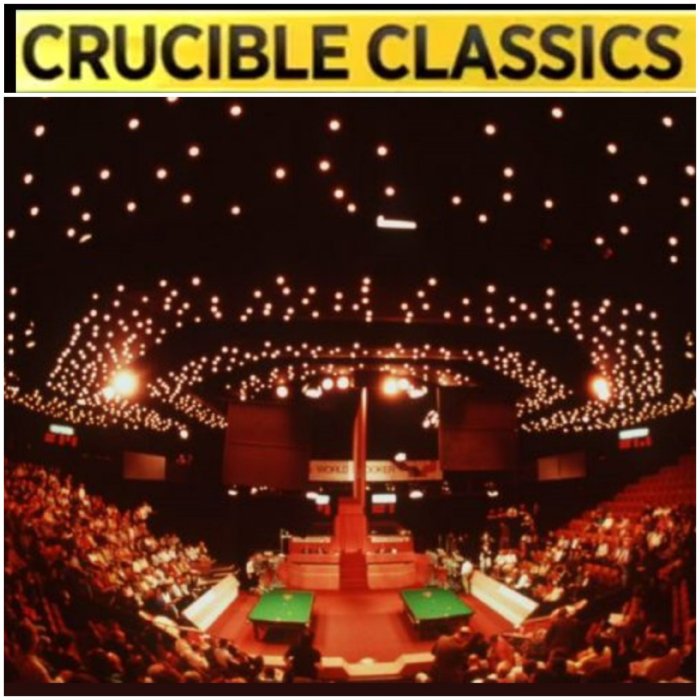
A maximum break with minimal fuss. O’Sullivan has been playing snooker professionally for an astonishing 28 years and rejoiced in 15 maximums, but he could add another 28 to that elongated mark and never quite encounter the fanfare he received for his 147 against Mick Price in the first round of the World Championship in 1997. Achieved in five minutes and 20 seconds, it was later discovered he officially completed the break in only five minutes and eight seconds at a mesmerised Crucible Theatre. A sort of Usain Bolt among snooker balls, it is a world record as the fastest competitive maximum in history.
t was the perfect break, the sporting equivalent of shooting 59 on a golf course, scalping 10 wickets in a Test innings, netting the perfect hat-trick in a Champions League match or despatching 24 aces in a set of tennis at Wimbledon. Some have compared to it a nine-darter in darts or a hole in one in golf, but there is a level of luck and chance in those sporting feats that a maximum break in snooker overshadows with 36 consecutive balls needing to be sunk to reach green baize nirvana. It is an achievement that transcends his sport, but the skill levels should not be disputed when you consider Cliff ‘The Grinder’ Thorburn required 15 minutes to make the first 147 at the sport’s blue-chip event in 1983.
It was not just the level of brilliance, potting and creativity that marks it out as the greatest 147 in the history of snooker, but the speed and fluidity with which it was achieved. O’Sullivan built his opus with cueball control as tight as two coats of paint. In the moment and sprinkling magic dust all over his Crucible canvas, it takes longer to piece together a decent sandwich. It still makes for scrumptious viewing 23 years on as the young O’Sullivan, suddenly £147,000 richer, nonchalantly tosses his chalk into the crowd before asking for a fresh one. At the age of only 21, he had the key of the Crucible door.
2. Back to black: Successive world titles after year in the wild

O’Sullivan decided to head into the wilderness after claiming his fourth world title in 2012 with an 18-11 win over Ali Carter, the man he had usurped 18-8 to lift his third title four years earlier. Apparently disgruntled about a new contract, the sport continued for a year without O’Sullivan, who occasionally opted for voluntary work on a farm during his sabbatical. He lost 4-3 to Simon Bedford in a low-key event in September 2012, but that was his only official green baize engagement over a 12-month vanishing act.
A press conference alongside fellow crowd favourite Jimmy ‘Whirlwind’ White to promote a vodka brand announced his intention to return to the scene of his triumph. It was his first competitive tournament in a year, but nobody would really have noticed.
O’Sullivan was in imperious form in Sheffield as he bulleted beyond Marcus Campbell, Carter, Stuart Bingham and Judd Trump before overseeing a commanding 18-12 victory over Barry Hawkins that contained six centuries to reign supreme.
Little did he know then that it would the last of his five world final victories, but it remains a quite sublime achievement to depart rarefied sport for so long yet manage to retain the game’s most coveted prize. How O’Sullivan was not nominated for the BBC Sports Personality in 2013 remains bewildering because as a stand-alone feat returning from a year off remains quite mind-boggling. O’Sullivan, Hendry and Steve Davis remain the only figures to successfully defend the tournament in the modern era. It will go down as one of the finest sporting comebacks of recent times.
3. Teenage kicks: The 1993 UK Championship victory
Such was the fascination with O’Sullivan after he lifted the UK Championship as a teenager in 1993, he wound up chatting to British chat show mainstays Richard and Judy the following day clutching his pot and new found fame. While snooker was slowly on a downward trajectory after the heady televised bonanza of the 1980s, the O’Sullivan story was capturing the imagination of the British public.
Set against the background of his dad being jailed for murder a year earlier, it meant O’Sullivan’s cueball crystallisation was bitter sweet, but espoused a very human aroma. To overcome the all-conquering Stephen Hendry 10-6 at the age of 17 and 358 days hinted at something very special. He remains the youngest winner of a ranking tournament in the history of the sport, but this was merely the first of his record seven UK successes. He pieced together two centuries and seven plus 50 breaks in a display full of swagger and self-belief that belied his years.
It was a coming of age triumph for O’Sullivan which had more than a touch of Alex ‘Hurricane’ Higgins about it at Preston’s Guild Hall, scene of Higgins’ 16-15 win over Steve Davis from 7-0 behind a decade earlier. A new people’s champion had been crowned.
“I’ve had some magical moments at the UK, the greatest of which is probably winning my first ranking event against one of my heroes in Hendry. It is an event I love playing in, second only to the World Championship. I’ve played some great matches at the UK.”
4. Avoiding nearly man tag: Winning the first world title

There was an air of expectancy when the 25-year-old O’Sullivan reached his first world final in 2001. Out of the class of ’92 of O’Sullivan, John Higgins (1998 world champion) and Mark Williams (2000 world champion) he was the only member of that golden triumvirate who had not yet lifted the world title. In encountering Higgins chasing a second win in the final, it was far from certain he would emerge victorious against such a daunting foe on the sport’s grandest stage.
O’Sullivan pieced together four sessions of focused snooker to keep the Scotsman at bay which illustrated not merely an ability to win the World Championship, but also his penchant for handling pressure under the fiercest heat. To emerge clasping the old pot with an 18-14 win was a relief as much as a moment to reflect. It is a sensation that Judd Trump experienced on the cusp of turning 30 in 2019. Landing the first one is like switching off a valve having been tipped for years to become world champion, but Jimmy White’s travails in losing six finals proves nothing is certain in a life spent in darkened rooms. It also suggests popularity is a poor second to poise.
“I am so happy to have won this event,” said O’Sullivan.
“Admittedly, the Jimmy White curse was weighing on my mind. You think about what happened to him and you wonder how he ever went back into that arena after losing the final six times. I was really feeling it from a mental point of view. I have never felt anything like it but you can guarantee I will be the happiest man in Sheffield tonight.”
Eight years after overcoming Hendry at the UK, he was finally world champion.
5. The young Master: A first triumph in London
The first of O’Sullivan’s seven Masters gongs was picked up way back in February 1995 at a time when snooker events were sponsored by cigarette companies, Blur and Oasis battled for UK chart supremacy and Eric Cantona karate kicked a fan at Selhurst Park. He came across fellow 19-year-old Higgins in the final. Higgins was only in the event on a wildcard, but showed his qualities by advancing to a duel with his time-honoured rival.
For the record, O’Sullivan overcame John Parrott, Terry Griffiths and Peter Ebdon in reaching the final at the old Wembley Conference Centre.
It was fairly a underwhelming denoument considering their latter achievements with neither player contributing a century, but O’Sullivan emerged stronger with a 9-3 victory seeing him become the youngest ever winner of the elite invitational event at the age of 19 years and 69 days.
And so began his love affair with the London tournament, an event that O’Sullivan thrives in as much as TOWIE in the Sugar Hut.
6. Back in business: Berlin provides return to former glories

There are greater tales of triumph and torment in the O’Sullivan back catalogue, but nobody should underestimate the importance of his victory at the German Masters in 2012. O’Sullivan had been largely in the doldrums since his success at the World Championship in 2008. Still capable on his day, but under-performing seemed to be the story as he careered towards the latter half of his thirties. The opening round of the German Masters was a staging post in his upturn.
O’Sullivan had gone three years without winning a ranking tournament, was 16th in the world and in danger of being forced to qualify for the World Championship. He trailed 4-0 in the first round to an inspired Andrew Higginson, who produced runs of 80 and 67 to move to the cusp of the last 16 and a resounding whitewash. O’Sullivan was one ball from defeat and 63 points behind, but went for broke, walloped in a blistering trademark long red and rallied by edging the second frame with a break of 67 enough to deny him on the black and a 5-1 victory.
He won the next three frames with three plus 50 knocks to complete the great escape. The significance of the 5-4 win should not be underestimated as victories over Joe Perry, Matthew Stevens, Stephen Lee and Stephen Maguire saw him clasp his first prize since the 2009 Shanghai Masters.
Within three months, he would be world champion for a fourth time.
7. The 1,000 century: A new landmark
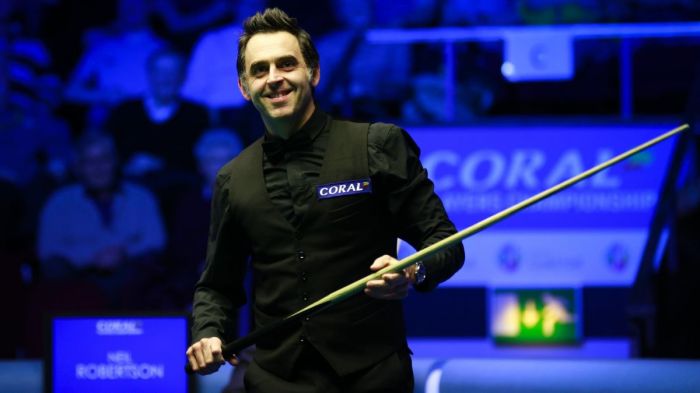
Despite his own protestations, O’Sullivan thrives in the limelight. He has always had a touch of theatre about him. A staged managed century, it was probably of minimal surprise that O’Sullivan became the first man to reach 1000 centuries in the final frame of his 10-4 victory over Neil Robertson in the final of the Players Championship at Preston’s Guild Hall. It was as if his career came full circle after lifting the UK Championship as a teenager for the first time at the same venue 26 years earlier.
Other players will go beyond that total in years ahead, but O’Sullivan was like a snooker Sherpa. He will always be recalled as the first man to reach the green baize promised land.
“It’s been a history making year. 19 majors, 1,000 centuries and in touching distance of Hendry’s 36 ranking events, so I’m totally delighted.”
8. Overhauling Hendry: Passing the great Scot’s century haul
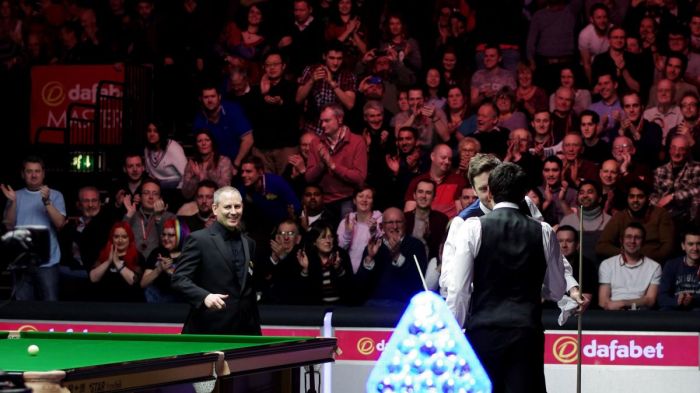
The Masters in 2015 was another seismic moment in the Rocket’s regalia. Watched by his celebrity mates in Rolling Stone Ronnie Wood and the artist Damien Hirst, O’Sullivan has always been as comfortable at the Masters as a cockney wallowing in jellied eels, mainly because he doesn’t have to travel far. He doesn’t so much arrive at the Masters as sweep in like some sort of heavyweight boxer. The raucous locals expect as much as a Morrissey concert, and O’Sullivan tends never to disappoint.
His 6-4 win over Ricky Walden in the quarter-finals – a figure he had butchered 6-0 a year before in the first round in one of the finest exhibitions ever witnessed in the event – produced a moment of TV gold as he set about equalling Hendry’s career record total of 775 centuries.
With Hendry commentating on his 46th birthday, O’Sullivan needed to fluke the final yellow to complete the ton. He duly bludgeoned the balls in a vain attempt to keep the break going. “You never know. There’s six pockets on a table,” said an excitable co-commentator John Virgo, the 1979 UK champion. The yellow duly galloped down a middle pocket and left him bang on the green. O’Sullivan mopped up
With Hendry watching in the commentary box, O’Sullivan rolled in the blue for the century as Virgo blurted out: “Happy birthday, Stephen”. It was fitting moment to equal Hendry. He passed it with a break of 101 against Marco Fu in the quarter-finals. All of O’Sullivan’s birthdays had come at once.
9. Passing Davis: Breaking the Nugget’s UK record
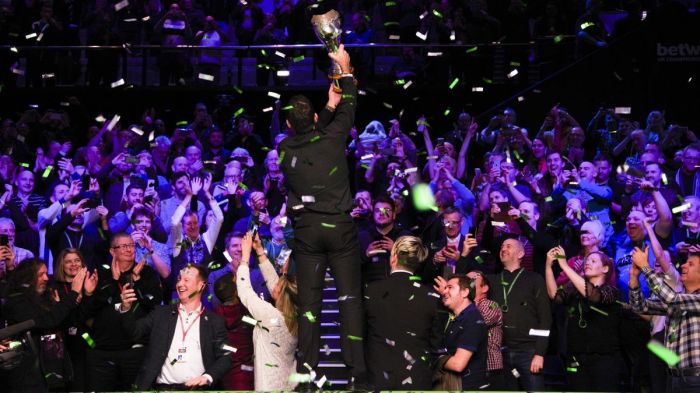
For a man with a desire to run miles in his spare time, O’Sullivan is well aware of personal milestones. Leaving a legacy in any sport is what drives individuals on, and O’Sullivan is no different. Steve Davis had won six UK titles, a figure that looked likely to remain intact when O’Sullivan lost 10-7 to his nemesis Mark Selby – a man who had come back from 10-5 behind to deny him a sixth world title 18-14 in 2014 – in the 2016 UK final.
O’Sullivan would not be deterred as a cavalier 10-5 win over Shaun Murphy in the 2017 final and a 10-6 triumph over Mark Allen in 2018 saw him equal and pass Davis, a pristine player who had inspired him to pick up a cue for the first time in the 1980s. O’Sullivan was well aware of the moment as he stood tall among the crowd, clasping the trophy closer to his bosom than the £170,000 winner’s cheque. “History is fantastic. “It’s amazing, I can’t believe it.
“I played very well, but I still had to convince myself because that is how hard it felt. It’s great to create history, great to beat Steve Davis’ record.”
10. Return to the promised land: Back at number one in his 40s
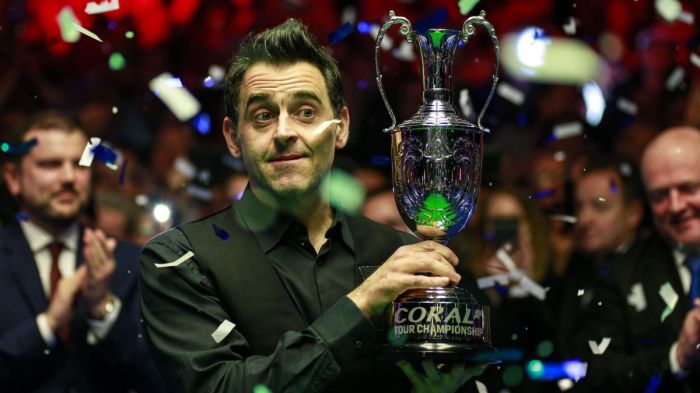
O’Sullivan has mocked the pursuit of ranking points, but they point to a direction of travel in a snooker player’s career. He has not only survived since turning 40, but has also flourished finding a new meaning and edge to his career that arguably eluded him in the two previous decades with a more measured approach from distance supporting his destructive short game. Avoiding the need to attempt outlandish pots, he has disavowed the notion that decline becomes natural as the years roll by becoming number one after a nine-year hiatus in March 2019.
As a mark of his application, he became the oldest and boldest number one in snooker since the six-times world champion – and a former mentor to O’Sullivan on tactical strategy – Ray Reardon of Wales held the coveted slot in 1983 aged 50.
When you look at the game’s other dominant forces, failure came with the passage of time: Steve Davis could not win another ranking event beyond the age of 37 – he landed the Masters aged 39 in 1997. And Stephen Hendry’s final ranking event success came in the Malta Cup in 2005 at the age of 36 before he retired at the age of 43 in 2012 fed up with his technique faltering.
O’Sullivan turned 40 in December 2015, and has won nine ranking events since that juncture including two UK titles plus two more invitational Masters. O’Sullivan’s longevity has been startling. He remains two world titles short of Stephen Hendry’s haul of seven world championships in the modern era, but it is the only meaningful live record he does not hold. It is also testament to his genius that some commentators believe he has underachieved for the amount of talent he possesses, but then again O’Sullivan has fought the black dog of depression while attempting to keep his career on the rails.
When O’Sullivan finally departs the scene, he will be sorely missed, but he has also laid down a quite majestic thesis on how snooker should be played as a mass entertainment sport. Indeed, its future probably depends on it.
Desmond Kane
Do you agree with our selection? Lets us know your thoughts



 Ronnie O'Sullivan