16 players announced for the 2020 World Championship qualifiers

This was published by WPBSa today:


WPBSA Qualifiers Announced for 2020 World Snooker Championship

11th March 2020

Snooker’s world governing body the World Professional Billiards and Snooker Association (WPBSA) and the World Snooker Tour (WST) have today announced the 16 amateur qualifiers selected to play at next month’s Betfred World Snooker Championship in Sheffield.

To be held at the English Institute for Sport from 8-15 April 2020, the qualifying rounds for this year’s World Championship will again be contested by main tour players not ranked inside of the world’s top 16 following this month’s Tour Championship, who will be joined by 16 elite amateur players to complete the draw.

The qualifying tournament will be run under an all-new format which will see those players seeded 17-48 needing to win two matches to join the world’s top 16 at the iconic Crucible Theatre. Remaining players will be required to win up to four matches to play on snooker’s greatest stage.

The 16 amateur players selected by the WPBSA have each earned their places on the basis of their performances at international amateur events including this year’s World Snooker Federation tournaments and Challenge Tour.

  1. Ashley Hugill – WSF Open champion, Challenge Tour number one ranked player, winner of two Challenge Tour events 2019/20, made maximum break at Challenge Tour event. Joins WST 2020/21 season.
  2. Gao Yang – WSF Junior Open champion, leading Chinese junior, Joins WST 2020/21 season.
  3. Lukas Kleckers – Won WST Place at Challenge Tour and winner of one Challenge Tour event. Joins WST 2020/21 season.
  4. Iuilan Boiko – WSF Open runner-up (aged 14).
  5. Sean Maddocks – WSF Junior Open runner-up, youngest player to make officially recognised maximum break.
  6. Dean Young – Challenge Tour Event Winner, WST Shoot Out last 32.
  7. Saudi Arabian Champion/No.1 – Saudi Arabia Sports Development Invite.
  8. Challenge Tour Play-Off Winner TBC – Winner of Challenge Tour play-off, Joins WST 2020/21 season.
  9. Reanne Evans – World Women’s Snooker No.1 ranked player and reigning world women’s champion.
  10. Ng On Yee – World Women’s Snooker No.2 ranked player and 2020 Belgian Women’s Open champion.
  11. Nutcharut Wongharuthai – World Women’s Snooker No.3 ranked player, first female player to make a verified maximum break, World Women’s Snooker Championship runner-up 2019.
  12. Aaron Hill – European Under-18 Championship winner 2019 & 2020, Shoot Out last 32, WSF Junior Open semi-finalist
  13. European Under-21 Championship winner TBC (10-14 March 2020)
  14. Cody Turner – Oceania Under-21 Championship Winner
  15. Ross Bulman – WST Shoot Out Last 32, German Masters performance beating Barry Hawkins.
  16. Wu Yize – WSF Junior Open semi-finalist

All players selected will appear subject to acceptance of their place and any travel restrictions in place. Any replacement players will be selected from a reserve list to include performances at World Snooker Federation and Challenge Tour events.

Good to see that this year the main focus is on young players. Good luck to them all!

Snooker news – March, 10, 2020

Yes, another snooker news episode…

The 2020 Gibraltar Open starts tomorrow. The rig is well underway at a new, much bigger venue.

Whilst the audience is restricted to maximum 100 persons, elsewhere it’s been announced that the Cheltenham festival and the London Marathon will go ahead as usual. Now folks, someone has to explain this to me. Is it that big money is immune to the covid-19? Or is it that actually all this hysteria is just that … hysteria and way over the top panic that is right away forgotten when big interests are at stake? You make your mind. You know my views.

Anyway, justified or not the panic is in top gear and the event is already suffering an unprecedented number of withdrawals as you can see here. Amongst the pros, Maguire, Carter, Dott and Noppon Saengkham have withdrawn. This means that Maguire and Dott  are definitely not going to qualify for the Tour Championship, and Carter and Dott will now definitely have to qualify for the Crucible.

Regarding te Tour Championship WST has already published some information regarding the schedule.

World Champion Judd Trump will play his opening match on the first day of the Coral Tour Championship in Llandudno on Tuesday next week.

Trump and Shaun Murphy – the top two seeds – have already had their quarter-final matches scheduled at the tournament which runs from March 17 to 22 at Venue Cymru in North Wales.

Trump will play at 1pm on 7pm on Tuesday March 17, while Murphy will be in action at 1pm and 7pm on Wednesday March 18.

It’s an elite field with only the top eight players on the one-year ranking list earning a place. Also sure to be in the line-up are Mark Selby, Neil Robertson, Ding Junhui and Yan Bingtao, and their matches are yet to be scheduled.

Mark Allen and John Higgins currently occupy seventh and eighth spots in the one-year rankings, but they could be overtaken at the last counting event, this week’s Gibraltar Open.

Stephen Maguire must reach the final in Gibraltar to jump into the top eight, while Graeme Dott, Thepchaiya Un-Nooh, Kyren Wilson, Joe Perry and Mark Williams all need to win the title.

The full draw and format will be released on Monday March 16, with the top seed (Trump) playing the eighth seed, second (Murphy) playing seventh and so on.

Trump has already won five world ranking events this season – one more would set a new record for the most in a single campaign.

Televised by ITV4, it’s the final tournament in the Coral Series, with the player earning the most money across the three events to earn a huge £100,000 bonus. The top prize on offer in Llandudno is a further £150,000.

Tickets starting at just £15 and VIP packages starting at £75 are still available for certain sessions but must be booked fast – for details call 01492 872000 or CLICK HERE

Neil Robertson won the first event in the series – the Coral World Grand Prix in Cheltenham in February, while Trump took the trophy at the second, the Coral  Players Championship in Southport earlier this month.

As it stands Judd Trump is set to face John Higgins in his opening match, whilst Shaun Murphy is set to play Mark Allen. This event is going ahead without particular restrictions, despite likely to attract a lot more viewers on site than the Gibraltar Open.

Regarding big money and my pet hate, snooker’s betting fuelled sponsoring, here is another interesting paper by the bylinetimes.

Iwan Doherty and Stephen Colegrave look at how the huge growth in gambling activity and revenue has grave consequences for society.

The gambling industry is growing up fast – with its worth increasing from £8.4 billion in 2011 to roughly 14.4 billion today.

Online gambling is fuelling this growth and, although nearly half of us are participating in gambling regularly, an increasing minority is suffering the consequences of its dark side in terms of debt and mental health. Indeed, 4.7% of problem gamblers claim to have attempted suicide.

Gambling has become all pervasive, with constant television adverts and marketing at sports events and, as online gambling dominates, the most active gamblers are young, aged 25 to 34. Many of these people have young families that also suffer its consequences.

Online gambling is outpacing attempts to regulate it as its operations are often offshore and beyond reach. Old-style betting shops, although still a sign of a poor area, are beginning to decline with plans to close more than 1,000 of these shops over the next two years as online gambling continues to take off.

Gambling can’t grow by more than 70% in a decade without causing harm. In 2017, a report of The Gambling Commission found that there were more than two million people addicted to gambling and more than 400,000 problem gamblers.

According to the Royal College of Psychiatrists, problem gamblers are more likely than others to suffer from low self-esteem, develop stress-related disorders, to become anxious, have poor sleep and appetite, to develop a substance misuse problem and to suffer from depression.

Seven per cent of gamblers say that they gamble to “earn money to get by day to day”. This doesn’t include the number of ‘day traders’ who are gambling on the stock market, often with little knowledge.

This is an industry that is squeezing money out of its customers and knows that problem gamblers are hugely lucrative. Denise Coates, the CEO of online gambling firm Bet365, is the highest paid chief executive of any British company, with her earning nearly $424 million last year.

Recently, the large betting companies have been exposed as relying on impoverishing a tiny number of problem gamblers to survive, with one company taking 83% of all deposits from 2% of its customers. Such gamblers, who habitually lose large sums of money, are compensated with perks such as free bets, cashback on losing wagers or football tickets. Unsurprisingly, they are much more likely to become addicted.

Personal adverts have become a new tool for the gambling companies and they are now using third-party companies to harvest people’s data, helping bookmakers and online casinos target people on low incomes and those who have stopped gambling. Betfred’s owners are making millions from a company treating those addicted to gambling, as well as being involved with debt advisory companies.

There is no doubt that the poorest members of society are hardest hit by the consequences of gambling. Even the National Lottery relies on less well-off gamblers, even though most of the causes it supports benefit the middle-classes, the opera being the most extreme example.

Why is this allowed to continue – particularly when 58% of us believe it should be discouraged?

Is it because gambling tax provides important income for the Government? Or because, for many members of the establishment, their only real experience of gambling is the glamour of horse racing? Or is it because the consequences of gambling are hidden and it is only the catalyst for debt, mental health and family poverty?

It is time we do something about this before the profits of gambling rise any further and the consequences for vulnerable people become even more bleak.

Betfred, the World Chapionship sponsor is explicitly named in this and I don’t think this paper would risk to be sued for libel by a company with the kind of money Betfred has.

David Hendon podcast – how things stand regarding the world Championship and the corona virus outbreak.

Amongst speculations and fears that the 2020 Snooker World Championship might be cancelled, David Hendon has released this podcast today:

All that sounds quite reasonable, and, of course, it would be a huge financial loss for everyone, so hopefully it will go ahead.

I asked David about the qualifiers, and this was his answer on twitter:

Screenshot 2020-03-09 at 16.33.36

The qualifiers start in less than a month. Fans, especially those traveling from abroad like me, really need to know asap. Hotels can be booked with free cancelation policy – at a cost – but usually flights or trains trips are not refundable except in very peculiar circumstances.


Snooker News – March, 9, 2020

Altough there was no main tour snooker played over the week-end, it was a very busy one for the amateurs…

The WSS (Seniors) Tour is thriving, and two events were played in Pot Black, Clacton-on-Sea, over the week-end. Michael Judge beat Aaron Canavan to book his place in the 2020 Seniors British Masters. This event will be played in Plymouth, early April. An emotional Gary Filtness won the 2020 Super Seniors Event 5, beating Colin Mitchell in the final. He will play in the Seniors Six-reds World Championship, in Coleraine, Northern Ireland, early June. You will find all the details about those two qualifying events here.

WST has announced that the WSF tour will head to Australia next season.

The World Snooker Federation (WSF) and Australian Billiards and Snooker Council (ABSC) are delighted to jointly announce a new agreement which will see two major amateur tournaments held in Adelaide, South Australia in January 2021.

Following the successful staging of the WSF Junior Open and WSF Open tournaments won by Gao Yang and Ashley Hugill respectively in Malta earlier this year, both mixed-gender competitions are now set to take place next year at the Snooker SA Venue in Adelaide.

Both competitions will be open to all players who are in good standing with their national federation and will offer main tour qualification to the professional World Snooker Tour from the start of the 2021/22 season.

Snooker SA, established by the Billiards & Snooker Association of South Australia at ‘The Venue’ in 2015, houses 12 full-size snooker tables and is based in the heart of Adelaide with local accommodation and amenities easily accessible.

Snooker has a proud history in the region dating back over 100 years to the formation of the Association in 1913 and has seen many great champions crowned including current world number two Neil Robertson, winner of the inaugural SA Snooker Open in 2001.

Jason Ferguson, WSF President said: “Together with our friends at the ABSC I am extremely pleased to be able to announce the next staging of these two highly prestigious WSF tournaments in Adelaide next year.

“This year’s open entry events in Malta proved extremely successful in breaking down barriers, providing opportunity for all in to gain access to the World Snooker Tour. Our new World Junior Open demonstrated clearly that there is a new generation of players waiting to appear in our major televised events. The tournament provides a fantastic opportunity for these players to compete for a world junior title in our sport, many of them also then contesting the subsequent open competition with the world’s best amateur players.

“The World Snooker Federation is going from strength to strength, and to fit with the WSF’s vision of reaching out to all destinations around the world we are delighted to be working alongside the experienced and passionate ABSC team. When staging international amateur events such as these, it is vital we find attractive international destinations for all. Having personally visited Adelaide in the past, I am sure all players along with their families and friends will soak up this wonderful Australian experience by the sea.

“Once again, these tournaments will be open to all and will again provide direct access to the World Snooker Tour, not only through main tour cards, but also further opportunities to compete in prestigious ranking tournaments.”

Frank Dewens, ABSC President said: “We are delighted and honoured to be offered the opportunity to host these two prestigious tournaments. The ABSC together with the Australian Confederation of Billiards Sports are providing our elite snooker players the opportunity to play against the best in the world.  Whilst Australia is at a distinct disadvantage geographically, these tournaments will be bringing the best in the world to Australia and to our region.”

Further information about the tournaments will be made available in due course.

Now, this has me a little bit concerned. The trip to Australia is both long, tiring and expensive for European amateurs. How many will actually be able to afford the it? And getting a visa might also prove more difficult for a number of nationalities. Will someone like Iulian Boiko, who was runner-up this year, be able to travel there? Not sure. And he’s just one example. On the other hand, I see the importance of being more global, and this location may be easier than Malta to get to for most Asian players.

The WDBS Tour – Disability Snooker – was at the Trickshot, in Bruges, Belgium. From what I heard, it was another great event, played in great spirit. There were several competitions running side by side, as the players compete in separate groups depending on the type and severity of their disability. All results – for all groups – are available here.

The revived 2020 English Women Championship was played this week-end at Barrats in Northampton, England. This event is part of the English Partnership for Snooker and Billiards initiative. It was won by Emma Parker – only just 20 – who beat Women’s n°3 Bex Kenna in the Final. It’s a great achievement for Emma whose progresses have been remarkable over the last couple of years. All results are available here.


No snooker? Fun snooker!

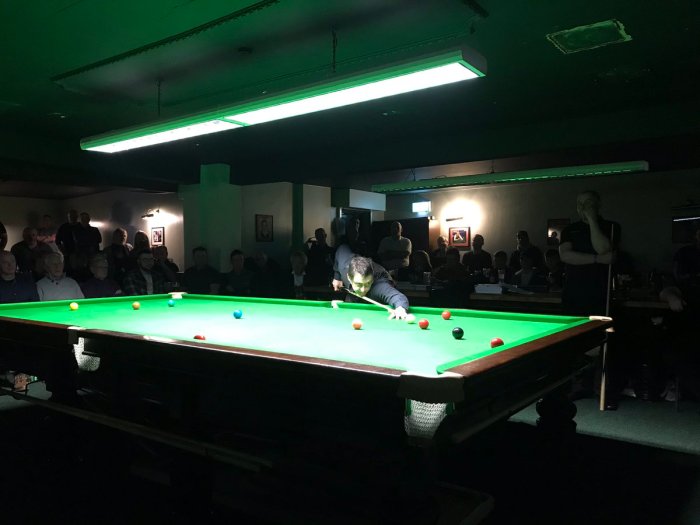
Ronnie played in Derry again yesterday and going by reactions on twitter, the fans loved it. It wasn’t the highest scoring night by Ronnie, who had only one 105 … played left handed from start to finish. He also made another 50 clearance entirely left handed.

Derry06.03.2020-1

Ronnie, Jason and John Virgo were just happy that they all managed to make it for the fans after the problems they faced because of the Flybe airline collapse.

The, yesterday, this emerged on social media:

Ronnie in his first year as a pro, plays and beats Steve Davis at Pot Black Time Frame.

Twenty minutes, each player allowed 10 minutes play, each player controlling his opponent clock. Normal snooker rules – no shot clock – except that every foul gives the opponent a free ball. As many frames as fit in the 20 minutes. The goal is to have more aggregated points than your opponent when the time is over.

And, yes, Steve Davis was certainly capable of playing fast. And, yes again, seeing this, one can understand why Ronnie somtimes claims he was a better player at that age. He played with such freedom, he had no fear nor angst.

Enjoy!

Top Ten Break Builders by Phil Yates

This was published by WST yesterday

Snooker journalist and commentator Phil Yates talks us through his top ten break builders of all-time…

10. Marco Fu
Turned Professional: 1998  
Centuries: 501     
Highest break: 147 (four times)

“Marco owns a small piece of history as he was the first player to have a 147 live on the internet, he made it at the Scottish Masters in 2000. Right from the word go Marco has been a great break builder. He made over 50 centuries in his first two seasons as a professional, which was extremely rare at the time. When he won the Scottish Open in 2016, he made 11 hundred breaks over the week. To compile that many centuries in a tournament which is made up predominantly of best of seven matches was amazing.”

9. Ding Junhui
Turned Professional: 2003
Centuries: 532  
Highest break: 147 (six times)

“Ever since he emerged on the circuit it was quite apparent that Ding’s game was built around scoring, but it was a different kind of scoring. His precision around the black spot is second to none. When he broke through and beat Stephen Hendry to win the 2005 China Open it was already obvious that his cue ball control was exemplary. When he makes big breaks sometimes they can get lost and not receive as much credit as they should, simply because he rarely needs to pull off big recovery shots due to his positional play being so good.”

8. Joe Davis
Turned Professional: 1926
Highest break: 147 (Not officially ratified)

“Joe Davis was a trailblazer. He played in an era where there was no real template on how to break build, he had to develop the positional skills himself. The balls were less responsive, the tables weren’t as good and the pack didn’t break up as easily. Despite all of that Joe made centuries, total clearances and even 147 breaks. He is nowhere near this list in terms of the numbers or the stats (records of how many centuries he made were not kept), but he is worthy of a place because he set the initial template of how to play the sport.”

7. Jimmy White
Turned Professional: 1980
Centuries: 319  
Highest break: 147

“Jimmy is such an entertainer. During the 80s and early 90s he made so many great breaks, when centuries weren’t the common currency they Jimmy Whiteare now. Everyone talks about that amazing 147 break that Kirk Stevens made against him at the 1984 Masters, but it’s often forgotten that Jimmy won the match with a sublime break of 119 in the very next frame. That was a modern day break, it was full of flair and he had the cue ball moving around the table in a similar fashion to Judd Trump. The way he went about compiling a break was ahead of its time.”

6. Steve Davis
Turned Professional: 1978
Centuries: 338      
Highest break: 147

“Steve made the first televised 147, which really was a mammoth achievement. People who make breakthroughs in sport deserve credit and that was definitely a very significant moment. Mark Selby is similar in that he is a great break builder, but at times that is overlooked because of his tactical prowess. The same can be applied to Steve, the difference between the two is that Davis was a pioneer. Like his namesake Joe, the numbers of centuries and maximums don’t quite add up, but there was no previous template for the way Steve played the game.”

5. John Higgins
Turned Professional: 1992   
Centuries: 790    
Highest break: 147 (nine times)

“The reason John has been so successful in his career is that he is an incredible all-round player. He has been able to take full advantage of his considerable tactical ability by exploiting a large percentage of the opportunities he manufactures and converting them into centuries. Unbelievably there was a time in the mid-nineties that he had never made a 147 in a tournament or even in practice. He made one in the 2000 Nations Cup and the floodgates opened.”

4. Neil Robertson
Turned professional: 1998
Centuries: 706    
Highest break: 147 (four times)

“Neil achieved the extraordinary feat of becoming the first player to make over 100 centuries in a season back in 2013/14. To score the 100th at the Crucible and against Judd Trump made it particularly special. What impressed me was how much he really wanted to do it. It was clear from his celebration after he made the 100thbreak just how much it meant to him. I’ve been on the circuit for many years and there was a time when Hendry held the record on 53. That stood for a very long time and nobody thought it would be beaten. Robertson almost doubled it.”

3. Judd Trump
Turned professional: 2005
Centuries: 704   
Highest break: 147 (four times)

“The fact that Judd is only 30 years old means that he is almost certain to have the record for most career centuries one day. That fact means he deserves to rank very highly in this list. He can produce superb positional shots time and time again. Forget the exhibition shots that he can play, he produces shots like that while the frame is still alive. He is capable of continuing breaks which appear to be dead. A high percentage of his breaks look as if they are over at the 70 or 80 mark, but he somehow manages to convert them to centuries.”

2. Stephen Hendry
Turned Professional: 1985
Centuries: 775  
Highest break: 147 (11 times)

“When he was at his best the calendar was threadbare, so to make 775 centuries in that era is remarkable. He was top of the all-time 147 list for a long time before being usurped by Ronnie O’Sullivan. I also think he made the most amazing 147 of all-time against O’Sullivan in the 1997 Charity Challenge. Having led 8-2, he was pegged back to 8-8 before he composed a maximum in the decider. Arguably the most impressive maximum break I have seen him make was against Gary Wilkinson at the 1995 UK Championship. If you went through it and tried to pick out key shots, you would struggle. He was never in a hint of trouble and never out of position for a second. It was absolute perfection.”

1.Ronnie O’Sullivan  
Turned Professional: 1992    
Centuries: 1,045   
Highest break: 147 (15 times)

“Despite reaching 1000 centuries, Ronnie could actually have had a lot more. In the most recent part of his career he hasn’t been playing a full calendar. That number, remarkable as it is, could have been considerably inflated. When you consider there have been top 16 players that never even made 100 centuries, it really puts O’Sullivan’s achievement into perspective. The timing of his 1000thcentury was typically dramatic. Not only to do it in a final, but to do it in the winning frame was a magical moment. There is absolutely no doubt that he is the best break-builder of all-time.”

Phil Yates was/is a big, big Hendry fan … and he’s now also a huge Trump fan.

He says here above that when Hendry was in his prime he had less tournaments to play in and that’s why he made “only” 775 centuries. Well … according to cuetracker, at the time of writing, when Stephen Hendry retired he had played 11722 frames in 376 tournaments, whilst Ronnie is currently on 11317 frames in 329 tournaments. So the 1045 centuries made by Ronnie, as compared to the 775 made by Hendry can’t be explained by the number of tournaments/frames played in the course of their career 😉 .

What is probably a factor is the fact that when Hendry was in his prime, the conditions were different. The cloth in particular was thicker, and, therefore, developping the pack was more difficult as it wouldn’t split as easily as it does today. That said, the same factor also meant that controling the cueball was probably easier…

That Judd Trump will overtake Ronnie’s record is almost certain. He’s been a pro for 14 years, Ronnie for 28. Yet with the current packed alendar, Judd has played 7549 frames in 256 tournaments. Since the number of tournaments has grown massively in the last 10 years, it’s likely that by the time Judd is 44 he will have played well over 15000 frames in well  over 500 tournaments, and if his striking rate stays the same he should be at over 1400 centuries by then. Ronnie isn’t finished yet, but another 350+ centuries doesn’t seem very realistic, especially with a reduced schedule. That said, making a lot of centuries doesn’t mean that you are a exceptional break builder. Judd plays a lot of recovery shots, and gets most because he is an exceptional potter, not an exceptional break builder.. He’s improved as a break builder in the last couple of years but certainly not third in the list in my eyes.

Ding is the opposite. He’s an exceptional break builder. His cue control is one of the best, if not the best. He spots shots that others don’t see. But he’s a bit too conservative in his shot selection and that probably explains why he hasn’t more centuries. That he is ninth in this list is a travesty.

Finally, whilst I like a century as much as anbyone else, I feel there is too much focus on them now.

Mark Williams isn’t in this list. I’m certain that, given his ability, he could have been there … if he had been interested, but for most of his career, Willo was known for pushing balls safe and ending frames this way when he was certain that his opponent wouldn’t come back at the table. He’d rather get on with the next frame or match. There is nothing in the rules forbidding players to do that, but I’m sure that, with the sport relying almost exclusively on the betting industry for its sponsoring outside China, and the bookies offering odds on centuries being made, players nowadays are not encouraged to do this.

No snooker? More snooker!

So there is no main tour snooker for the next five days, until the amateur rounds f the 2020 Gibraltar Open starts next Wednesday.

But there is still plenty going on on the green baize.!

Ronnie is in Derry, Northern Ireland for two nights of exhibitions.

The first one was yesterday and Ronnie had two centuries, 104 and 106, and missed the 12th red when on a maximum attempt (88).

Derry05.03.2020-1

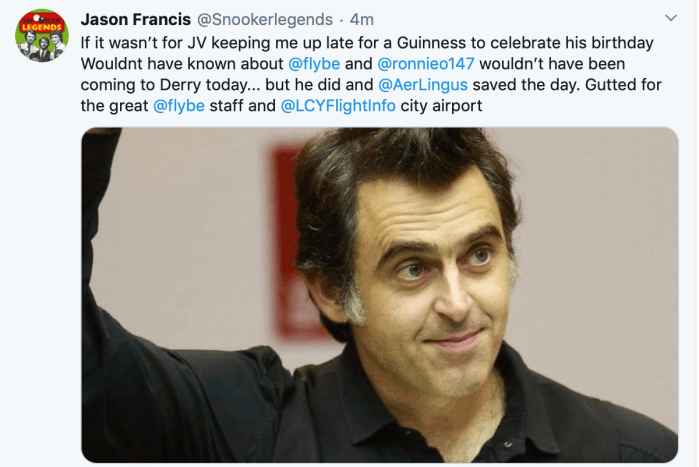
He almost didn’t make it there though… indeed he was due to fly with Flybe and the company went into administration. It was only announced yesterday. Jason Francis who went to collect John Virgo late at the airport the previous evening, stayed there for a birthday drink and heard about it by chance…. phew!

Screenshot 2020-03-05 at 12.37.39.png

The “Seniors” are battling it out in Pot Black Clacton, for a place in the 2020 WSS British Masters to be played early April in Plymouth.

You can find more information here and follow the scores as the tournament unfolds here.

There is also a “Super Seniors” event being played at the same place during the week-end and that one can be followed here.

Also starting tomorrow, there is the 2020 WDBS Belgian Open. It’s played at the “Trickshot” club in Bruges, and, again you can follow the event here. Like most “Disability Snooker” events, there are in fact several “sub-events” depending of the players type and severity of disability. There are a number of Belgian players in the draw, including Kurt Deklerck, a wheelchair player, and multiple World, European and Belgian Champion.